• Skip to primary navigation
  • Skip to main content
  • Skip to primary sidebar
  • Skip to footer
RSVP

RSVP

The Research Society for Victorian Periodicals

  • Home
  • About
    • Join RSVP
    • Privacy Policy
  • Grants and Prizes
    • Award Calendar
    • Curran Fellowships
    • Linda H. Peterson Fellowship
    • Patrick Leary Field Development Grant
    • Colby Book Prize
    • Sally Mitchell Dissertation Prize
    • Rosemary VanArsdel Prize
    • VPR Expanding the Field Prize
    • Conference Travel Awards
  • Conference
    • Past Conferences
  • VPR
  • Resources
    • Teaching Materials
    • RSVP Digital Salon Resources
    • RSVP Bibliography
    • VanArsdel Bibliography
  • News & Events
  • Contact

RSVP News & Events

Memorial Service for Michael Wolff

February 7, 2017

A memorial gathering to celebrate the life and work of Michael Jonas Wolff will be held on Sunday, February 19, 2017 at 9:30AM at the Jewish Community of Amherst.

There will then be a gathering back at the Marriott Courtyard hotel for a light lunch after the service.

Jessica, Jeremy and Judith Wolff ask that if you would like to share a brief ​tribute or ​memory of Michael, to email them in advance.

Filed Under: Members News, RSVP News

RSVP Annual Conference CFP Extended: 15th Feb

February 1, 2017

The call for papers for our next conference Borders and Border Crossings is still open and the website can be found here. The conference will take place at

Freiburgfreiburg University, Germany, 27th – 29th July 2017.

RSVP is an interdisciplinary and international organization welcoming all scholars interested in the richly diverse world of the 19th-century British press. Please send a proposal (250 words maximum) and a short CV (no more than 200 words) to rs4vp2017@gmail.com by 15th February 2017. Individual presentations should be fifteen to twenty minutes, and proposals for panels of three are welcome. Please include a brief rationale for the panel along with an abstract and CV for each presenter.

Filed Under: Conference News, Graduate News, Members News, RSVP News

‘The Private Space of Police and Prison’ by Sam Saunders (Liverpool John Moores University)

January 6, 2017


Sam Saunders is a current PhD candidate at Liverpool John Moores University, where he is researching the role of the periodical press on the construction and evolution of Victorian detective fiction. His research explores non-fiction periodical discussions on the police and crime, as well as early examples of serialised crime fiction. Sam has previously written for the British Association for Victorian Studies and is a regular contributor to the Huffington Post UK. He is also completing articles for the Journal of the Police History Society and the Law Crime and History Journal, due to be published later this year.

You can find him on twitter @samfordsaunders or by email at s.j.saunders@2014.ljmu.ac.uk


The Private Space of the Police and the Prison: Periodicals and the Voyeuristic View of Victorian Law Enforcement

In this post, I intend to highlight the voyeuristic aspects of nineteenth century crime fiction and articles on crime published in mid-nineteenth century periodicals, and relate this to the chronology of crime fiction. I will explore the interest in making the private world of criminality and law enforcement public, and suggest how this aspect of periodical writing can help augment our understanding of the crime fiction genre and its evolution.

One of the earliest places where we can see a voyeuristic interest in readers of crime literature is eighteenth and early nineteenth century execution broadsides. This has already received some scholarly attention; in her book The Rise of the Detective in Early Nineteenth Century Popular Fiction, Heather Worthington argues:


…the broadsides made their appeal to the voyeuristic interests of the masses, exposing the gory and sometimes salacious details of the crimes and making public what had been private.[i]


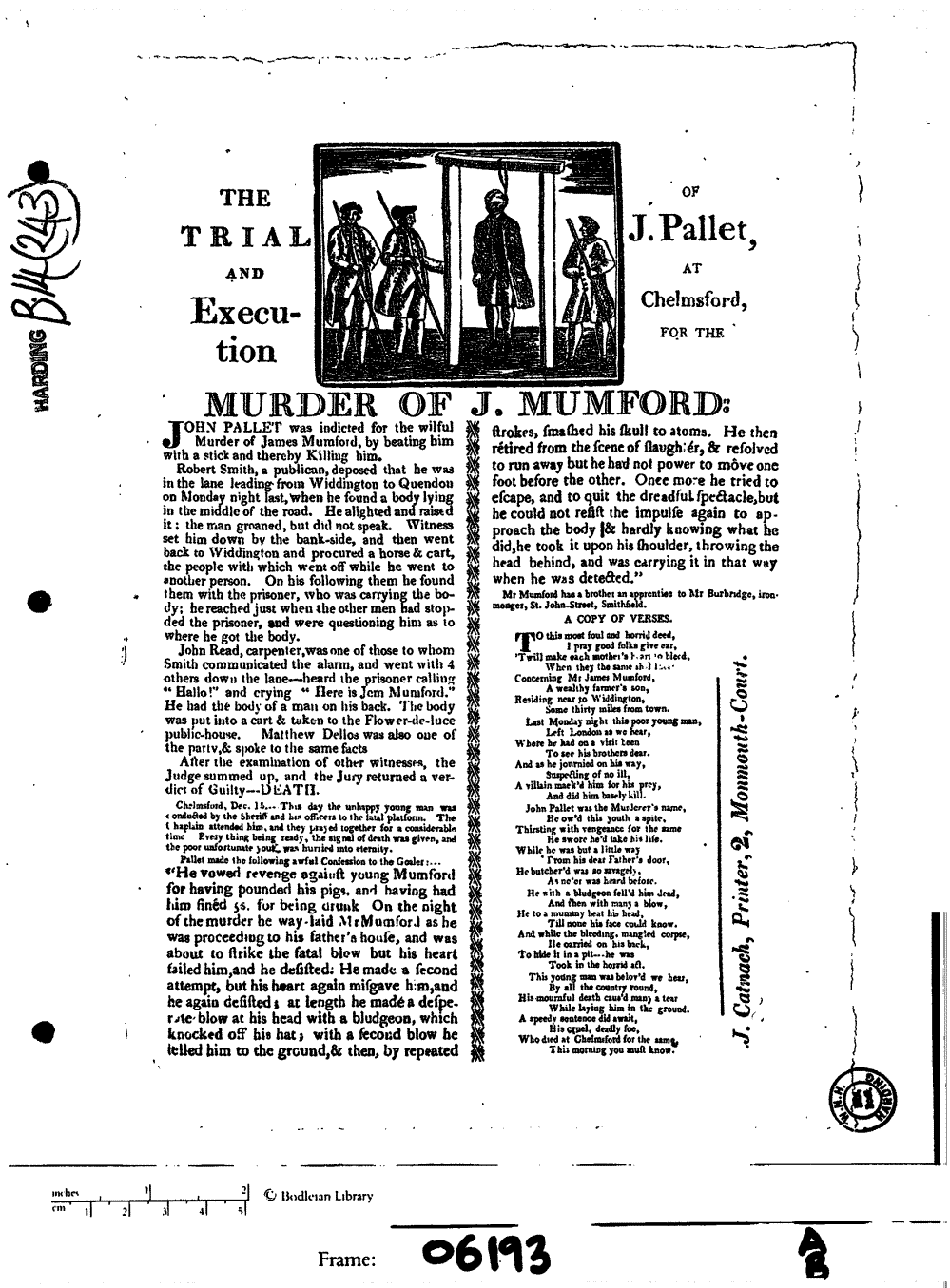
Worthington here refers to execution broadsides when she argues that they appealed to the voyeuristic interests of the masses and presenting a public view of hitherto ‘private’ spaces. However, this can also be readily applied to Newgate Calendars and other early crime writing designed to ‘render the private public’. Execution broadsides were popular throughout the late eighteenth and early nineteenth centuries, written and sold by peddlers at public executions. They were single-sheet, heavily sensationalised accounts of the lives of criminals, their crimes that led them to the gallows and a usually graphic description of the executions or other punishments. They also usually included a crude woodcut of the execution taking place, and the prose was often accompanied by a piece of penitent verse, usually printed surrounding the details of the crime and a crude, generic woodcut of the execution taking place (see fig. 1).

sam-aunders-fig-1
Figure 1: Broadside detailing the execution of J. Pallet. Bodleian Library, University of Oxford, online resource available at http://ballads.bodleian.ox.ac.uk/static/images/sheets/10000/06193.gif (dated between 1813-1838)


On one hand, execution broadsides publically demonstrated ‘sovereign or state power … encapsulated in pictures and prose and the spectacle of execution reached a wider audience than would have been possible in reality.’[ii] This complements the purpose of the public execution itself, however the broadsides’ alternative purpose was to entertain, and the provision of moral, social or religious instruction remained more a pretence as opposed to the main reason for broadside publication.[iii]

This tension between information and entertainment highlights the execution broadside as a space where a public desire to see ‘inside’ the private arena of the criminal world can be identified.  Execution broadsides complemented a spectacle that was already publically visible, and the detail as to why this particular person had been condemned by the state was therefore a matter of public interest.

Picking up on the broadside’s popularity, The Ordinaries of Newgate began publishing their own versions from inside the prison. These accounts of criminal misdeeds and executions were known collectively as the Accounts of the Ordinaries of Newgate, and were much less sensationalised than common broadsides. The Ordinaries’ access to criminals also gave them an extra edge over the broadside; they could obtain information that a street-seller could only speculate about.[iv] Their widespread popularity reveals a public desire to see inside the private space of the prison – contextual information surrounding a criminal and a highly public execution proved very popular.

Both publications were eventually collated and published as a volume – publications known as The Newgate Calendar(s). The first of these to appear under this name appeared in 1773.[v] These became less focused on executions, and more interested in criminals’ lives. Each story was focused on a specific criminal, their crime and their punishment, and again we see a form of crime-writing that renders a private space public – in this case the life and misdeeds of a stranger, either contemporary or historical. These accounts also often depicted a narrative of the proceedings that took place inside the court-room, another private space that this kind of writing rendered public.

Some issues of the Newgate Calendars were subtitled ‘Comprising Interesting Memoirs the Most Notorious Characters who have been Convicted of Outrages on The Laws of England’. The concept of a ‘memoir’ suggests a link to a form of writing that emerged in the mid nineteenth century that continued the voyeuristic interest of readers – police memoir fiction. One of the first examples appeared in 1827, titled Richmond, or, Scenes in the Life of a Bow Street Runner and is attributed to Thomas Sturr, though it was anonymously published. The text surrounds the life of John Richmond, a Bow Street Runner – one of the first organised groups of law-enforcement prior to the establishment of the Metropolitan Police in 1829.  It was not published in a periodical, but as a three-volume novel. However, it fits into the memoir-style category by relating Richmond’s life and his experiences in the Runners as if he were relating a tale to the reader after he had left. For example, Richmond reflects on his memories of joining the Runners:


My first adventure in my new capacity [as a Runner] gave me a strong interest in the sort of life I had now adopted, and compensated for many of the awkward and disagreeable feelings which I had to undergo. I was by this time tolerably well acquainted with London; but was personally a stranger to police transactions, and everything at Bow Street was new to me.[vi]


There are, however, some aspects that distinguish Richmond from later police memoir writing. It is too biographical – the first half is devoted to Richmond’s childhood and early-adult experiences – his adeptness at playing pranks, his schooling, his first love-interest (who tragically dies early on) and his experiences of early adulthood living amongst gypsies. These details are not completely irrelevant; by using this contextual information the novel creates a sophisticated plot-relationship between the two halves of the story, using details from the first to create the second. For example, the loss of Richmond’s first love-interest disassociates him from emotional ties and allows him to undertake the antisocial occupation of a police officer free from emotional attachments. Secondly, Richmond’s life among gypsies prior to starting as a Runner gives him connections in the criminal underworld which he uses as accomplices or for information in his exploits.

This novel is therefore a sophisticated yet isolated example of a police memoir, as later examples of this genre published in the mid-century and in periodicals cannot as effectively use the early life of the character as effectively to set up their narratives. Despite its isolation both chronologically and formulaically, it is an example of a police memoir that continues the theme of allowing readers to see inside a private space, and as such deserves recognising as a milestone in the genre’s development.

In the 1850s and 1860s, police memoir fiction became a popular feature in periodicals, frequently emerging in the pages of a variety of titles. A prolific author was the largely unknown William Russell – distinct from the more widely remembered William Clark Russell. Russell was a writer living in London throughout the 1850s, contributing significant amount of fiction to periodicals and magazines – notably Chambers’s Edinburgh Journal and The Sixpenny Magazine before its untimely demise.

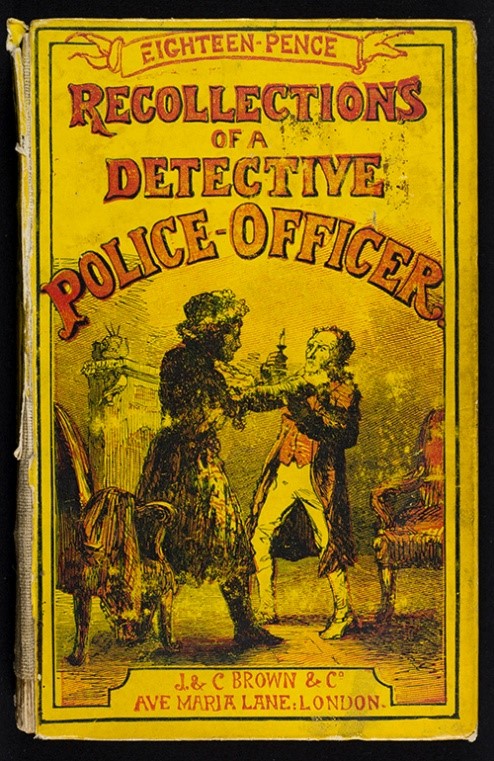
Russell’s earliest example was published in Chambers’s Edinburgh Journal between 1849 and 1853, entitled Recollections of a Police Officer. It was an example of pseudo-non-fictional insight into the police force, designed to appeal to the reading public’s curiosity about the police and provide a literary window into the police force. The serialised publication in Chambers’s proved popular enough for the stories to be collected into a three-volume collection in 1856 (see fig. 2). However, it was retitled Recollections of a Detective Police-Officer.

sam-saunders-fig-2
Figure 2 – Recollections of a Detective Police Officer, London; J&C Brown and Co. (1856) – available at http://www.indiana.edu/~liblilly/etexts/detective/images/pr5271-r8-r22_00001.shtml

Crucially, the collection of the stories into one three-volume edition added the opportunity to justify, or perhaps explain, the idea behind the creation. In a newly-added preface, Russell argues:


I, therefore, offer no apology, for placing these rough sketches of the police experience before the reader. They describe incidents more or less interesting and instructive of the domestic warfare constantly waging between the agents and the breakers of the law…[vii]


Russell informs us that these stories are specifically designed to give the reader an inside-view into how the police operated, and he remained interested in this genre as it developed. Perhaps his most widely distributed example of memoir fiction was Experiences of a Real Detective, published in The Sixpenny Magazine in 1862. In the first instalment, published in March 1862, Russell argues:


“Detective” literature, if it may be so called, appears to have acquired a wide popularity, chiefly, I suppose, because the stories are believed to be, in the main, faithfully-told, truthful narratives. I have read them all, and need hardly say have discovered mistakes that proved to me that the best, most popular of them were the handiwork of a literary man, not the records of an actual experience. I have frequently made remarks in this sense to my friends, several of whom thereupon suggested that I should publish my own real experiences.[viii]


This is an aggressive passage with which to open a new set of stories about the exploits from within the police force. It suggests a growing awareness by the author that detectives and police officers are proving to be popular figures in cheap, accessible and widely published literature. Secondly, the idea of ‘detective literature’ here specifically refers to memoir fiction, suggesting that the perceived nature of ‘detective fiction’ at this time was memoir fiction. The passage specifically points to the fact that the point of the genre was to relate the experiences of a real police officer to the reader. This is unlikely to be true, however it suggests the fact that these narratives were specifically designed to appeal to the voyeuristic interests of readers.

Police memoir writing performed two overall tasks. It began to blend non-fiction with fiction, as it was influenced by much earlier genres of non-fictional crime literature. By looking ‘inside’ the police force, a police memoir style of writing offered a new perspective to experience criminality for readers by following the police officer, rather than the criminal. These memoir writing narratives did however keep an element of the ‘non-fiction’ marketing that these earlier genres also maintained.

The second task that memoir writing performed was help to proliferate understanding of the operational structure and social remit of the police force as an everyday organisation after 1856.The police were often seen as a physical manifestation of Governmental influence in far flung regions away from London, and police memoir-writing allowed readers to get a more first-hand, internal view of the force. It also helped to lay the foundations for later, more recognisable detective fiction.


Endnotes

[i] Worthington, H., The Rise of the Detective in Early Nineteenth Century Popular Fiction, Basingstoke: Palgrave Macmillan (2005), p. 7

[ii] Ibid., p. 7

[iii] Ibid., pp. 6-8

[iv] Ibid., p. 7

[v] Knight, S., Form and Ideology in Crime Fiction, Basingstoke: Macmillan (1980), p. 9

[vi] ‘Richmond’ (attrib. T. S. Surr), Richmond, or, Scenes in the Life of a Bow Street Runner, New York: Dover Publications (1976) (orig. published 1827), p. 89

[vii] Russell, W., Recollections of a Detective Police-Officer, London: J&C Brown and Co. (1856), p. vi

[viii] ‘Experiences of a Real Detective’, The Sixpenny Magazine, March 1862, p. 325


Bibliography

‘Experiences of a Real Detective’, The Sixpenny Magazine, March 1862, p. 325

‘Richmond’ (attrib. T. S. Surr), Richmond, or, Scenes in the Life of a Bow Street Runner, New York: Dover Publications (1976) (orig. published 1827), p. 89

Knight, S., Form and Ideology in Crime Fiction, Basingstoke: Macmillan (1980), p. 9

Russell, W., Recollections of a Detective Police-Officer, London: J&C Brown and Co. (1856), p. vi

Worthington, H., The Rise of the Detective in Early Nineteenth Century Popular Fiction, Basingstoke: Palgrave Macmillan (2005), p. 7


Filed Under: Research Blogs

January 4, 2017

The Gale Dissertation Research Fellowship in Nineteenth-Century Media

The Research Society for Victorian Periodicals (RSVP) is pleased to announce that the eighth annual Gale Dissertation Research Fellowship is now open for applications. Made possible by the generosity of publisher Gale, part of Cengage Learning, the award is in support of dissertation research that makes substantial use of full-text digitized collections of 19th-century British magazines and newspapers. A prize of $1500 will be awarded, together with one year’s passworded subscription to selected digital collections from Gale, including 19th Century UK Periodicals and 19th Century British Library Newspapers.


Deadline:  February 1, 2017, for awards beginning in 2017
Award notification:  Not later than April 1, 2017.

Purpose: The purpose of the Gale Dissertation Research Fellowship is two-fold: (1) to support historical and literary research that deepens our understanding of the 19th-century British press in all its rich variety, and (2) to encourage the scholarly use of collections of full-text digital facsimiles of these primary sources in aid of that research.

Eligibility:

In order to be eligible for the award applicants must be enrolled as a postgraduate student at the time of entering the competition. They may be based in any academic discipline, but must be working on a doctoral dissertation or thesis that centrally involves investigation into one or more aspects of the British magazine and newspaper press of the 19th century. Preference will be given to projects that are interdisciplinary in approach, and that propose to use innovative methods of exploration that are uniquely possible with online collections. The digitized collections used in this research may include those created by any publishers or projects, whether commercial or non-commercial. Applicants who were unsuccessful in previous years are encouraged to apply again if they continue to meet the above criteria.

This year’s winner: RSVP is delighted to announce that the Gale Dissertation Research Fellowship for research to be undertaken in 2016 has been awarded to Amelia Joulain-Jay, a PhD. student in History at Lancaster University, for her work on using Geographical Information Systems and Corpus Linguistics methods to investigate how places were represented in nineteenth-century British newspapers.
Applications: Applicants should send a c.v. and the names and contact information of two scholars who are familiar with the applicant and his or her dissertation project; it is expected that one of these will be the student’s dissertation director. The project description (approx. 500-800 words) should concisely explain the aims of the proposed research and the key importance of the role of full-text digitized collections in that research. Applications for the Gale Fellowship for dissertation research to be undertaken in 2017 must be submitted in electronic form and sent to galefellowship@rs4vp.org by February 1, 2017. Any queries about the application may be sent to the same address. Notification will take place by email not later than April 1, 2017. The successful applicant will be expected to submit a brief report to RSVP at the conclusion of the funded portion of the project, describing the results of the research.

https://archive.rs4vp.org/2708-2/

Filed Under: Graduate News

Linda H. Peterson Fellowship: Deadline February 1, 2017

January 3, 2017

In 2017 the Research Society for Victorian Periodicals will award one Linda H. Peterson Fellowship to provide a researcher with the most valuable scholarly resource—time. The Peterson Fellowship is intended to support, first and foremost, primary research on the nineteenth-century newspaper and periodical press. Therefore, eligible projects must engage primary sources, whether those sources appear in print, manuscript, or digital facsimile. The amount of the award will be $17,500. To apply for the Fellowship please see the details of eligibility and application procedure here.

Filed Under: Awards News, Members News, RSVP News

Call for Papers: ‘Visual Design: the Periodical Page as a Designed Surface’

January 3, 2017

Call for Papers: ‘Visual Design: the Periodical Page as a Designed Surface’

International Conference of the DFG research unit “Journalliteratur“ (FOR 2288), 23-25 November 2017, Philipps-Universität Marburg (Germany)

The conference “Visual design: the periodical page as a designed surface” is concerned with the visual design of the Journal, taken to mean the whole spectrum of periodical print publications, including amongst others newspapers and magazines. Interest is thus focused on the periodical page (or double-page spread) as a visible printed surface on which words and images appear in a designed context. The premise is that the written and pictorial content of the periodical are not realized in abstraction (as disembodied and placeless), but remain tied to the materiality of the periodical, which provides for a two-dimensional and sequential arrangement of diverse visual elements. The design governs how words and pictures appear across the broad spectrum of different media formats, as illustrations or in the typography or layout. The aim of the conference is to identify and outline periodical-specific elements of (double) page design, not least in comparison to the formats of other media, especially the book. Here the research unit is concentrating on German-language forms from the long 19th century. Older and more recent examples may also be discussed within the framework of the conference. Papers on periodical cultures in other languages are also explicitly encouraged. Case studies will be welcomed, as will historical and international comparisons, or studies comparing different media. The content and context of the following subject areas should be addressed:

  1. Preconditions: technology / economics / organization

The visual presentation of a printed page, the way words and pictures are arranged on it, e.g. the way they are distributed over columns or framed, is linked with technical requirements, e.g. with paper manufacturing, or the possibilities of typesetting, printing or binding. Page design is also influenced, however, by processes of organization and distribution, as well as by economic considerations. These connections, in turn, are subject to historical change: the acceleration of production processes as a result of technological developments, the improvement of distribution channels, or the diversification of the journalistic and literary market. Some possible questions on this complex might be: to what extent are historical caesurae in layout linked with technological innovations? Which specific forms of work emerge in different countries or in particular magazine formats? How does the organization of work processes shape the interplay of image and word? What layout schemes were recognized as especially efficient? What aspects of visual design practice are emphasized by the terms visual design, graphic design, layout, mise en page, typography etc.?

  1. Forms: aesthetics / design

Areas of interest from an aesthetic point of view are the rules determining page makeup, which are also subject to historical changes. These include prevailing logics of composition in the area of typography and layout, the way the reader’s gaze and attention are directed by the design and arrangement of areas of text and image on the periodical page (or double-page spread), and the rules and techniques for optimizing perception by means of typeface or image composition, typography, illustration and layout. The combination of texts and images constitutes a particular formal problem. Relevant questions might be, for example: what varying design strategies characterize different magazine cultures? What forms of the visuality of writing emerge in specific media and formats? What methods and terms can be used to describe the complex connections on a page and between the pages? What links are established between image and text?

  1. Consequences: cultures of reception / semantics / effects

The designed surface of the periodical page is intended to guide its own reception by means of optical arrangements. The visual design shapes specific reader expectations corresponding to the given media format, and suggests certain meanings, but at the same time it works on the premise that readers are able to understand the visual codes. As the number of pictures has increased since the 19th century, the relationship between image and word has taken centre stage. The connections created between pictures and words may be semantically contrasting, indifferent or mutually affirming. But pictures can also form the flow of words into a textual image, or make the page look like a three-dimensional arrangement. Relevant questions in this context might include: how is the content linked with the typography and layout? What directions of looking and reading are allowed for by the design, the columns and frames? To what extent can it be assumed that the contemporary audience had the skills to decipher the semantics of the typography and layout? Can intentions and concepts relating to the directing of readers’ attention be linked with the historical context? What role is played by frames, columns, and other methods for dividing up the page?

Submissions: Submissions are invited for 25-minute conference presentations. The conference languages are generally English and German, but presentations in French are also welcomed. Travel and accommodation costs will be covered by the research unit organizing the event. To apply, please submit abstracts (maximum length 500 words) and a short CV (maximum 150 words), which should be sent to journale@uni-marburg.de by 15 January, 2017.

The conference is being organized by subprojects 3 (Volker Mergenthaler, Nicola Kaminski, Stephanie Gleißner), 4 (Andreas Beck) and 5 (Jens Ruchatz, Vincent Fröhlich).

Please contact journale@uni-marburg.de if you have any questions.

Website of the research unit: www.rub.de/journalliteratur


Filed Under: Members News, RSVP News

  • « Go to Previous Page
  • Page 1
  • Interim pages omitted …
  • Page 16
  • Page 17
  • Page 18
  • Page 19
  • Page 20
  • Interim pages omitted …
  • Page 31
  • Go to Next Page »

Primary Sidebar

Blog Categories

  • Awards News (39)
  • Conference News (25)
  • Graduate News (36)
  • Members News (63)
  • Research Blogs (14)
  • RSVP Digital Events (28)
  • RSVP News (141)
  • Teaching & Learning News (11)
  • Uncategorized (13)
  • VPR News (18)

Footer

Search Our Site

Visit Our Blog

Connect with Us

  • Facebook
  • Twitter
  • YouTube

Copyright © 2026 · Genesis Sample on Genesis Framework · WordPress · Log in