• Skip to primary navigation
  • Skip to main content
  • Skip to primary sidebar
  • Skip to footer
RSVP

RSVP

The Research Society for Victorian Periodicals

  • Home
  • About
    • Join RSVP
    • Privacy Policy
  • Grants and Prizes
    • Award Calendar
    • Curran Fellowships
    • Linda H. Peterson Fellowship
    • Patrick Leary Field Development Grant
    • Colby Book Prize
    • Sally Mitchell Dissertation Prize
    • Rosemary VanArsdel Prize
    • VPR Expanding the Field Prize
    • Conference Travel Awards
  • Conference
    • Past Conferences
  • VPR
  • Resources
    • Teaching Materials
    • RSVP Digital Salon Resources
    • RSVP Bibliography
    • VanArsdel Bibliography
  • News & Events
  • Contact

RSVP News & Events

Call for papers: Magazines on the Move – North American Periodicals and Travel

June 30, 2017

Call for papers: Magazines on the Move: North American Periodicals and Travel

A one-day seminar hosted by the Centre for Travel Writing Studies, Nottingham Trent University, in collaboration with the Network for American Periodical Studies.

Friday 22nd September 2017, Nottingham Trent University, Clifton Campus

Keynote speaker: Professor Andrew Thacker (Nottingham Trent University)

Organisers: Dr Victoria Bazin (Northumbria University); Dr Rebecca Butler (Nottingham Trent University); Dr Sue Currell (Sussex University); Prof Tim Youngs (Nottingham Trent University).

Confirmed speakers include Dr Claire Lindsay (UCL) and Dr Rachel Farebrother (Swansea University).

This day-seminar will focus on the relationship between North American travel writing and the periodical format. Its primary purpose is to facilitate historical and critical discussion of narratives of travel in North American periodicals.

Nottingham Trent invite proposals for twenty-minute papers that examine accounts of travel to, within, or from North America, published in North American periodicals. They also welcome papers on periodicals and travel of Canada, Mexico and the Caribbean.

Topics to be examined in considering the interplay between the travel experience, the written and/or visual record of travel, and the periodical publication of the travel record, may include, but are not limited to:

  • Commercial considerations
  • Editorial policy and interventions
  • Gender and sexuality
  • Periodical context and design
  • Purpose of travel
  • ‘Race’
  • Readership
  • Solo or group travel
  • Technologies of transport/mode of travel
  • Tourism
  • Visual representations

The seminar is a collaboration between Nottingham Trent’s Centre for Travel Writing Studies (CTWS) and the Network of American Periodical Studies (NAPS). It draws on the expertise of both research centres, as well as that of our keynote speaker, Professor Andrew Thacker (NTU), a specialist in modernist magazines and spatial geographies of modernism.

The Centre for Travel Writing Studies (CTWS) was established by Prof Tim Youngs (Nottingham Trent University) in 2002 to produce, facilitate, and promote scholarly research on travel writing and its contexts, without restriction of period, locus, or type of travel writing.

The Network of American Periodical Studies (NAPS) is a research initiative set up by Dr Sue Currell (Sussex University) and Dr Victoria Bazin (Northumbria University). It aims to bring together scholars working on American periodicals (magazines, newspapers and other periodical publications) from a range of historical periods and disciplines.

Papers are welcomed from scholars at any career stage. Postgraduates are strongly encourage to submit a proposal for consideration. Paper proposals of c200 words should be sent to ctws@ntu.ac.uk by 28th July 2017. Early submission is advised.
With grateful thanks to the British Association for American Studies (BAAS) for financial support a limited number of travel bursaries and fee waivers for postgraduate students to attend are offered. Priority will be given to those offering papers. Please state at the end of your proposal if you are a postgraduate wishing to apply for help towards costs.
Filed Under: Conference News, Graduate News, Members News, RSVP News

Digital Methodologies: Using Semantic Vector Spaces for Identity Research

June 5, 2017


Quintus van Galen is a PhD candidate at Edge Hill University, working on the application of computerised textual analysis to historical questions in periodical studies. His thesis will focus on the methodological viability of such analyses within historiography, by the use of a case study on imperial identity in Victorian newspapers. When not working on his own research, he teaches methodology to undergraduates, and acts as an assistant for Bob Nicholson’s digital projects.

Quintus would be happy to answer any questions you have regarding LSI and what it can do for your research at vangaleq@edgehill.ac.uk or through twitter @QVgalen


When I graduated with an MA in History in 2015, I was part of the first cohort that started their programmes after the genesis and widespread adoption of digital archives in the early 2010s. We had been part of the first generation to have access to full-text web-searchable databases for our dissertations. Many of our generation, myself included, gratefully used those resources and many would not have been able to complete their dissertation without them. While on archival research in India, I could cross-reference documents found there with those in Kew, Brussels or The Hague with just a few mouse-clicks. Yet there was one thing our training left us unprepared for when using these fonts of knowledge – the incredible amount of material they contained. The methodologies that have served historians so well for as long as historiography has existed were always meant to cope with a dearth of information, in the implicit understanding that there was always some source that was unknown or unavailable to the historian. Now, it seems we are swamped by sources the moment we hit the search bar.

One possible solution to this textual overload comes in the form of ‘distant reading’. A term popularized by Franco Moretti in 2005, it offers the historian a way to analyse a large collection of texts and gaining a clearer understanding of the way these texts influenced each other – and society. The simplest way to preform distant reading for historical research, on both a practical and conceptual level, is the N-gram method. First conceived in the 1990’s, these are graphs measuring occurrences of a string of words of length n over a set of documents over time. They are commonly used in the branch of historiography known as culturonomics, which seeks to analyse of culture based on statistical evidence.

The research for my PhD will use N-grams in a primarily exploratory role. By adding the tables of the category under investigation (for example, a year of a specific periodical) and deriving the relative word frequencies from these we can construct N-gram graphs, which can answer very specific research questions. While no n-gram corpora exist (publically) for periodicals, short grams are easy to generate.[i] In the initial stages of the project, I built a simple 1-gram viewer. This allowed me to do two things: to get a very rough overview of the content of the digitised periodicals and its evolution over time, and to choose subsets for further programs to work with in a less biased way.

But there are questions N-grams cannot answer. They look at grams in isolation, therefore they lose the contextual meanings of the words they chart. An N-gram to research the adoption of the American term ‘skedaddle’ in Victorian newspapers would indeed show its adoption in the British vocabulary, but would also show the brief reign of the racehorse of the same name – without distinguishing between the two. The list of context-sensitive terms is almost endless. Without contextual semantic information embedded in the rest of the sentence, it is impossible to know which you are mapping. Collocate searches can provide some solace, but only to a degree.

The solution is to no longer consider words as solitary semantic units, but to include their contexts in the analysis. This is easier said than done, and only recently have computers become ‘smart’ enough to deal with semantic ambiguities; the most accessible way of achieving this is by using semantic vector spaces. These programs apply the saying “you shall know a word by the company it keeps”, and encode each word as a vector containing its relation with all other words in the corpus. Among others, one such method is Latent Semantic Indexing (LSI).

My PhD research focusses in on the perceptions of Imperial identity in the British press, and the way the press helps construct this identity. As part of this process, I am using LSI to discover whether there is an evolution in the topics discussed in British newspapers, and if different newspapers generally report on different topics. Both of these questions require the use of a large dataset of digitised newspapers, which is fortunately available in the form of the British Library Nineteenth Century Newspaper Archive.

To answer these questions, a slice is made in the newspaper corpus to narrow it down to a time period, newspaper, or keyword-topic. In this case, the Gensim LSI algorithm was applied to a sample of one thousand newspaper articles which contained the keywords ‘empire’ and either ‘border’ or ‘frontier’, with the aim of discovering trends in the narrative about the edge of the Empire. The reason for this relatively small sample size is that the analysis program is still in heavy development, and using more articles would incur exponentially longer processing times. Eventually, the goal is to use a sample around the ten to one-hundred thousand mark. The output is a list of the strongest semantic clusters. Very few historians have employed the technology yet, so its full potential is still unknown. However, promising experiments on the Dutch Newspaper corpus Delpher have seen the technique used to calculate the most important words in a text, and subsequently determine the associations between these words and the entire text. My PhD project was in large part inspired by those experiments.

Several of these are clearly garbage – a sure sign the OCR-cleaning algorithm is slacking at its job. Some of the associations are expected in a dataset such as this, for example, the Boer War. This is a good sign, because it means the program is to some extent working like it should. There are, however, several interesting observations that can be made from these. For one, about half of the clusters contain some form of reference to the military, the backbone of the Empire; seven clusters containing “Troops”, and three mention staff officer ranks (Colonel and General). Additionally, there are clear clusters of enemies, most notably the Russians (who are strongly associated with the Turks and the French), and above all the Boers. It needs to be stressed though, that the importance given to this latter group is a reflection of the overrepresentation of the late 1890’s in the sample. Of particular interest is the cluster I interpreted as discussing the national budget, which contains strong associations with “Army” and “Tribes”. These findings seem to suggest that the British Empire was indeed strongly defined in the papers by its military actions on the frontiers, supporting scholarship by Makenzie, Potter, Williams and others.

The second interesting find is the lack of “Britain” or “England” in the clusters. “British” occurs in only two clusters: once with “Government” and “War”, and once with “Africa” and “Turkish”. This absence might be explained by the theory of Banal Nationalism: there was no need to explicitly state a paper was discussing the British Empire – this was known by the reader by virtue of it being the only ‘Empire’ worth mentioning as such. A closer reading will have to be carried out to verify this, but this suggests the importance of the British press in ‘Flagging the Empire’ on a daily basis cannot be overestimated.

Going forward, the biggest obstacle to overcome is the lack of quality in the OCR, and improving this will be the first step towards producing better analyses. Fortunately, there are various options available to deal with this issue, so there are multiple avenues to explore. Once this is dealt with, I hope to apply LSI to various slices of the newspaper archive (by time, newspaper, or topic), which should allow for tracking trends over these categories. This should provide both an insight in the viability of LSI as a historical research tool, and allow an overview of the entirety of newspaper reporting without having to resort to sampling.


[i] The n-grams that do exist for the BLNP dataset have to remain within institutions for copyright reasons. They have been built and operated with great success by the University of Bristol. See: Lansdall-Welfare et al, ‘Content analysis of 150 years of British periodicals’, DOI: 10.1073/pnas.1606380114


References:

Michel et al. ‘Quantitative Analysis of Culture Using Millions of Digitized Books’,  Science, December 2010.

Nicholson, B. and Johnes, J., ‘Sport History and Digital Archives in Practice, in G. Osmond and M. Philips (eds.), Sport History in the Digital Era (University of Illinois Press: Chicago, 2015). Pp. 53-74.

Lansdall-Welfare et al. ‘Content analysis of 150 years of British periodicals’, PNAS, January 2017.

Williams, K., Read All About It! A history of the British Newspaper (Abingdon: Routledge, 2010).

Potter, S. (ed.), Newspapers and Empire in Ireland and Britain: Reporting the British Empire, c.1857 – 1921 (Dublin: Four Courts Press, 2004).

MacKenzie, J., Propaganda and Empire: The Manipulation of the British Public Opinion 1880-1960 (Manchester: Manchester University Press, 1984)

Billig, M., Banal Nationalism (London: SAGE, 1995).

http://lab.kb.nl/tool/frame-generator

http://radimrehurek.com/gensim/


Filed Under: Research Blogs

Winner of 2018 Linda H. Peterson Fellowship Announced

April 14, 2017

Congratulations to Ian Haywood, Professor of English at the University of Roehampton, UK, who has been awarded the second Linda H. Peterson Fellowship for his project: “The Rise of Victorian Caricature: Satirical Periodicals 1830-1850”. Further details of Professor Haywood’s project can be found here.

Filed Under: Awards News, Members News, RSVP News

Winner of the Colby Book Prize 2017 Announced

March 30, 2017

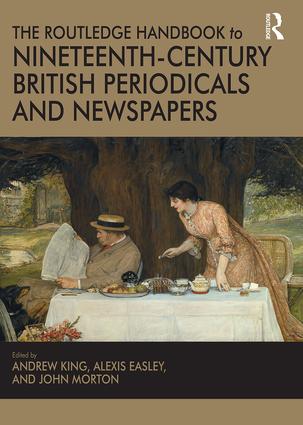
routledge handbook nineteenthThe Research Society for Victorian Periodicals is pleased to announce the winners of this year’s Robert and Vineta Colby Scholarly Book Prize is The Routledge Handbook to Nineteenth-Century British Periodicals and Newspapers co-edited by Andrew King, Alexis Easley and John Morton.

The Committee, chaired by Katherine Ledbetter, describes the book as “a standard reference work” that offers “cutting-edge, comprehensive scholarship by experts in each area”. The volume was seen as “wide-ranging and diverse” in ways that stepped beyond Great Britain to consider British newspapers and periodicals in relation to North American, European, Australian and Asian publications.

Congratulations to all scholars involved in the volume!

Filed Under: Awards News, Members News, RSVP News

Finding Mr. Poe: Intertextuality and Periodicity between Edgar Allan Poe and Charles Dickens

March 9, 2017


Katie Bell is a PhD student at the University of Leicester. Her thesis is titled “The Diaspora of Dickens: Death, Decay and Regeneration”, the focus of which is the intertextuality of Dickens’s works and 20th century American texts of the Southern Gothic genre. The American authors examined in her thesis are William Faulkner, Flannery O’Connor and Carson McCullers.  She is based in the United States where she is also a volunteer docent for The Wren’s Nest, the home of Atlanta author Joel Chandler Harris most famous for his ‘Br’er Rabbit’ tales.  She can be found on Twitter @decadentdickens


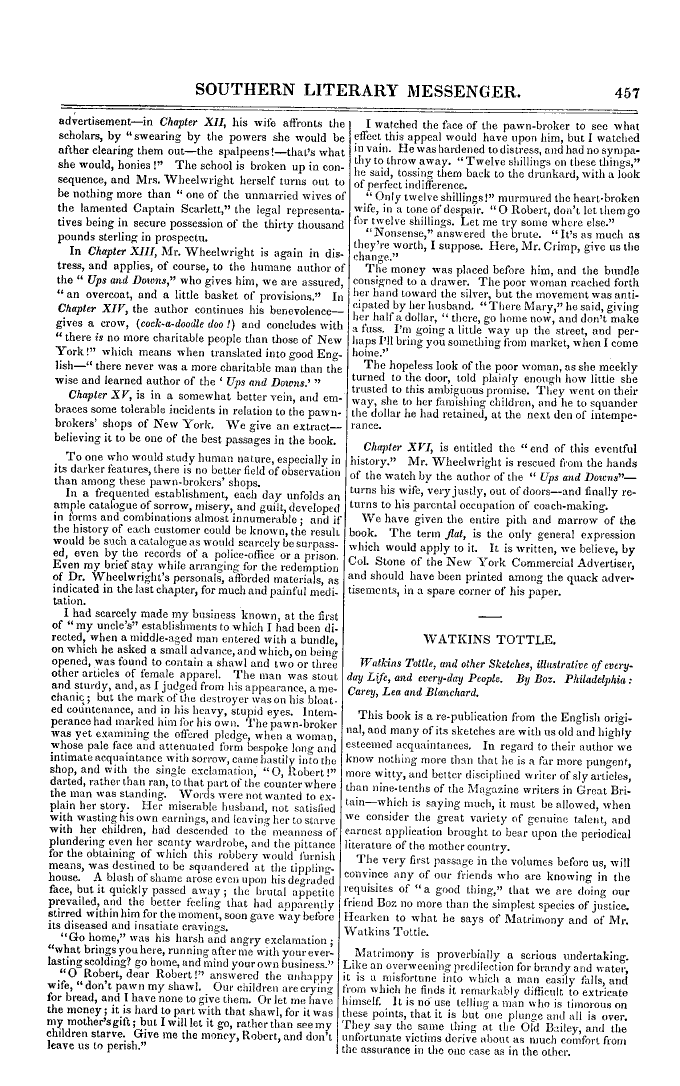
Edgar Allan Poe is remembered as an eccentric loner, a poet, and a writer of gothic “tales.”  He earned his living (albeit a meagre one) as a journalist, writing more literary criticism than poems or tales.  As a critic, he quickly gained the nick-name of “the man with the tomahawk,” a racist epithet but one which was meant to make light of his cutting negative critiques, for which his reviews became popular for giving.[1]  From 1835 until his death in 1849, Poe wrote approximately one thousand critical pieces and defined the American “standard for book reviewing.”[2]  In these pieces Poe criticised many American newspapers for “puffing” second–rate American books simply because they were American, and he identified himself as being one of the first American fans of Charles Dickens when he reviewed Sketches by Boz in June of 1836.  Poe had never heard of Dickens (or Boz) prior to his review (Sketches was Dickens’s first collection, so few readers knew of him), and Poe wrote of Dickens: “we know nothing more than that he is a far more pungent, more witty, and better disciplined writer of sly articles, than nine-tenths of the Magazine writers in Great Britain.”[3]

Watkins Tottle  In the Saturday Evening Post, Poe went on to attempt to solve the mystery of the murder in Barnaby Rudge after having read only the first three available chapters, which he did for the most part. Through his reading and critique of Barnaby Rudge, Poe crafted the framework necessary for a finely tuned detective story which would come into his work with his character Dupin later that year.  Dickens and Poe met briefly in Philadelphia on Dickens’s 1842 American tour, and there is no concrete evidence of what the two discussed (partly due to Poe’s tendency towards fabrication and Dickens’s later burning of his personal letters), but from most accounts, it is understood that the two got on very well.  Poe felt the most important aspect of Barnaby was the relationship between Barnaby and Grip.  In Poe’s first review of the available chapters of Barnaby he wrote of Barnaby and Grip that:

[Grip’s] croakings are to be frequently, appropriately, and prophetically heard in the coarse of the narrative, and whose whole character will perform, in regard to that of the idiot [Barnaby], much the same part as does, in music, the accompaniment in respect to the air. Each is distinct. Each differs remarkably from the other…This is clearly the design of Mr. Dickens¾although he himself may not at present perceive it.[4]

This relationship between Barnaby and Grip is revisited in “The Raven” and Poe picks up where he felt Dickens left off; Poe’s raven is the answer to the questions that the narrator of the poem poses and the echo of his deeper self.

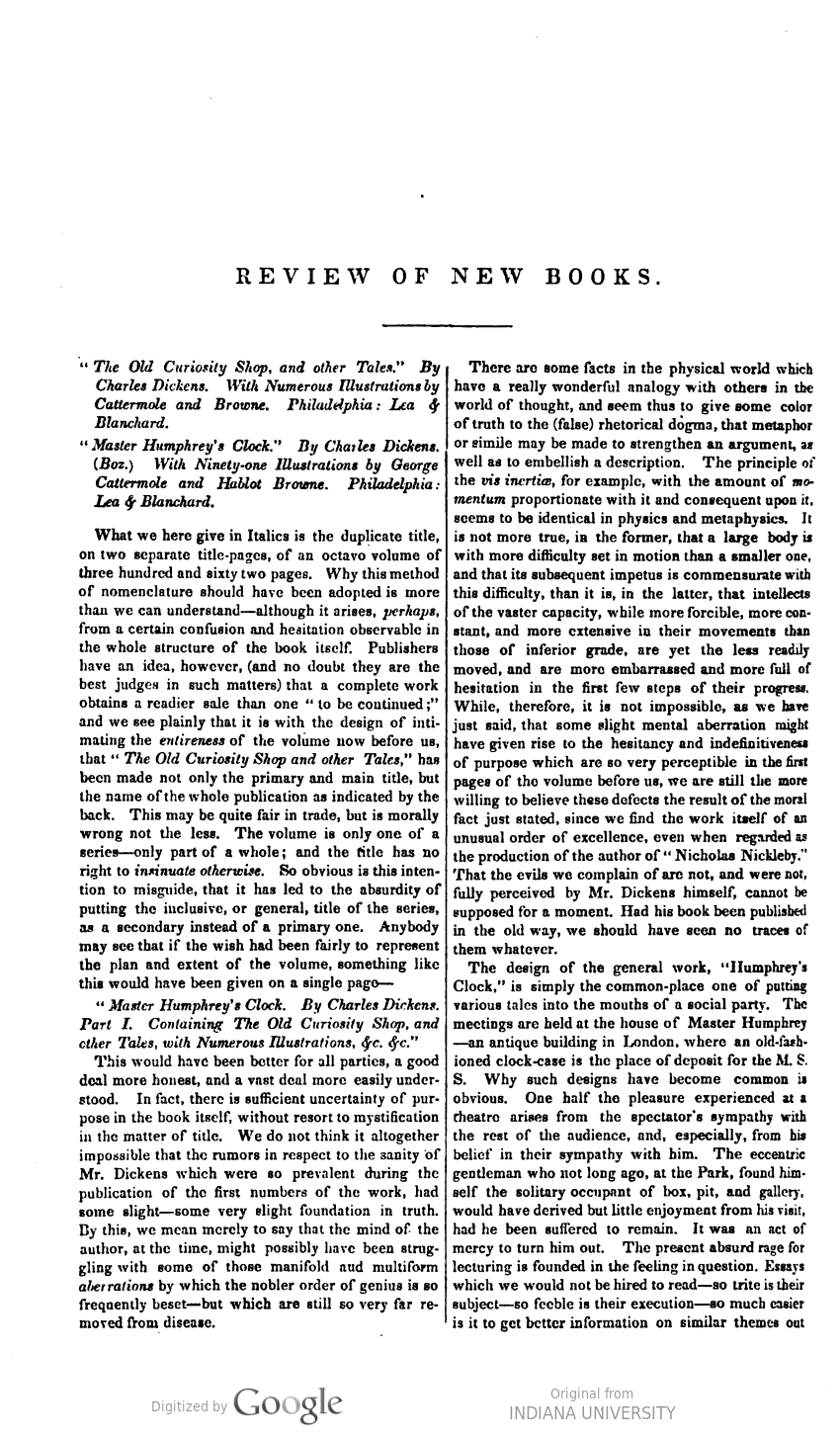
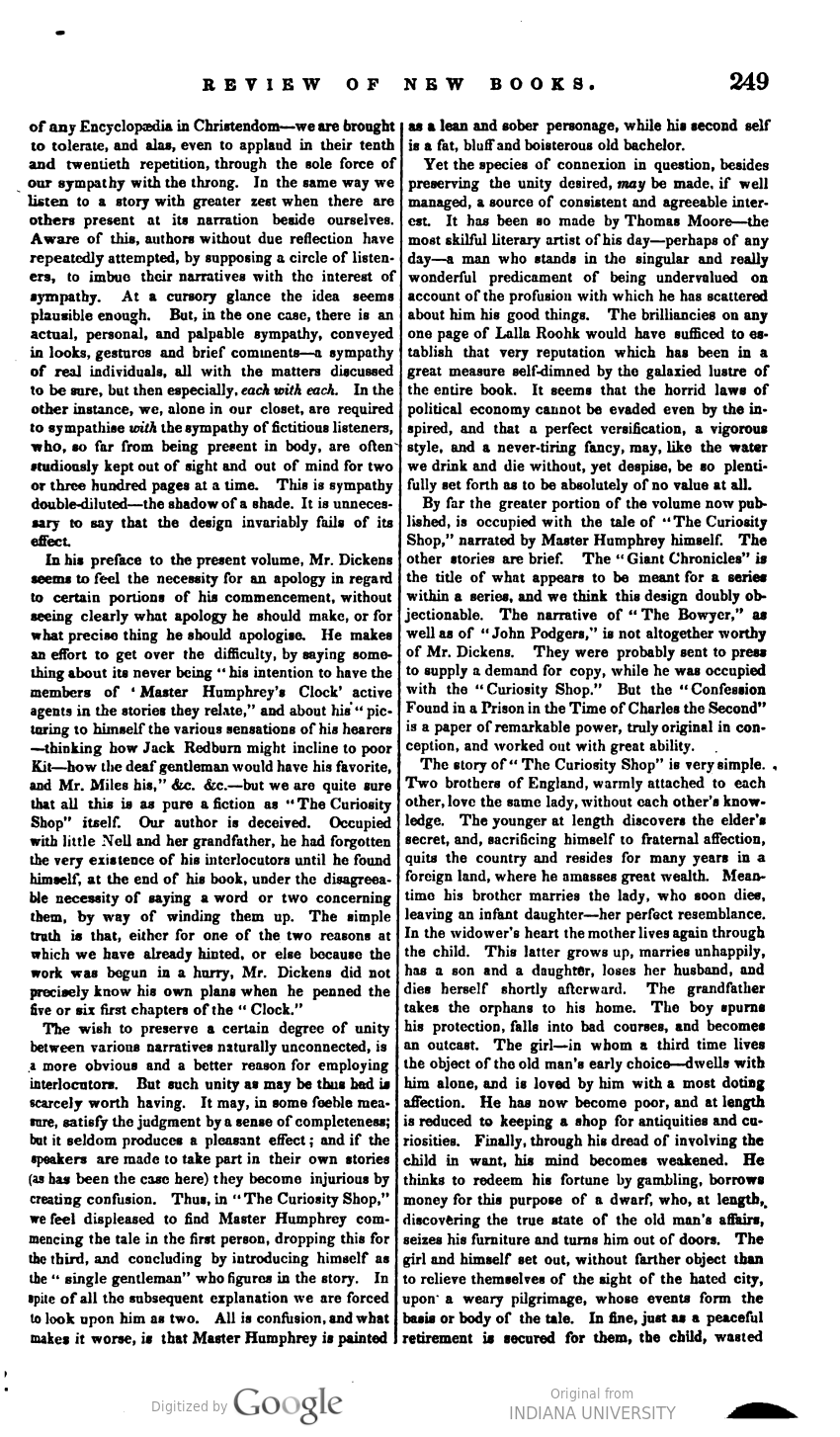
Master Humphrey 1Before he had “The Tell-Tale Heart” published in The Pioneer in 1843, he was taken with Dickens’s Master Humphrey’s Clock (1840) and reviewed the collection favourably in 1841.  He specified that of all the tales held within Humphrey, “A Confession Found in a Prison in the Time of Charles the Second” was the most “power[ful].”  He wrote, “The other stories are brief…The narrative of ‘The Bowyer,’ as well as of ‘John Podgers,’ is not altogether worthy of Mr. Dickens.  They were probably sent to press to supply a demand for copy…But the ‘Confession Found in a Prison in the Time of Charles the Second’ is a paper of remarkable power, truly original in conception, and worked out with great ability.”[5]


Master Humphrey 2Many are not aware of this lesser known Dickens piece, as the way in which we currently read The Old Curiosity Shop is not in its original serialised form within Humphrey, therefore, the short stories which come between the larger texts (Curiosity Shop and Barnaby) are lost for most modern readers. To summarise the story, a retired soldier finds himself the adoptive father of his nephew, whose eyes and gaze he fears for an inexplicable reason.  Ultimately, the narrator becomes so overwhelmed with this little boy’s gaze that he is driven to murder him and bury his body in the garden.  Friends of the narrator come to call, and he entertains them with food and drink upon the very spot the boy is buried.  The denouement is that a neighbour’s errant bloodhounds enter the party having sniffed out the boy’s remains, and dig up the body in front of the narrator and his guests, thus exposing his evil deed.  The narrator ends his piece by stating he is writing this account while sitting in jail awaiting his execution.

Modern-day readers will be more aware of the plot of Poe’s “The Tell-Tale Heart,” in which he explores the mind of a killer who becomes obsessed with “the evil eye” of a perceived oppressor.  After killing the old man with which he lives, the also unnamed narrator buries him under the floorboards of their shared house, invites investigating police officers in and offers them refreshments on the very spot the old man is buried. His undoing is that the narrator continues to hear the beating of the old man’s heart and also believes the police officers hear the beating as well, and are ignoring it in order to make “a mockery of [his] horror.”[6]

“The Tell-Tale Heart” was extremely well received by both its American and British readers; it was a “sensation.”[7]  Reviewing it for the New York Tribune in July 1843, Horace Greeley (the founder and editor of the Tribune) noted it “a strong and skilful, but to our minds overstrained and repulsive, analysis of the feelings and promptings of an insane homicide.”[8]  The success of “The Tell-Tale Heart” is due in part to the extent to which Poe utilized the then undefined Freudian term “uncanny,” but also to the powers of Poe’s editorial skills: his talents at seeing how to best manipulate a plot into a “tale.” As well, it is due to a seed planted by Dickens in his early work with Master Humphrey’s Clock, which we can trace back through Poe’s thoroughly written reviews of Dickens’s works.  Poe “tomahawked” most every writer in his reviews, but he never once had a negative word to say about any of Dickens’s pieces. Re-reading “Confession” through the eyes of Poe, we can see how deeply Dickens was interested in the psyche of a madman at this early point in his career, and that he sought to explain the motives of a killer.  Poe was undoubtedly paying tribute to Dickens with “The Tell-Tale Heart,” but he does so in a way that gives a rebirth to Dickens’s work and allows for a new interpretation to emerge, chiefly that Dickens’s “Confession” is one of the first pieces in which an author sought to explain the “why-done-it” as opposed to the “who-done-it” of horror stories.

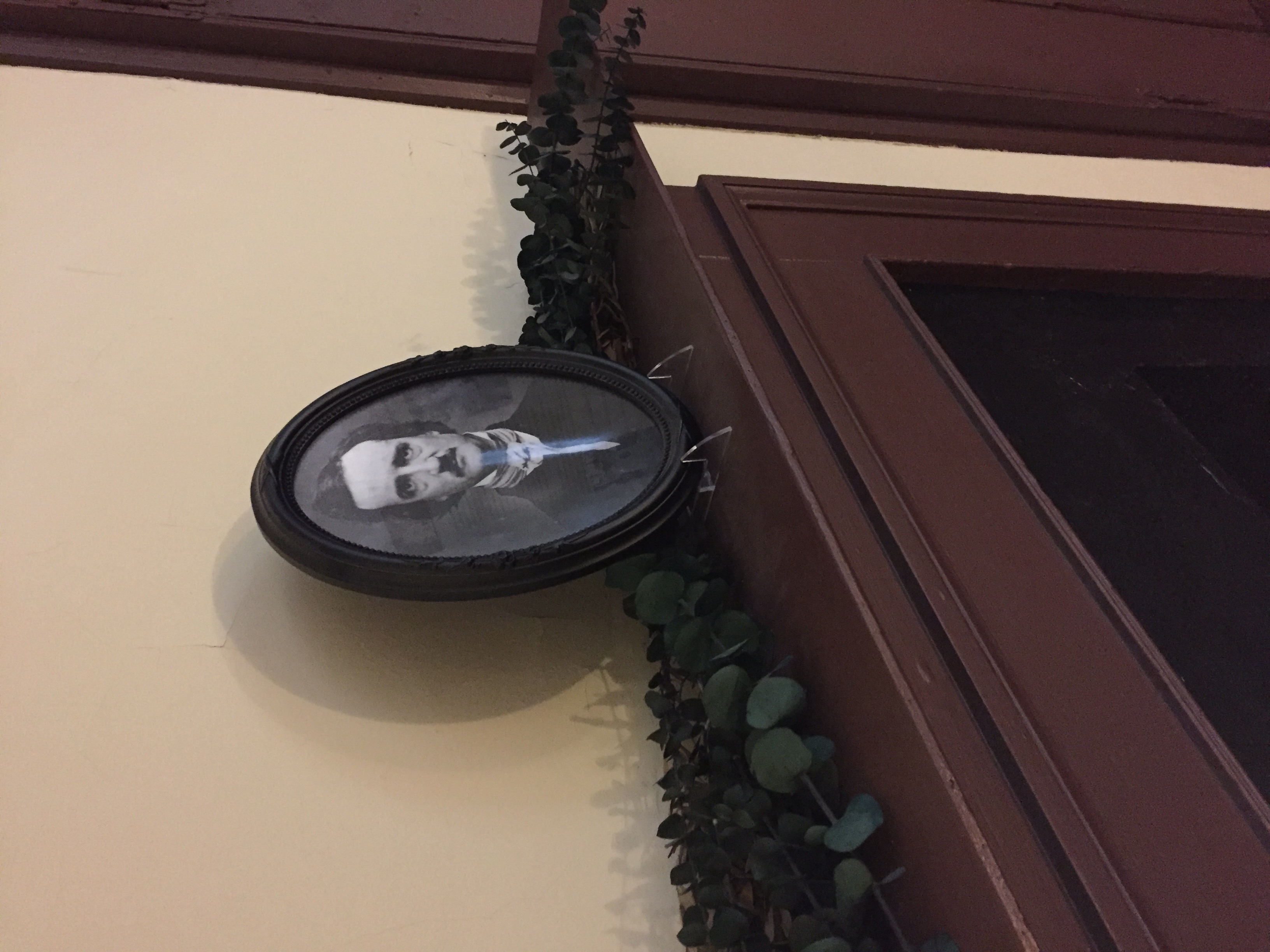
Poe House Baltimore


[1] Hutchisson, James M. Poe. University of Mississippi Press, 2005, p. 62.

[2] ibid., p. 57.

[3] Poe, Edgar Allan. “Critical Notices.” Southern Literary Messenger, Vol. II, no. 5, June 1836, p. 447.

[4] Poe, Edgar Allan. “Original Review.” Saturday Evening Post, May 1, 1841.

[5] ¾. “Review of New Books.” Graham’s Magazine, May 1841, p. 249.

[6] Poe, Edgar Allan. “The Tell-Tale Heart.” The Annotated Poe, edited by Kevin J. Hayes, The Belknap Press of Harvard University Press, 2015, p. 265.

[7] Hayes, Kevin J. Annotations of “The Tell-Tale Heart,” by Edgar Allan Poe, The Annotated Poe, edited by Kevin J. Hayes, The Belknap Press of Harvard University Press, 2015, p. 259.

[8] ibid.


Images:

Image 1:

“Critical Notices” Southern Literary Messenger, Vol. II, no. 5, June 1836, pp. 445-460. Made available through Making of America Journal Articles, www.quod.lib.umich.edu

Images 2 and 3:

“Master Humphrey’s Clock By Charles Dickens. Part I. Containing The Old Curiosity Shop, and other Tales, with Numerous Illustrations, &c. &c.” Graham’s Magazine, May 1841, pp. 248-251. Original image held by Indiana University, made available through the Hathi Trust, Digital Library, www.catalog.hathitrust.org.

Image 4:

Image of Poe from the Edgar Allan Poe House, Baltimore, Maryland.  Photograph by the author. www.poeinbaltimore.org


Works Cited:

Poe, Edgar Allan. “The Tell-Tale Heart.” The Annotated Poe, edited by Kevin J. Hayes, The Belknap Press of Harvard University Press, 2015. 259-265.

“Critical Notices.” Southern Literary Messenger, Vol. II, no. 5, June 1836, pp. 445-460.

“Original Review.” Saturday Evening Post, May 1, 1841.

“Review of New Books.” Graham’s Magazine, May 1841, May 1841, pp. 248-251.

Hutchisson, James M. Poe. University of Mississippi Press, 2005.

Filed Under: Research Blogs

Call for Papers: Editing the Twentieth Century

February 18, 2017

Members of the RSVP community may be interested in the following CFP:

‘Editing the Twentieth Century’, The British Library. 5 September 2017

Call for Papers: What do editors actually do? What makes a good editor? And more importantly, what makes a successful editor? From the Times Literary Supplement to Les Temps Modernes and Novyi Mir, from The Criterion to Die neue Rundschau and Spare Rib, there can be no doubting the influence of literary-intellectual magazines in selecting and shaping our cultural knowledge, our beliefs and values. But we still know surprisingly little about how these crucial cultural institutions were led and managed and even how day-to-day editorial duties were undertaken in practice. Above all, we lack any kind of comparative perspective on the role of the periodical editor, both across national and historical boundaries and across different types of publications. How does the role of editor compare between the nineteenth and twentieth centuries, for example, or between the French and British intellectual fields? How does it vary across literary reviews, newspapers, academic journals and commercial magazines? And in all these cases, how can we reconcile the reality of editorial practice – so often mundane and resolutely collective –with the stubbornly persistent myth of the singular charismatic editor?

As part of the British Academy funded project, Editing the Twentieth Century, we invite papers and workshop contributions addressing these issues for a one-day event to be held at the British Library on 5 September 2017 exploring the key role played by the editors of periodical publications throughout the long twentieth century. As well as specific studies of individual editors and publications, we particularly welcome comparative analyses (both chronological and geographical), theoretical approaches, and reflections from practitioners. Contributors may choose to address one or more of the following issues:

  • Editorial success and failure
  • Editorial responsibilities, competences and dispositions
  • Editorial foundations, programmes, and manifestos
  • Editorial succession
  • Editorial leadership and administration
  • Editorial creativity and sociability
  • Editorship as authorship
  • Collective and uncredited editorship
  • Comparative studies across periodical genres, national contexts, and historical periods

Proposals of around 250 words for 20-minute papers should be sent to editors.bl.17@gmail.com by 15 March 2017. We also welcome proposals for joint panels of three or four related papers or other forms of presentation and discussion.

Filed Under: Conference News, Graduate News, Members News, RSVP News

  • « Go to Previous Page
  • Page 1
  • Interim pages omitted …
  • Page 15
  • Page 16
  • Page 17
  • Page 18
  • Page 19
  • Interim pages omitted …
  • Page 31
  • Go to Next Page »

Primary Sidebar

Blog Categories

  • Awards News (39)
  • Conference News (25)
  • Graduate News (36)
  • Members News (63)
  • Research Blogs (14)
  • RSVP Digital Events (28)
  • RSVP News (141)
  • Teaching & Learning News (11)
  • Uncategorized (13)
  • VPR News (18)

Footer

Search Our Site

Visit Our Blog

Connect with Us

  • Facebook
  • Twitter
  • YouTube

Copyright © 2026 · Genesis Sample on Genesis Framework · WordPress · Log in