• Skip to primary navigation
  • Skip to main content
  • Skip to primary sidebar
  • Skip to footer
RSVP

RSVP

The Research Society for Victorian Periodicals

  • Home
  • About
    • Join RSVP
    • Privacy Policy
  • Grants and Prizes
    • Award Calendar
    • Curran Fellowships
    • Linda H. Peterson Fellowship
    • Patrick Leary Field Development Grant
    • Colby Book Prize
    • Sally Mitchell Dissertation Prize
    • Rosemary VanArsdel Prize
    • VPR Expanding the Field Prize
    • Conference Travel Awards
  • Conference
    • Past Conferences
  • VPR
  • Resources
    • Teaching Materials
    • RSVP Digital Salon Resources
    • RSVP Bibliography
    • VanArsdel Bibliography
  • News & Events
  • Contact

RSVP News & Events

Women in Punch 1841 – 1920, 02 Nov 2017, Senate House, London

October 10, 2017

Registration is now open for ‘Women in Punch 1841 – 1920’, 02 Nov 2017, Senate House, London.


Punch: or the London Charivari first appeared in 1841, published as a weekly magazine with a strong political agenda. Although some work has been done on the social reform agenda of Punch, very little is known about women in the magazine. Were there any women contributors? What representations of women appeared in the magazine, both in images and text? Women were certainly a subject for humour and caricature in Punch, but what were the political implications of those comic illustrations? What was the role played by verse in the depiction of women? Did representations of women change significantly between 1841 and 1910, and if so, how and why? How do the caricatures and/or depictions of women in Punch differ or resemble those in other illustrated papers, such as the Comic Almanack (1835 – 1853), The Illustrated London News (1842 – 1989), the Man in the Moon (1847 – 1849), andFun (1861 – 1901)? Queen Victoria subscribed to Punch; did it have many women subscribers and/or readers? How was the ‘New Women’ reported in the pages of the magazine? Was Punch interested in female education or the entry of women into the professions?


These are some of the questions to be explored by this one-day conference, which will look at some of the below themes:

  • Women in the literary marketplace
  • Education
  • ‘New Women’ and ‘cartoons’
  • Domesticity
  • Punch and the Intellectual Woman
  • Women and sports
  • Representations of Political Women
  • Punch and female readership
  • Sex, body, and Punch caricatures.


The programme for the day can be found here.
Conference organiser: Mariam Zarif, mariam.zarif@kcl.ac.uk.
Filed Under: Conference News, Graduate News, Members News, RSVP News

Dr. Paul Fyfe wins Prestigious Donald Gray Prize

September 14, 2017

Congratulations to RSVP member Dr. Paul Fyfe winner of this year’s Donald Gray Prize for the best essay published in the field of Victorian studies.

Dr. Fyfe’s article ‘An Archaeology of Victorian Newspapers‘ was published in the Winter 2016 edition of Victorian Periodicals Review.

The NAVSA judging committee – Deborah Denenholz Morse (Chair), Mary Jean Corbett, Martin Danahay, and Peter Hoffenberg  – commented:

Paul Fyfe’s ‘An Archaeology of Victorian Newspapers’ excavates a portion of “the largely hidden history of how Victorian data gets to now” by filling in some of the gaps between then and now.  This fascinating essay, which draws on the methods of book history and media archaeology, as well as practicing a form of “investigative scholarly journalism,” explores the occluded material histories of one large-scale digitization project: the British Library’s massive collection of nineteenth-century newspapers.  He establishes its complex relations to a range of mid-twentieth-century agents, technologies, and institutions, from the preservation efforts undertaken in the aftermath of the second world war to the emergence of (and continuing role played by) microfilm in the collaboration between libraries, micropublishers, and the forerunners of the CIA. Victorian media became digital, Fyfe argues, both by subordinating the provinces to the metropole and by having the techno-labor of its production outsourced to India and Cambodia. In a timely investigation of what now constitute “the enabling conditions of our scholarship,” the essay charts a path forward for thinking about—and critically reflecting on—the digital tools we all use.


Filed Under: Conference News, Graduate News, Members News, RSVP News, VPR News

Pushing the Bounds of Obscenity in The Times and Ella Hepworth Dixon’s The Story of a Modern Woman

September 11, 2017


Jennifer Wood recently finished her Masters degree and is hoping to begin a PhD in 2018 to continue her work. She is researching the history of divorce in Victorian literature and its role in pushing the boundaries of decency in Victorian culture and hopes to expand into transcontinental studies of divorce. When not working on her research, she teaches both American history as well as Western civilization to undergraduates at Metropolitan Community College in Kansas City.

You can reach Jennifer at Jennifer.wood@mcckc.edu


Ella Hepworth Dixon’s The Story of a Modern Woman, first serialized in The Lady’s Pictorial between January and March of 1894, is known as a quintessential ‘New Woman’ novel. John Sutherland calls it “the greatest unread novel of female struggle of the century.”[i] Dixon used her book to address both a double standard in expectations for women’s behavior and in expectations for the publication of fiction. That is, she explored the subject of adultery in the life and fiction of the “modern woman” in her title. By examining Dixon’s novel alongside the divorce accounts in the London Times, I argue that Dixon fought against these double standards in life and fiction even while forcing her main character to succumb to them.


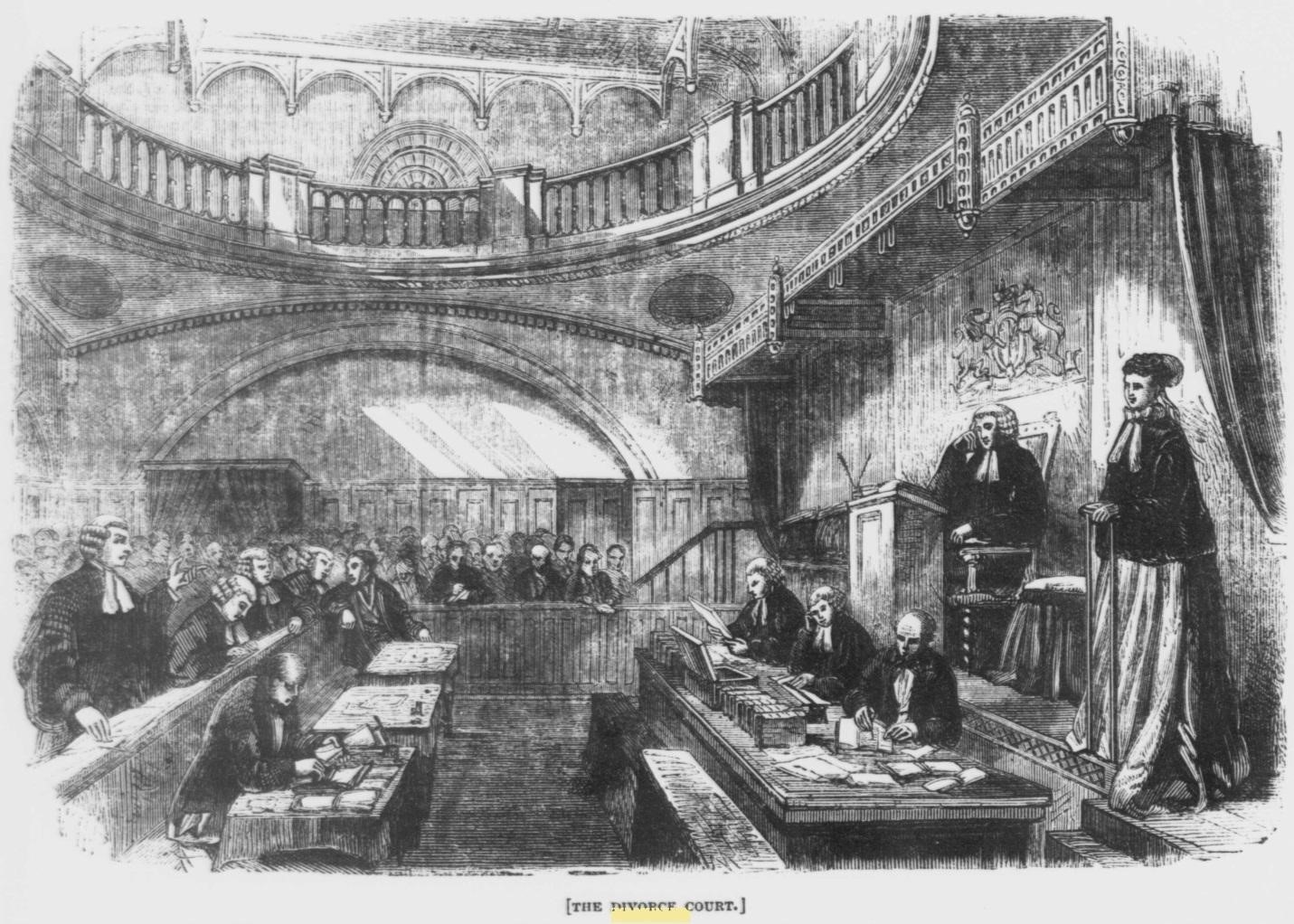
Jen Wood 1Divorce became a civil issue after the Matrimonial Causes Act of 1857, and as soon as the courts opened for business, the London Times reporters were there, documenting each divorce case. With each new case heard, sales increased and publishers realized they had a fresh and constantly renewable form of scandal that would sell papers. Claiming ‘democracy of print’ or the important role of making political and judicial figures accountable to the public, the London Times and other newspapers would use divorce cases to titillate their readers.  Both the press and the public would attend regular open divorce hearings, crowding into the courtroom to bear witness to the spectacle. Petitioners for divorce were required to offer all of the proof they had concerning the affairs of the accused, and the accused would then have to defend themselves. Giving testimony, especially for a woman was a difficult undertaking, where being “put on the stand” often meant standing before a packed courtroom revealing the most intimate aspects of her life. Divorce proceedings became such a popular form of entertainment that people had a hard time getting a seat in the courtroom.[ii] It was alright if you couldn’t see it in person, however, because multiple London newspapers would report all of the scandalous testimony in detail.

For instance, in 1891 the case of Russell v Russell made headlines.   Lady Russell petitioned for a judicial separation due to her husband’s cruelty.  Countess Russell claimed that Earl Russell threatened to shoot her on multiple occasions, and on the night of June 10th he:

Insisted on his wife leaving his bed, and on leaving it she fell on the floor.  A nurse found her lying there naked, and the respondent’s explanation was that, she having fainted, he threw water over her and she became so wet that he had to take off her nightdress.  After that she felt she could live with him no longer.[iii]

The charge of cruelty, however, would be overshadowed by her claim of her husband’s homosexual relationship with Herbert Roberts, head mathematics master at Bath College.  The Times reported that Earl Russell:

insisted upon a man named Roberts sleeping in the house for three or four days and nights, and after the respondent had undressed, going up to Robert’s bedroom, remaining with him for several hours, and again in the morning.  Upon the petitioner expostulating with him upon his conduct the respondent told the petitioner to go to the devil and mind her own business.[iv]

Jen Wood 2


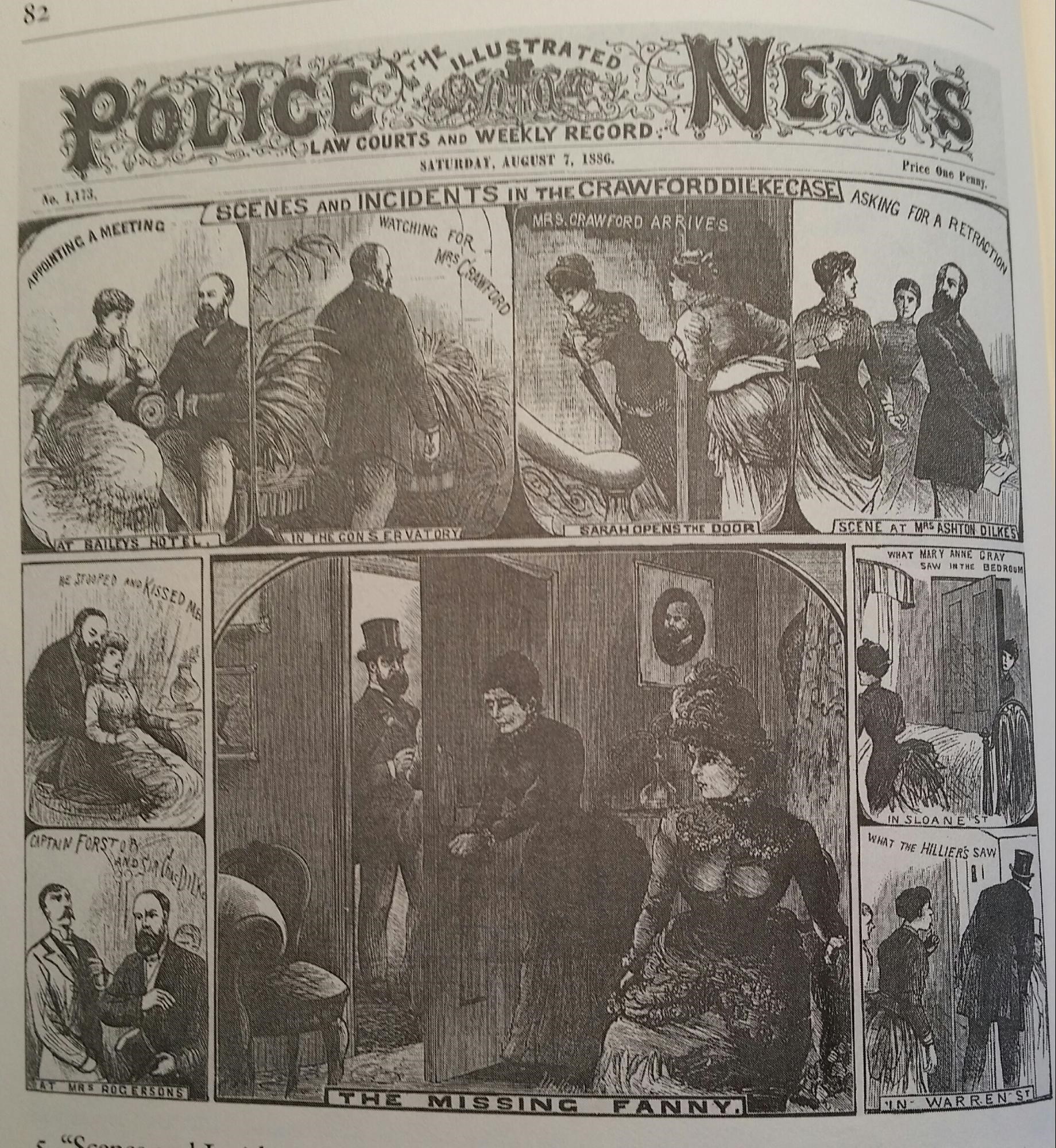
The scandal involved with the Russell case was intense.  Anyone reading the newspapers would know the activities going on within their home and the testimony would leave no question as to the character of all the parties involved. Despite the final ruling of the Russell case, Earl Russell would forever be associated with a homosexual relationship and cruel behavior leaving plenty of fodder for gossips in all level of society.   For those cases that were especially popular, newspapers such as the Illustrated Police News (Fig.2) would use illustrations allowing the scandal to be not only visualized for audience members, but for those who were illiterate, the pictures would allow them to join in on the gossip.


Some people found the newspaper reports to be vulgar and a danger to public morality.   Even Queen Victoria implored the courts to cease the flow of news reports.

None of the worst French novels from which careful parents try to protect their children can be as bad as what is daily brought and laid upon the breakfast-table of every educated family in England, and its effect must be most pernicious to the public morals of the country.[v]

While the Queen’s opinion was taken into account, court officials hoped that the printing of these court cases would act as a deterrent to those tempted to wander off the path of marital virtue.  They would argue that the newspaper accounts acted as an informal education on what not to do in a marriage.[vi]  Even those most opposed to the passage of the divorce act believed that the publications of the hearings were to the ultimate benefit to the public as a whole.[vii]

Many respectable people internalized the lessons intended by the courts, reassuring them about their own honorable lives –“I’d never do that”– and helped them set limits of expected behavior.[viii] This ability of the reader to distance themselves from those on trial was what kept newspapers safe from the obscenity laws and what allowed readers to feed on the scandal without feeling influenced by it. By placing those at the center of the controversy outside the regular sphere of everyday life, it distanced the reader from temptation of the immoral act of adultery.  It especially helped if those unlucky few on trial were of a higher social station.[ix] Despite their belief in scandal for the public good however, divorce numbers continued to increase in the last half of the nineteenth century.[x]


Fiction, though, was held to different standards. While novelists often used stories and headlines from the newspapers as a means of inspiration and proof of relevancy, they also sought to use their medium as a way to push back against this double standard that existed between fiction and journalism.[xi] The obscenity laws were keenly felt among Dixon and her peers, and more successful authors chose pamphlets and essays to argue their case.  George Moore spent his own money to publish Literature at Nurse, or Circulating Morals, as a way of criticizing circulating libraries, specifically Mudies, for their censorious natures, noting that “the character of strength, virility, and purpose, which our literature has always held, the old literary tradition coming down to us through a long line of glorious ancestors, is being gradually obliterated to suit the commercial views of a narrow-minded tradesman.”[xii] Moore displays disgust at Mr. Mudie’s decision to discontinue carrying his novels based on the letters of a couple of disapproving “ladies in the country”.[xiii]  Moore’s newest novel A Mummer’s Wife was censored because it was told from the point of view of the wife who cheats on her husband and subsequently divorces him for another man.


Eliza Lynn Lynton also had words about the double standard but contemplated a different solution, namely that “a great nation should be candid and truthful in art as well as in life, and mature men and women should not sacrifice truth and common sense in literature for the sake of the Young Person.”  She advocated for age specific genres and “locked bookcase(s).”[xiv]

Jen Wood 3Ella Hepworth Dixon would use her novel as a similar vehicle for protest against “circulating library” standards. Mary Erle, the protagonist of The Story of a Modern Woman, is an orphaned young woman responsible for the care of her younger brother. Though she aspires to be an artist, she takes up journalism and fiction writing as a faster means of supporting her small family. Educated and raised in polite society, Mary remains free to mingle among those with whom she was raised despite her misfortune. Her friends exist in both the upper classes of London as well as the working class and because of her situation; she is able to afford her readers the perspective of both worlds. Dixons first exploration of divorce comes in the form of Lady Blaythewaite, a secondary character, who hovers in the background of Dixon’s tale. In the story, Lady Blaythewaite is known for her beauty and her jewels but she is introduced as a soon to be divorcee. “She brings the case, of course, but she won’t get it.  They’re betting on it at the clubs.”[xv]  Dixon shows how Lady Blaythewaite had become the object of scandal in polite society by the whispered talk about her at the theater, and later by the way Dixon portrays the actual divorce through the medium of newspapers.

When Mary goes to discuss her novel with the editor of Illustrations magazine, she has to pass the Strand, an area near the center of London where newspaper boys shouted headlines to passersby.  Mary would stop to read the headlines. “The Great Divorce Case. Cross-Examination of the Plaintiff. Unabridged Report. Ladies Ordered Out of Court. Sketches of the Co-Respondents.”[xvi] Dixon would compare the Blaythewaite divorce case to a disease that would infect all of London, influencing conversation wherever people met.  “Spesh–shul! Extra spesh–shul! The great divorce case! Extraordinary evidence! Cross-examination of Sir Horace Blaythewaite!”[xvii] Not unlike real life and the Russell divorce case, the Blaythewaite divorce became highly publicized and incredibly detailed fodder for newspapers.  Dixon’s very next scene brings home the jarring contradiction in the publishing industry at the time.

When Mary sits down to discuss the manuscript of her novel, the editor rejects her ending as too scandalous. As George Moore’s case suggests, in an effort to avoid violating the 1857 Obscene Publications Act, editors often censored their writers prior to publication. Mary’s editor attempts to curb her discussion of potential adultery:

You’ve put the most extraordinary things in this last chapter. Why, there’s a young man making love to his friend’s wife.  I can’t put that sort of thing in my paper.  The public won’t stand it, my dear girl.  They want thoroughly healthy reading.” “Do they?” said Mary, who could not help remembering the columns of unedifying matter which had lain on the breakfast table that morning, nor the newsboys vending the latests details of the great scandal, served red hot, at the street corners. “I thought,” she continued quietly, “that the public would take anything – in a newspaper.” [xviii]

Dixon uses the voice of the editor to stand in for the censorship and morality laws that regulated the print industry for fiction. Dixon goes on to push this double standard home when the editor, during their meeting, takes a phone call about the Blaythewaite case and urges his photographer to get as many photos as possible of Lady Blaythewaite and asks for a “couple of pages of drawings” in an attempt to boost revenue through scandal[xix].  Oblivious to his own contradiction, the editor continues with Mary telling her that “the fact is…novels are-er-well-novels.  The British public doesn’t expect them to be like life.”[xx]  Mary goes on to defend the literary world when she argues, “But even the people in the country parsonage must occasionally see life as it is — or do they go about with their eyes shut?”[xxi]  It is in this line that Dixon spells out her frustration with English morality and the double standard in publishing.


So, why was it acceptable to read about scandalous divorce cases in the papers but not in literature?  The assumed audience of novels was impressionable young women. It would be incorrect to presume that young women didn’t also read newspapers, but novels took a different, more important role with their readers.  Fictional literature, worked to close that distance between the reader and the story. Where newspapers allowed the reader to place the subject of adultery at a distance so as to ridicule and objectify, novels did the opposite.  Authors asked their readers to empathize, to identify, and to imagine themselves as aligned with their characters, thus eliminating any gap between the two. Where newspaper stories were merely scandalous, literature was dangerous.  If an impressionable reader could empathize with a character, they could then imagine themselves doing the actions of the characters. Because of this, stories that dealt with scandal and adultery attempted to place the main character as the victim of the crime instead of the perpetrator.

Despite Mary’s failure to conclude her serial with an adulterous scene, Dixon does so in her novel.  The Story of a Modern Woman begins with Mary’s courtship with an ambitious family friend, Vincent Hemming.  Hemming makes clear he intends to marry her.  However, when he impulsively chooses to marry another woman for her money, Mary is left heartbroken.  At the end of the novel, Vincent confesses his mistake and pleads with Mary to run away with him. “You are above the prejudices of our false civilisation, you are capable of being a true woman, of giving up something for the man you love.”[xxii] What Vincent pleads with Mary to give up is her pride and place of respectability in English society. He suggests they move somewhere far away so that she would not have to deal with the opinion of others or the scandal that his divorce case might incur. Mary refuses Vincent, yet despite her resistance, she is still “conscious of the fascination, the odious fascination which belongs to sin.”[xxiii] Dixon plays here with that fine line of protagonist as victim.  She allows Mary to imagine for a moment that she could exist outside of social prejudices.  In the end however, Dixon rallies for the plight of women and their helplessness at the hands of men and society.  “…the impotence, the helplessness of woman, struck her with irresistible force.  She was the plaything, the sport of Destiny, and Destiny always won the game.”[xxiv] Mary’s choice allowed Dixon to remain on the right side of the censors while still candidly exploring the subject of adultery.


The obscenity laws and editors fearful of conviction dictated the rules of publishing in nineteenth century England, and those in control of the systems held tight reigns on what was and was not accepted as publishable material.  Newspapers like the London Times flaunted their ability to freely publish erotic stories thus ensuring daily readers, while authors such as Dixon pushed against their restraints in ways that represented the reality of publishing while simultaneously upholding the straw man of adultery. Dixon understood the difference between the two audiences and their ability or inability to distance themselves from the subject at hand, and she wrote with those audiences in mind. She didn’t hesitate to reveal, however, the double standard at play in the publishing world with her realistic story of frustration in the face of contrasting principles. The loophole in the obscenity laws regarding newspapers would hold fast in England until 1926 when, instead of the courts loosening their grip on censorship, they deemed it no longer proper nor educational to report on divorce cases.[xxv]


End Notes:

[i] The Stanford Companion to Victorian Fiction (Stanford: Stanford UP, 1989):2.

[ii] Horstman, Allen. Victorian Divorce. Croom Helm Ltd, 1985. 89.

[iii] London Times, December 2, 1891, pg3; issue 33497

[iv] Ibid.

[v] Victoria, Queen of Great Britain.  The Letters of Queen Victoria: a selection from Her Majesty’s correspondence between the years 1837-1861, published by the authority of His Majesty the king ed. Arthur Christopher Benson and Viscount Esher.

[vi] Ibid. 94.

[vii] Savage, Gail. “Erotic Stories and Public Decency: Newspaper Reporting of Divorce Proceedings in England.” The Historical Journal Vol.41, no. 2 (1998) 512.

[viii] Horstman, Victorian Divorce. 97.

[ix] Ibid.

[x] Savage, Gail. “The Operation of the 1857 Divorce Act, 1860-1910 a Research Note”. Journal of Social History, Vol. 16 no. 4 (1983) 104.

[xi] Rubery, Matthew.  The Novelty of Newspapers: Victorian Fiction After the Invention of the News. Oxford University Press, 2009. 163.

[xii] Moore, George. Literature at Nurse, or Circulating Morals. 1885.

[xiii] Ibid. 3.

[xiv] Lynton, Eliza Lynn. “Candor in Fiction”. 1890.

[xv] Dixon, Ella Hepworth. The Story of a Modern Woman. Broadview Press, 2004. 138.

[xvi] Ibid. 145.

[xvii] Ibid.

[xviii] Ibid. 146.

[xix] Ibid. 147.

[xx] Ibid.

[xxi] Ibid. 146.

[xxii] Ibid. 183.

[xxiii] Ibid.

[xxiv] Ibid. 184.

[xxv] Savage, Gail. “Erotic Stories”. 528.


List of Images:
[1] “The Divorce Court” Image. “The Mordaunt Divorce Case,” London Journal, 26 March 1870. 196-197.  This illustration depicts The Mordaunt Divorce Case.  This was an incredibly sensational divorce case as Lady Harriet Mordaunt confessed to having had affairs with several men, including the Prince of Wales. She had a daughter that was suspected to be from one of the men she named.  She was later examined and found to have puerperal mania or postpartum psychosis and her husbands divorce was dismissed on these grounds. Lady Mordaunt lived the rest of her life in an asylum.
[2] “Scenes and Incidents in the Crawford Dilke Case.” Illustrated Police News, 7 August 1886. This illustration shows how cases could be visualized in detail almost fictionalizing the story through illustration.
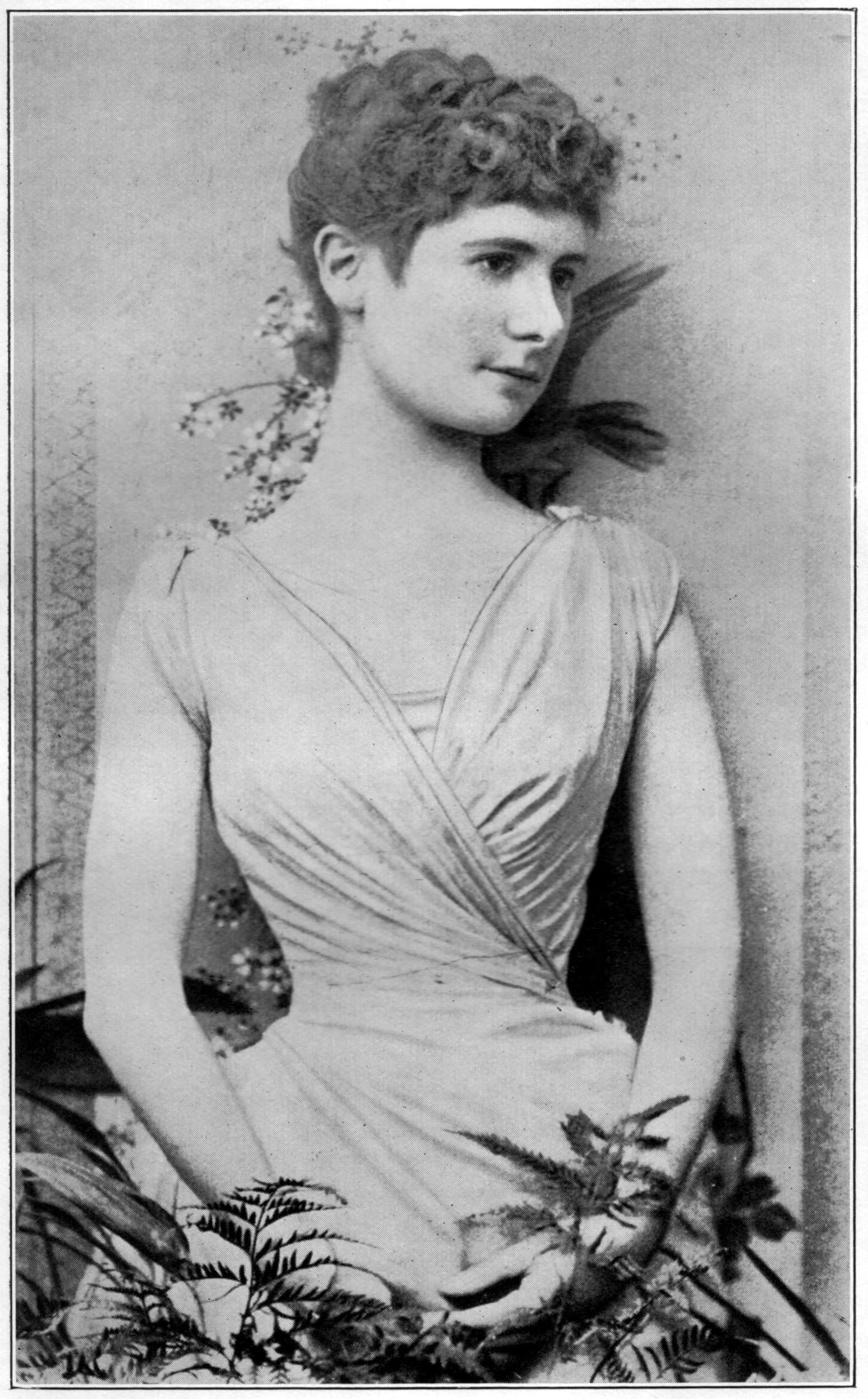
[3] “Ella Hepworth Dixon” Image. Circa 1888 (from her autobiography, As I Knew Them, 1930).

Filed Under: Research Blogs

CFP: Special issue of Victorian Periodicals Review: The Strand Magazine

August 17, 2017

CFP: Special issue of Victorian Periodicals Review: The Strand Magazine

Described by Reginald Pound as a ‘national institution’, the Strand Magazine (1891–1950) was the foremost British New Journalistic fiction paper of the 1890s. This heavily illustrated monthly promised its readers ‘cheap, healthful literature’, including short and serial fiction, factual articles, human-interest features and celebrity items, by some of the best-known authors of the time. Yet, in spite of its popularity, the Strand has attracted limited scholarly attention and is often dismissed as a prime example of the Victorian middlebrow. This special issue of Victorian Periodicals Review seeks to elicit original essays assessing the nature, role and significance of the Strand in the period 1891–1918. Possible contributions might address, but are not limited to, topics such as:


  • The Strand and the short story
  • The Strand and genre fiction
  • The topical Strand
  • The Strand and popular science
  • The Strand and celebrity culture
  • The Strand and the New Journalism
  • The Strand’s editorial policies
  • The Strand and periodical design
  • The Strand and illustration
  • The Strand and its readers
  • The Strand and the middlebrow
  • The Strand and British identity
  • The Strand abroad
  • The Strand and the ‘Victorian’
  • The Strand and the modern
  • The Strand in the digital age


Please send a 300-word abstract and a one-page CV to our guest editors Emma Liggins (e.liggins@mmu.ac.uk) and Minna Vuohelainen (minna.vuohelainen@city.ac.uk) by 1 December, 2017. Final essays of 5000-9000 words (including notes and bibliography) will be due by 1 May, 2018 and should be prepared in MS Word according to the Chicago Manual of Style. The special issue will be published in summer 2019.

Filed Under: Graduate News, Members News, RSVP News, VPR News

Registration open: Editing the 20th Century – 5th September, British Library, London

August 15, 2017

Registration is now open for ‘Editing the 20th Century’

As part of the British Academy funded project, ‘Editing the Twentieth Century’, a one-day conference will take place at the British Library on 5 September 2017 exploring the key role played by the editors of periodical publications throughout the long twentieth century.

Registration is open here.

A PDF of the programme is also available here: Editingthe20thCenturyConferenceProgramme.

Tuesday 5th September 2017, 9.00am-6.45pm. The British Library, 96 Euston Road, London, NW1 2DB.

Filed Under: Conference News, Graduate News, Members News, RSVP News

CFP: Special Issue of Victorian Periodicals Review: The Material Culture of Victorian Domestic Life and the Press

August 9, 2017

The Material Culture of Victorian Domestic Life and the Press

The Victorian press actively shaped Victorians’ notions of domestic life around several topics: material culture, architecture, interior design, and the gendering of domestic space. In addition to the many studies of Victorian domestic life and coffee table books on Victorian interiors and furnishings are new readings of Victorian authors Isabella Beaton, Charles Eastlake, and Mary Eliza Haweis on domestic taste and furnishings, as well as a neo-Victorian fascination with Victorian design, food, cooking culture, and household management.

Despite this literature, there are many still-understudied areas that are addressed in the periodical press:

  • working-class domestic lives
  • rural home decoration and furnishing in relation to urban design and furnishings
  • the ways Britons recreated British domestic life in the colonies
  • the physical organization of domestic space
  • changes in laws, aesthetics, and gender and class relations (e. g., the 1882 Married Women’s Property Act, the 1870 Education Act, Aestheticism, the department store, the New Woman) that introduced new objects, designs, family relations, gender roles and spatial structures in homes
  • advertising and illustrations of furnishings and the material page

This list is not meant to restrict, but to suggest topics. This CFP seeks to elicit essays on the press’s role in the production of domestic life as an ideal and a set of practices, including across class and the geography of Britain and the colonies. We encourage authors to address the texture of conflicting views on how to conduct and represent domestic life within individual periodicals and across periodicals that contained different ideologies, intentions and readerships in a range of periodicals—the women’s press, architecture journals, general periodicals, the art press and other specialized or trade periodicals.

Please submit a 300-word abstract outlining your proposed contribution and a CV by September 15, 2017 to our guest editor Julie Codell at: Julie.codell@asu.edu Final drafts of essays selected for inclusion in the special issue will be due January 5, 2018. These essays should be 5,000-9,000 words in length (including notes and bibliography) and formatted in Chicago style.

Filed Under: Members News, RSVP News, VPR News

  • « Go to Previous Page
  • Page 1
  • Interim pages omitted …
  • Page 14
  • Page 15
  • Page 16
  • Page 17
  • Page 18
  • Interim pages omitted …
  • Page 31
  • Go to Next Page »

Primary Sidebar

Blog Categories

  • Awards News (39)
  • Conference News (25)
  • Graduate News (36)
  • Members News (63)
  • Research Blogs (14)
  • RSVP Digital Events (28)
  • RSVP News (141)
  • Teaching & Learning News (11)
  • Uncategorized (13)
  • VPR News (18)

Footer

Search Our Site

Visit Our Blog

Connect with Us

  • Facebook
  • Twitter
  • YouTube

Copyright © 2026 · Genesis Sample on Genesis Framework · WordPress · Log in