• Skip to primary navigation
  • Skip to main content
  • Skip to footer
RSVP

RSVP

The Research Society for Victorian Periodicals

  • Home
  • About
    • Join RSVP
    • Privacy Policy
  • Grants and Prizes
    • Award Calendar
    • Curran Fellowships
    • Linda H. Peterson Fellowship
    • Patrick Leary Field Development Grant
    • Colby Book Prize
    • Sally Mitchell Dissertation Prize
    • Rosemary VanArsdel Prize
    • VPR Expanding the Field Prize
    • Conference Travel Awards
  • Conference
    • Past Conferences
  • VPR
  • Resources
    • Teaching Materials
    • RSVP Digital Salon Resources
    • RSVP Bibliography
    • VanArsdel Bibliography
  • News & Events
  • Contact

graduate@rs4vp.org

Review Periodicals and the Visibility of William Lane’s Minerva Press by Megan Peiser (University of Missouri)

March 4, 2016


Megan Peiser is a PhD candidate in the department of English at the University of Missouri where she is currently working on her dissertation, ‘British Women Novelists and the Review Periodical, 1790-1820’. Her project uses her Novels Reviewed Database, 1790-1820 (NRD) to track the contemporary critical response to the only period in literary history when women published more novels than men. She is particularly interested in how the fields of book history, literature, digital humanities, and material culture intersect in the field of periodicals studies.

You can contact her on Twitter via @MeganPeiser or email her at megan.l.peiser@mail.missouri.edu.

Review Periodicals and the Visibility of William Lane’s Minerva Press


If you opened a Review periodical in the late eighteenth or early nineteenth century, you would find, tucked in the less prestigious Monthly Catalogue section, reviews of novels published by William Lane and his notorious Minerva Press.[1] Review readers knew how to navigate the monthly Review periodical, reading longer reviews of more prestigious publications in the opening 60 to 100 pages, and flipping to the back pages where shorter reviews were divided by genre. The ‘Novels’ section was the penultimate section (followed only by ‘Sermons’). Regular Review readers would find short reviews there, very often of novels published by William Lane. Indeed, almost every issue of The Monthly Review and The Critical Review from 1790 to 1820 included a review of one of Lane’s novels.
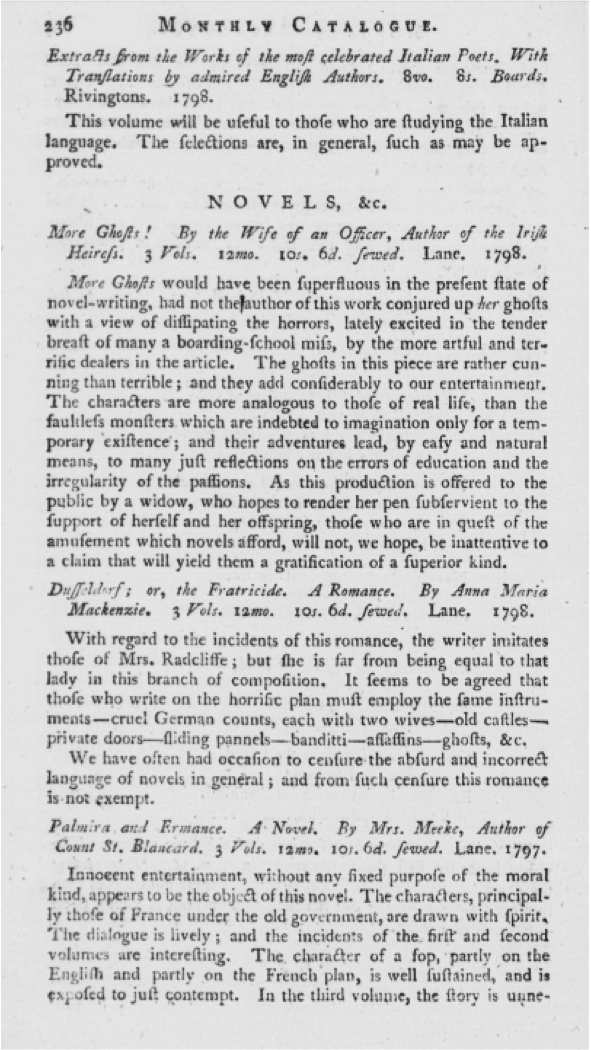
An entire page of reviews for Lane’s novels. From The Critical Review’s Monthly Catalogue (October 1798 second series, pp. 236)
An entire page of reviews for Lane’s novels. From The Critical Review’s Monthly Catalogue (October 1798 second series, p. 236)

Despite an almost constant presence of his novels in Review publications, William Lane’s Minerva Press was largely condemned by contemporaries, and is only now beginning to receive attention from scholars. The Minerva Press and the novels it produced became synonymous with hack writing, and factory-produced plots. Lane’s novels fed his own circulating library, and the many other lending libraries popping up around England during the period. It is, in part, thanks to Lane that novels were made available widely and cheaply for the growing population of novel readers of the early nineteenth century. It was also thanks to Lane’s Minerva Press that many women writers became published novelists during this period. Lane’s influence is perhaps hard to see because the novels he published have not made their way into our modern canon. However, by reading Review periodicals from the period with a new methodology, we can piece together a picture of how the reading public might have encountered Lane’s novels.

In my project I research Review periodicals using a combined qualitative and quantitative method. I read periodicals qualitatively by analysing their contents page-by-page, via archives, microfilm, and digital reproductions. And I also read Review periodicals through data analysis, using my Novels Reviewed Database, 1790-1820 (NRD). The NRD includes data on 1,215 novels, 1,639 book reviews, 445 identified authors, and more. This two-pronged approach has brought me some surprising insights in to the practices of criticism by the first two review periodicals in England: The Monthly Review and The Critical Review. The contemporary critical response to this period in the novel’s history, and this period of women writers’ dominance of the novel has not yet been closely studied. The NRD enables me to conduct a study of a large amount of textual information—thirty years of reviews—to identify trends in criticism, authorship, elements of the novel genre, and as in Lane’s case, publishing.

The period from 1790 to 1820 that the NRD explores is significant in women’s literary history—women writers were, for the first time, publishing more novels than men. The Minerva Press was a great supporter of their dominance, putting out more works by women than any other publisher. 1790 to 1820 is also the period during which the Minerva Press was booming. Set up by William Lane at Leadenhall Street in London in 1790, it became synonymous with voluminous and hastily printed novels that Jane Austen would call ‘the trash with which the press now groans’.[2]

Using the NRD I have found that the novel publisher long labelled a hack, William Lane, was very visible in the Reviews. Novels in our modern canon, like those of Frances Burney or Jane Austen, received more pages of review, and reviews in the prominent front section of the Review periodical (rather than relegated to the Monthly Catalogue), but Lane was the most visible in terms of volume. The Reviews’ mission to review all recent publications forced them to include even those of which they disapproved, and this practice worked in Lane’s favour.

William Lane’s Minerva Press published one third of all new novels in London during the period the NRD considers.[3] If a person were a regular shopper at bookstalls in the metropolis, it would be impossible to overlook the degree to which Lane’s publications dominated the novel market. But what about those many readers in England not strolling the streets of London? What about rural readers? Subscribers to circulating libraries? They were reading Reviews. Derek Roper estimates that one sixth of England’s reading public was purchasing a Review periodical, and that as each issue was likely read by upwards of 10 people: much of England’s reading population was consuming a Review periodical.[4] And where novel reviews were concerned, Lane was easy to see in their pages.

Number of Reviews

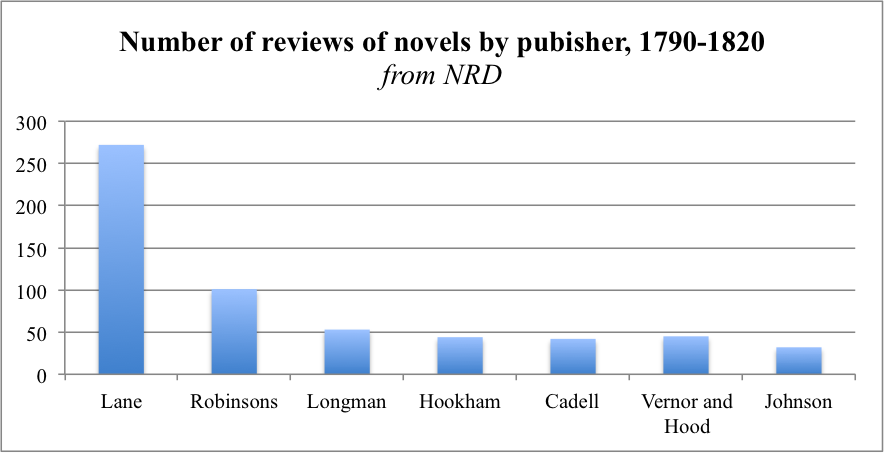
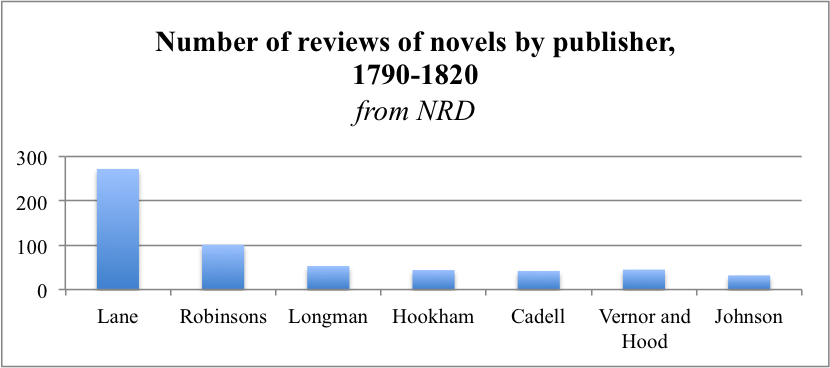
My first method of tracking visibility in the Reviews is by number of review articles. Across the NRD, reviews of Lane’s novels make up 16.5% of all reviews—more than any other single publisher. Chart 1 represents reviews of Lane’s novels compared to the six next most prolific publishers.
Number of reviews of novels by publisher, 1790-1820

Lane far outstrips the others in number, receiving 272 reviews. A novel reader using the Reviews as their guide could not have thought of the marketplace without Lane. When it came to number of reviews by publisher, Lane and the Minerva Press were most visible. A reader of Review periodicals would reliably run into a review of one of Lane’s works every month.

Location of Reviews

But what about the novel-reader who paged through the front section of the Review periodical – the section with longer, essay-style reviews? The NRD enables me to create data visualisations. These visualisations (the charts included here) show how changing our question about what makes a novel-publisher visible to Review readers re-casts Lane’s dominance as the most visible novel-publisher from this period. We have considered that the number of reviews might make Lane more visible to Review readers, but how might the location of the reviews present him to those readers?

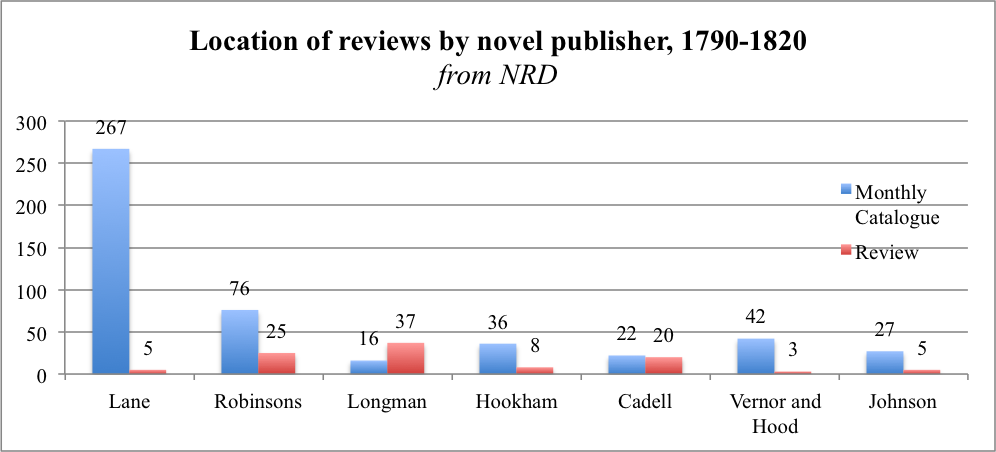
Only 11% of all novels reviewed during this period were featured in the front section. As Chart 2 shows, between 1790 and 1820 Lane had a mere five novels reviewed in the front, more prestigious section of the Reviews. Longman’s novels received the most front-section reviews with 37 (approximately one novel per year). Cadell is the only publisher whose novels are reviewed equally in both sections.
Location of reviews by novel publisher, 1790-1820

Number of Review Pages

The number of pages of review a novel received would have increased its visibility to Review consumers. And if we examine the number of pages of review that each of these novel publishers received, Longman comes out on top again:Number of review pages by novel publisher, 1790-1820
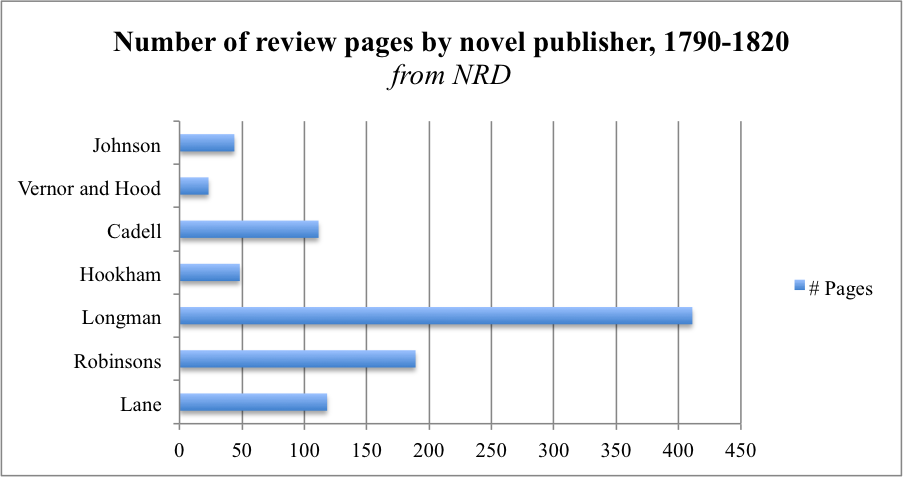
The number of pages of review space in Chart 3 is calculated by combining the number of pages of criticism, and the number of pages of excerpt from the novel each review printed. Long excerpts featured in the front section almost exclusively. This explains Longman outstripping the other publishers by more than 200 pages. Those novels reviewed in the Monthly Catalogue could expect a few lines of criticism at best. Because Lane has the most novels reviewed in the Monthly Catalogue (see Chart 2), his sheer volume of reviews calculates a page space equal to that of Cadell seen here in Chart 3.

Even though Lane’s novels are not so prominently placed, or as lengthy as Longman’s, he still maintains strong visibility in two of the three categories the NRD has helped us to consider. In number of reviews Lane is clearly #1, and his novels still make a strong showing in terms of number of pages. It is likely then that a regular Review reader of the period would have been just as familiar with Lane and his novels as Jane Austen’s biting comment shows she was. Studying Review periodicals helps to deepen our understanding of his dominance of the novel market.

Using the NRD helps us to think about the variety of ways a Review reader might understand the novel marketplace, and Lane’s role in it. While a reader in the period would not have these charts available to them, they would have felt the levels of representation that my findings reveal to modern periodical scholars about Review visibility. When researching periodicals it is often difficult to grasp their influence on their contemporary readers. Even when we read historical periodicals widely and deeply, we are still doing so in a removed state. Quantitative readings of periodicals cannot make up for our lack of historical proximity, but they can help us to ask new questions about periodicals that our distanced reading obscures from our view.


[1] I adopt Derek Roper’s practice of referring to periodicals as the ‘Reviews,’ and individual articles within the periodicals as ‘reviews’. See Derek Roper, Reviewing before the Edinburgh, 1788-1802 (Newark: University of Delaware Press, 1978).

[2] Jane Austen, Northanger Abbey ed. Susan Fraiman (New York: W.W. Norton and Company, 2004), 22.

[3] William St. Clair, The Reading Nation in the Romantic Period (Cambridge: Cambridge University Press, 2004), 244.

[4] Roper, 24-25.
 

Filed Under: Research Blogs

What’s So Funny About Buddhism? Unexpected Humour in the Late Victorian Popular Press by Emily Eiben (Ludwig-Maximilians-Universität München)

November 20, 2015


Emily Eiben is a PhD candidate in the department of Religious Studies at the Ludwig-Maximilians-Universität München. Her project focuses on the popularisation of Buddhism through the British periodical and newspaper press in the years 1875 to 1895 – between when the Prince of Wales visited the Buddha’s tooth in Ceylon in 1875 and when Sarah Bernhardt starred in a Buddhist-themed stage play in London in 1895. She is particularly fascinated by the way that pop culture and the media joined forces to create an enthusiastic new audience for a once little-known ‘heathen’ religion and the ways that this enthusiasm was fuelled by the British colonial encounter.

You can contact Emily at Emily.Eiben@campus.lmu.de.


What’s So Funny About Buddhism? Unexpected Humour in the Late Victorian Popular Press

joke 3

When I began exploring the depiction of Buddhism in the British newspaper and periodical press at the close of the nineteenth century, I was astounded by the diversity and sophistication of views I encountered in my sources. What really blew me away, though, was the surprisingly wide array of jokes, satires, and comics that the late Victorians produced about Buddhism and Buddhists. The Victorians thought Buddhism was funny? This was new. This comedic material—some of it still surprisingly funny 130 years later—shed a whole new light on the playfulness, wittiness, and sophistication of the Victorians’ encounter with Buddhism. More than any other discovery in the digital archives, my immersion in the unexpected humour of the newspaper and periodical press profoundly altered my understanding of my subject.


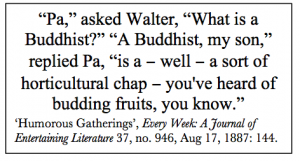
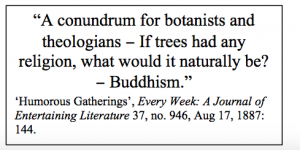
On the one hand, I stumbled across a plethora of groan-inducing one-liners about tree buds and ‘bud’-dhas, like the ones above, that feature a simple, straightforward style of humour based on the apparently universal Victorian penchant for puns and homonyms. This style of humour was designed to appeal to all ages, classes, and literacy levels; here were jokes that could be read aloud in the club, to a seatmate on the omnibus, or to the children on a Sunday afternoon. These one-liners encapsulated the ubiquity of talk about Buddhism in the 1880s; in my dissertation, they help me to demonstrate its total and seamless integration into everyday speech language and contexts.

joke 1But barbless and family-friendly was notthe only type of Victorian humour, of course, and many periodicals took a sharply satirical view of their contemporaries’ interest in Buddhism. This Victorian penchant for satire has received renewed academic attention in recent years, especially as digitisation has made it possible to locate larger amounts of comic material from a wider variety of sources. (Most will know of Bob Nicholson’s project, with the support of the British Library, to create a “Victorian Meme Machine” – see his blog here. I can’t wait to explore it!) In my dissertation I examine a number of sharply satirical pieces involving Buddhism that appeared in some of the most widely-read popular comic papers in the in the 1880s, such as Fun, Punch, and Judy. These are not one-liners and puns, but elaborate comedic setups whose decoding requires deeper analysis of their context. In many of the satires, the new interest in Buddhism presents itself as a lively and competitive option for an increasingly choosy (if overwhelmed) public – faced with the task of evaluating increasingly diverse options in the marketplace of religious ideas.
In one of my favourite specimens, the comic paper Fun sharpened its knives on the Victorian national-cultural obsession with the discovery of Buddhist relics in a satire from 1889 titled ‘The Latest Discovery.’[1] The satirical ditty is a direct commentary on British archaeologist James Campbell’s discovery near Asoka (India) in late 1888 of a fingernail supposedly belonging to the Buddha. The discovery was first reported in England by the Daily Telegraph, and the story was quickly picked up by the other major dailies—The Spectator and The Times—and then by evening society papers such as the Pall Mall Gazette. Fun‘s piece, published a scant week after the serious newspaper reports, appears close on the heels of the discovery and is obviously eager to take the wind out of its sails and make the whole episode look ridiculous. Fun‘s humorous ‘take’ on a serious archaeolojoke 4gical find transformed how I viewed the Victorians’ responses to such discoveries.
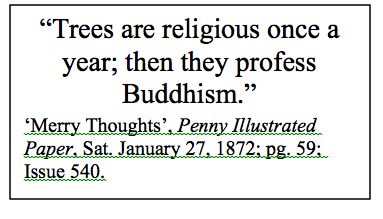
I also unearthed a plethora of quotes and quips that were strongly suggestive of how Buddhism formed part of the common cultural currency of the period. In many cases, a mere reference to the Buddha sufficed to imply a world of meanings. Most amusingly, in the political realm, both Disraeli and Gladstone were compared to Buddha when they wore passive or bored expressions in Parliament: “The Prime Minister [Disraeli] moves on sublimely indifferent to all that irresponsible and frivolous outsiders can speak or print. He appears, like Buddha, to be absorbed in contemplating with imperturbable self-satisfaction, his own perfections of his policy, and nothing can disturb his blissful reveries.”[2] The allusion was not party-specific: Gladstone, too, was described in 1883 as possessing that “bland passivity with which the image of the Buddha contemplates the prostrations of his adorers.”[3] (The likeness does seem more fitting for Gladstone than for Disraeli!) These short quips rely on a familiar interpretation of Buddhism that draws mainly on the remarkably persistent popular understanding of Buddhist nirvana as a passive cessation of interest and activity, if not a complete annihilation of personality. Here, too, was more evidence of exactly what I was hoping to prove in my dissertation: that Buddhism had been absorbed into the quotidian language of everyday men and women.

The jokes I found were instrumental in changing my approach to my subject and in deepening my appreciation of the sophistication with which the late Victorians tackled the cultural developments of their day. Specifically, these comedic materials assisted me in gauging the extent to which Buddhism had penetrated popular discourse, offering valuable evidence for understanding both the depth of knowledge as well as the types of associations that circulated in popular culture. Satire, in particular, is tightly bound to popular culture in a mutually (de)constructive way and offers unique insights into contemporary cultural concerns. Most of the jokes I discuss in my dissertation work with, and play off, other contemporary discourses; most are only obliquely funny (if at all) until one probes the social context of the joke and the frameworks of knowledge that undergird it.
joke 2

Finally, these comic materials bear powerful witness to the active role played by the mass media and popular culture in shaping contemporary opinions. The jokes I mention here are creative and constructive (rather than merely derivative); they use contemporary forms and formats to comment on what was, at the beginning of the Victorian era, still a highly specialised topic for academics and missionaries. Comic magazines such as Punch and Fun as well as family magazines such as All the Year Round, played a central role in translating serious, abstruse Buddhism into the language of popular culture. This insight was instrumental in transforming how I understood the late Victorians’ talk about Buddhism. The wry, winking humour of the popular periodicals provided a much-needed antidote to the moral seriousness and intellectual intensity that one finds in more ‘serious’ periodicals, and reminded me again and again that—contrary to popular contemporary stereotypes—the Victorians may actually have had a better sense of humour than we do. It was in their jokes, of all places, that the Victorians really came alive to me, practically leaping off the pages into the present with a sense of humour that works across time.


[1] “The latest discovery.” Fun. April 3, 1889, 149.

[2] “Summary of the Week.” Manchester Times (Manchester, England), Saturday, August 9, 1879; Issue 1129.

[3] Aberdeen Weekly Journal (Aberdeen, Scotland), Friday, October 12, 1883; Issue 8944.


Filed Under: Research Blogs

Is Our Memory of the Great Marriage Debate a Failure? by Emma Burris-Janssen (University of Connecticut)

October 2, 2015


Emma Burris-Janssen is a third-year PhD student at the University of Connecticut. Her research interests centre on gendered violence and trauma, which is how she became acquainted with the work of Mona Caird and the Great Marriage Debate of 1888, and she is currently working on a larger project connecting Mona Caird’s work on marriage with that of Thomas Hardy. Her dissertation will bring these research interests into tighter focus by examining figurations of criminalised abortion in the British periodical press (particularly medical journals) and the British novel from 1861-1967. As this project is in its early stages, reading recommendations are more than welcomed!

You can contact Emma via email at emma.burris-janssen@uconn.edu or via Twitter @CairdTooMuch.

Is Our Memory of the Great Marriage Debate a Failure?

ripper street
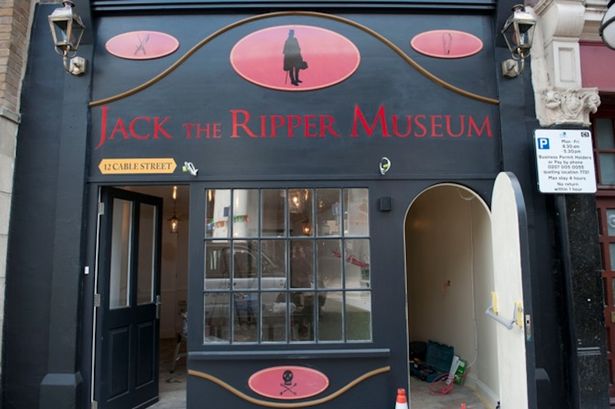
The newly open and controversial Jack the Ripper Museum, Cable Street, London.

Some weeks ago, the building of a museum dedicated to celebrating the women of London’s East End was supposed to be nearing completion. Instead, as Lisa Mckenzie observes in her blog post for Times Higher Education, “what [has] opened on 12 Cable Street is a museum that […] sell[s] T-shirts and coffee mugs featuring a black silhouette of the Ripper stood in a pool of blood, reducing the women of the East End to a red smudge.” Quite rightly, the Jack the Ripper Museum’s opening has stirred public protest and created a controversy, with the designers of the museum recently calling the fruit of their own labours (they too thought they were building a women’s history museum) so much “salacious, mysogynist rubbish.” What is at issue here is memory. How are the women of the nineteenth-century East End to be remembered? Are they to be remembered as voiceless, victimised bodies laid bare to the prurient public gaze? Or, are they to be remembered as agential subjects who started and sustained numerous grassroots rights movements?

Of course, this is not the first time that the sensationalised image of the Ripper has threatened to silence a more nuanced representation of women’s histories. In 1888, a similar battle was waged in the pages of the Daily Telegraph with the Ripper murders eventually overwhelming the Great Marriage Debate – a public dialogue partly spurred by the words of early feminist journalist and novelist Mona Caird. As Judith Walkowitz puts it in her classic book City of Dreadful Delight, the “two media events, the marriage debate and the Whitechapel horrors, tensely coexisted for four weeks, but the balance of interest and fascination began to shift from West of East, from left to right. Finally, after 29 September the marriage correspondence ceased publication, and the Ripper murders took over the whole newspaper” (168). But, the problem of how we remember Mona Caird and the Great Marriage Debate does not start or end with the Ripper murders.

is marraige a
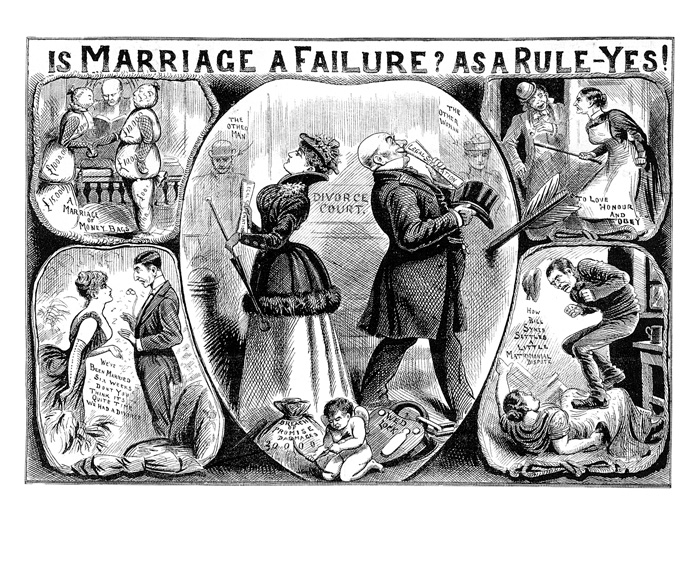
Is Marriage a Failure? Front-page engraving from the Illustrated Police News, 4 April 1891. (© The British Library Board)

Though August of 1888 is now better remembered as the month of the first Ripper murder, it was also the month that Mona Caird published her article entitled “Marriage” in the “wicked” Westminster Review. Because Parliament wasn’t in session and there wasn’t much to print, the much more popular Daily Telegraph decided to use Caird’s article as an excuse to pose the question that would spark the Great Marriage Debate of 1888: Is Marriage a Failure?

An estimated 27,000 readers responded, giving their personal views on the institution. Some used the opportunity as a vehicle for publicly airing grievances about such cardinal sins as a husband’s tendency to place his feet on the mantelpiece (oh, the horror!). Others wrote desperate pleas for help – for someone to bear witness to the daily cruelties, insults, and abuses they had to suffer at the hands of their spouses. Still others took the opportunity to declare their pious, undying loyalty to the institution.

Even before the intervention of the Ripper murders, the terms for remembering Caird’s “Marriage” essay were problematic, as it is unlikely that many of the Daily Telegraph’s letter writers would have read Caird’s original article in the Westminster Review. Even in the official 1888 collection of the Daily Telegraph’s Great Marriage Debate letters, Caird’s original article was not reprinted in full. Instead, the collection’s editor, Harry Quilter – a conservative barrister, who was far from sympathetic to the concerns of “New Women” like Caird – directed interested readers to the relevant edition of the Westminster Review if they wanted more than an extracted version of Caird’s piece. In the meantime, a “brilliant” paper by one Mrs. Lynn Linton (an opponent of women’s rights with whom Caird tangled in 1892 in the pages of the Nineteenth Century) was provided to the reader in full. While Quilter labels Caird’s text “rather vague and high-falutin’,” he commends Linton’s for its “vigorous common sense, its absence of sentimental feeling, and its concentration of wide experience,” all of which make it “well worthy of the closest attention, while as a piece of literary workmanship it is more than admirable” (13-14). And, it is this very collection of the Daily Telegraph’s letters that is still regularly referenced in discussions of Caird and the Great Marriage Debate.

127 years after the publication of Caird’s controversial essay, I still find myself swimming in questions about the way its content – and the public reaction to its content – has filtered into popular memory: How accurate is Quilter’s edited memorial to the Great Marriage Debate? What is re-membered in its pages? What is forgotten? And, beyond that, how accurately did the Daily Telegraph itself depict the nature and content of the 27,000 letters that allegedly flooded its editor’s desk? What has become of those letters? Do they still exist? What can they tell us about the relationship between the public and private spheres during this period? What can all of this tell us about which women’s experiences are remembered and which are erased?

In a discussion of memory, women’s rights, and Mona Caird, I can do no better than leave you with Caird’s own last words from the “Marriage” essay that eventually became so notorious. I have always found these lines to be haunting because of what they could not possibly have foreseen. There’s such a delicate optimism to them – an optimism that has too often been denied in the various rememberings, forgettings, and distortings of the piece:

We see a limitless field of possibility opening out before us; the adventurous spirit in us might leap up at the wonderful romance of life! […] We shall begin, slowly but surely, to see the folly of permitting the forces of one sex to pull against and neutralise the workings of the other, to the confusion of our efforts and the checking of our progress. We shall see, in the relations of men and women to one another, the source of all good or of all evil, precisely as those relations are true and noble and equal, or false and low and unjust. With this belief we shall seek to move opinion in all the directions that may bring us to this “consummation devoutly to be wished,” and we look forward steadily, hoping and working for the day when men and women shall be comrades and fellow-workers as well as lovers and husbands and wives, when the rich and many-sided happiness which they have the power to bestow one on another shall no longer be enjoyed in tantalising snatches, but shall gladden and give new life to all humanity. (252)


Works Cited

Caird, Mona. “Marriage.” 1888. “Criminals, Idiots, Women, and Minors”: Victorian Writing by Women on Women. 2nd ed. Ed. Susan Hamilton. Toronto: Broadview Press, 2004. Print.

Mckenzie, Lisa. “Why I Am Protesting Against the Jack the Ripper Museum.” Times Higher Education Blog. Times Higher Education, 5 August 2015. Web. 10 August 2015.

Quilter, Harry. Is Marriage a Failure? London: Swan Sonnenschein & Co., 1888. Hathi Trust. Web. 19 October 2014.

Walkowitz, Judith. City of Dreadful Delight: Narratives of Sexual Danger in Late-Victorian London. Chicago: University of Chicago Press, 1992. Print.

Filed Under: Research Blogs

‘Piecing the Story Together’ by Lucy Warwick (Oxford Brookes University)

August 20, 2015


Lucy Warwick is a PhD candidate at the Oxford International Centre for Publishing Studies at Oxford Brookes University. Her thesis focuses on the representation of the British Empire in the works of the Society for the Diffusion of Useful Knowledge, 1832-1845.

She can be contacted via Twitter @LxWarwick and at lwarwick@brookes.ac.uk


Piecing the Story Together


They are probably the most dreaded and feared words for any researcher: ‘not in place’, or even worse, ‘missing’, ‘lost’. These words strike fear into my heart as a library invigilator as well as a researcher.

Sometimes the archives just don’t exist, they’ve been ‘lost to the war’, or simply thrown away, but sometimes items have gone missing more recently. This is often a more frustrating situation, and has been a frequent occurrence on my mission to uncover the work of wood engraver and draftsman, Stephen Sly.

penny mag toucan pic
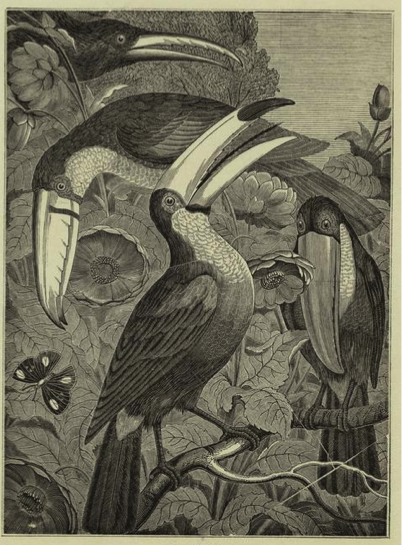
One of Sly’s most attractive woodcuts appeared in the ‘Penny Magazine’, 25 May 1833 (Issue 73)

My work on Stephen Sly is part of my PhD thesis at Oxford Brookes University which investigates how the Society for the Diffusion of Useful Knowledge (SDUK) represented the British Empire in their publications. The Society was founded in 1826, with Henry Brougham as its chair, and several prominent men on its committee, including politicians, academics, men of science, and of religion. The SDUK aimed to ‘impart knowledge’ to those who had no access to schooling, or simply wished to learn alone. It began its publishing operations in 1827 with scientific treatises on subjects such as mechanics and optics, before moving on to subjects of a broader appeal, including several on wildlife- wild and domestic, plants- edible and ornamental, and travellers’ tales of foreign lands. However these were sold at 2s, or 4s 6d (bound in fancy cloth) and were therefore still fairly expensive. In March 1832, under the superintendence of publisher Charles Knight, the Society began its Penny Magazine, aiming to provide an alternative to the coarse language and provocative politics of the radical unstamped press. From the start, Knight, as editor of the Penny Magazine, wanted to provide his readership with high quality illustrations to aid the reading of otherwise complex articles.

The Penny Magazine is not unknown to us, but there is a distinct lack of information on those who created the illustrations the magazine is known for, and indeed, was bought for. This left a gaping hole in my research which I was determined to fill. In order to understand the magazine’s production I wanted to know the minds behind its biggest selling point. The illustrations in the magazine are nothing less than eclectic and encyclopaedic; they range from reproductions of great works of art, to views of British cities, to peoples and animals from far-flung corners of the globe. Who were the men that brought the world to the fingertips of the Great British reader?

Knight’s circle of draughtsmen brought together by the Penny Magazine included two prominent names: William Harvey, and John Jackson. As pupils of the ‘father of wooden graving’—Thomas Bewick—their names survive, but another part of Knight’s circle remained shrouded in mystery: Stephen Sly & Co.

As far as I am aware, Knight’s archive was largely thrown away by his wife, and any remains were destroyed in the Second World War, so my first port of call in researching the mysterious Stephen Sly was the SDUK archive. To my delight, Sly was listed twice in the SDUK correspondence index, for one personal folder of correspondence, and another addressed to the firm of Sly, Wilson and Evans. UCL, who hold the archive, allow six items to be pre-ordered two weeks in advance – you have to pick wisely! I chose the Sly correspondence and the corresponding out-letter books, as well as the boxes of papers on illustrations belonging to Charles Knight. This seemed to me like it would give me the whole picture of the relationship between Knight, the SDUK, and Sly.

In the two weeks leading to my archival visit, I did as much additional research on Sly as possible. I found entries for him in map engraving indexes, and several mentions in contemporary periodicals. These sources all gave me glimpses into his life, but most turned out to provide contradictory dates, and almost no insight into Sly’s work outside of the SDUK.

Arriving at the archive, I was incredibly excited to be treading new ground, revealing the life of a talented, but forgotten, engraver. I opened the box of ‘S’ correspondence and sifted through to find Sly’s folders. They weren’t there. I checked, and checked again. That dreaded word ‘missing’ came to mind.

One Hundred and Fifty Woodcuts Selected from the Penny Magazine- Worked by the Printing Machine, from the Original Blocks
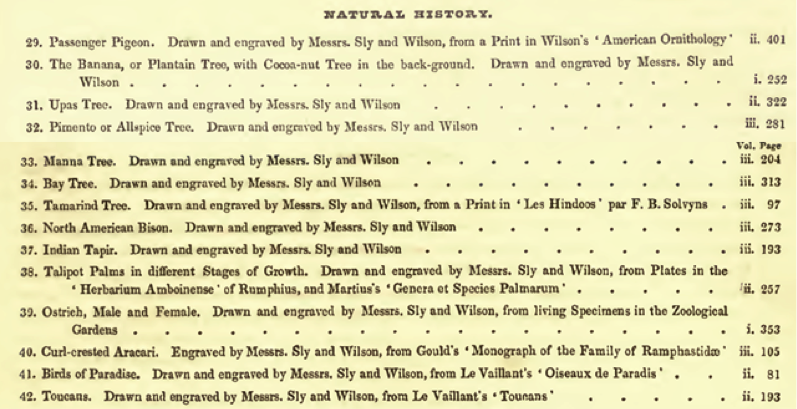
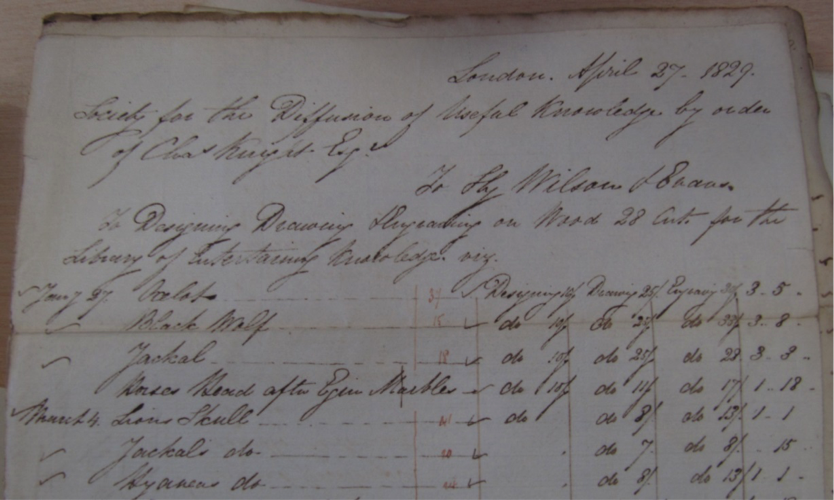
Without archival records from Knight or Sly, analytical lists, found in ‘One Hundred and Fifty Woodcuts Selected from the Penny Magazine: Worked by the Printing Machine, from the Original Blocks’ (published by Knight in 1835) and copies of accounts forwarded by Knight to the SDUK, are the only method of discovering which woodcuts were Sly’s, and where they were used. The second image lists which woodcuts were designed, drawn, and engraved by the firm. (UCL, SDUK Papers, Bills and Receipts, Item 94).

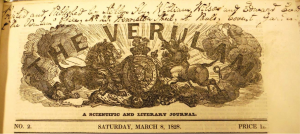
Only a year into my doctoral research, I hadn’t experienced this before. What do you do when archival papers are missing? They’re the truest window into the past a researcher can find, and provide answers that no secondary source can replace. I continued to see if I could salvage details of Sly’s life and work anywhere. Charles Knight sent lists to the SDUK of every woodcut Sly made for their volumes, as well as information relating to how much they cost, but there was nothing lists which woodcuts were designed, drawn, and engraved by the firmon the Penny Magazine at all. There was, however, a circular in the box that listed Sly, Wilson and Evans as the proprietors and publishers of a scientific and literary journal, The Verulam. I located two copies of the journal, both in the British Library. I was elated! Sly’s work was within my reach. But when I arrived to the reading room, my order had been cancelled, and I met those words again: ‘lost in the war’. Sly continued to evade me.

My last hope was a copy of The Verulam in the British Library’s Newspaper Reading Room, which, against the odds, was there and in place! It revealed much about both Sly’s early work, and a little about his interactions with the SDUK.

verulam magazine
The masthead of ‘The Verulam’ reveals the importance the firm placed on illustration, and the journal includes several woodcuts throughout each issue. Interestingly, the imprint reads: ‘Printed, Published, and Engraved by the Proprietors, SLY, WILSON, & EVANS, Wood Engravers TO THE SOCIETY FOR THE DIFFUSION OF USEFUL KNOWLEDGE…’. This is just one indication that the firm were the main wood engravers to the Society despite their invisibility.

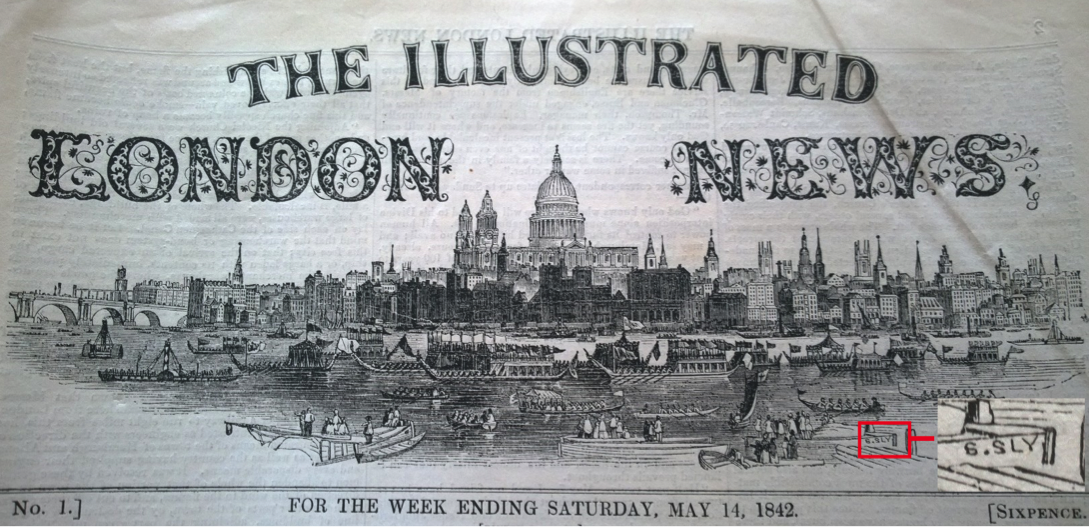
So I was left with fragments: snippets from Sly’s career with the SDUK, patchy information from engraving dictionaries, and some mentions in secondary sources. But what I considered the keystone—the correspondence—was missing. Nonetheless I was able to piece together what I had, to tell at least a partial story of Sly and Co. from their beginnings with The Verulam, to their work with the SDUK, and their feats in colour printing, including William Lee’s Classes of the Capital, Knight’s Old England, and advertisements for the London and Dover Railway. Despite his invisibility in our history books, one of Sly’s illustrations is well known: the view of the Thames on the masthead to the first issue of the Illustrated London News. It contains his name hidden in a boat in the corner of the woodcut.

london illustrated news masthead
Probably Sly’s most famous piece of work: the view over the Thames for the first issue of the ILN, 1842.

I have only scratched the surface of the mammoth undertakings of Sly and Co., and I will continue to research the firm to uncover the works of these brilliantly talented tradesmen. But for now, what I have found so far on Sly and Co. is indicative of what I’d like to convey in this post, that research is not always straightforward, and it is easy to consider your topic lost beyond hope when there are missing pieces. To uncover untold stories and bring to light the lives of those missing from our history books is not easy, and sometimes you have to piece together what you can, patching the holes that cannot be filled by archives. There is no ‘right way’ to deal with the problem of missing archives, but the years we spend researching help to train us to find innovative strategies to deal with these otherwise disappointing situations.

This correlates with my work in antiquarian book buying and the rehoming of editions abandoned by libraries. We often see pleas for help saving archives on book history mailing lists, and it is devastating to think of this primary material being lost. I blame this feeling for my SDUK-book buying habit and recent acquisition of 102 years of the history of science journal Isis that was being disposed of by a university library in favour of digital editions.

But, in the words of Tristram Hunt MP, on missing files in the National Archives: ‘I’m hopeful it’s a temporary aberration…These things do get lost and come back to life.’

And that is our job as researchers, to bring history back to life.

Filed Under: Research Blogs

‘Trilby-Mania’ by Erica Haugtvedt (Ohio State University)

July 18, 2015


Erica Haugtvedt is a Ph.D. candidate at Ohio State University. Her research focuses on early forms of transmedia and participatory culture emerging from engagement with Victorian serial narratives published in numbers or in periodicals. She is fundamentally interested in the emotional dynamics of serial reading. Her article ‘The Sympathy of Suspense: Gaskell and Braddon’s Slow and Fast Sensation Fiction in Family Magazines’ will appear in the Spring 2016 issue of Victorian Periodicals Review.

You can contact Erica on Twitter @EHaugtvedt and at haugtvedt.3@osu.edu


Trilby-Mania: Serial Fiction Merchandising during the fin de siècle

‘For we’ve got Trilby jugs and Trilby mugs and Trilby chairs and lamps / We’ve all got Trilby plates of meat, and carry Trilby gamps— / This Trilby craze will end my days—at home we’re all insane / We’ve Trilby, Trilby, Trilby, Trilby on the brain’ goes the chorus to the 1896 music hall song, ‘Trilby on the Brain’ (Sewell).

Published two years after George Du Maurier’s Trilby was serialized in Harper’s New Monthly Magazine in eight parts from January to August 1894, the song captures the Trilby-mania that chiefly overtook the United States—but also overflowed into Britain—in the mid to late 1890s. The song is parodic, but its catalogue of Trilby items is not far off from the reality that Emily Jenkins and L. Edward Purcell have documented.

Trilby-1894-Horsman-from-Du-Maurier-story_Fotor
Figure 1: an example of Trilby mania merchandise

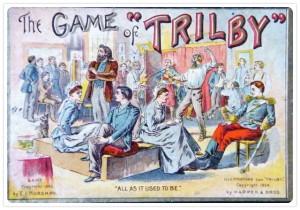
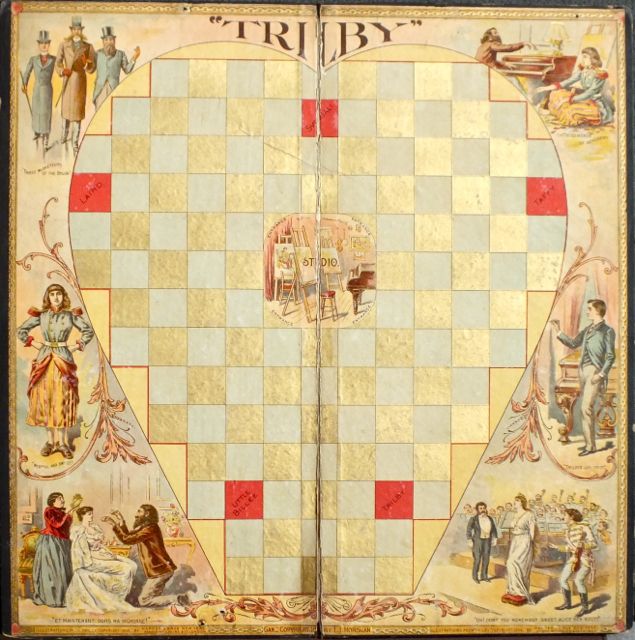
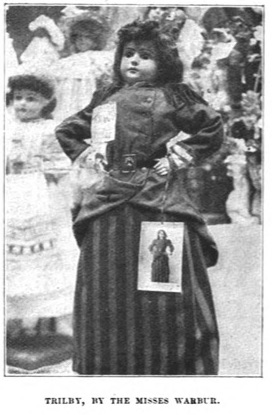
Trilby was co-opted for advertising restaurants, sausages, toothpaste, soap, shoes, jewelry, dolls, board games, and more. The expansiveness of Trilbyana begs the question: what is the relation between these things in the marketplace and Trilby? In my thesis I contend that the reaction to Trilby in the mid-1890s indexes the ways in which advertisers and consumers curated their engagement with the serially published novel. Not only does Trilby-mania anticipate aspects of fiction franchise marketing and merchandising of a later time, but the consumption of Trilby-emblazoned items emblematizes how readers exported condensed versions of Trilby’s meanings beyond the boundaries of the magazine in order to signify readers’ own values in a cultural environment in which Trilby was, for a while, the shared topic of conversation.

In my research project I argue that Trilby-mania depends upon a logic of proliferation, remediation, and convergence that operates in periodical literature, advertising, and consumerism during the Victorian period. In the merchandising of Trilby, marketers glancingly associate their products with aspects of the novel. Why market Trilby toothpaste unless the association is assumed to garner some positive attention, to present the toothpaste as an alluring alternative to non-Trilby branded items? Trilby, after all, has ‘thirty-two British teeth as white as milk and as big as knuckle bones,’ (Harper’s New Monthly Magazine February 1894, 335). The toothpaste thus implicitly promises to remake the consumer in Trilby’s image.

At the same time, as Michel De Certeau has argued, the consumer cannot be fully reduced to the image reflected in the advertiser’s intended messages. Consumption confronts production with its ‘ruses, its fragmentation (the result of the circumstances), its poaching, its clandestine nature, its tireless but quiet activity, in short by its quasi-invisibility, since it shows itself not in its own products (where would it place them?) but in an art of using those imposed on it’ (De Certeau, Practice of Everyday Life 31). Much like the reading activities of flesh-and-blood readers, the uses consumers make of these products are ephemeral, but their ephemerality does not necessarily render these activities less significant but rather more difficult to trace. Whereas De Certeau is eager to dismiss the evidence of advertising slogans, I turn to them to infer how the advertiser intended to market Trilbyana to a consumer audience.

68639a483b18cd56319894f0cafec889
Figure 2: the Trilby boardgame

What can we learn from the merchandised products derived from nineteenth-century periodical literature? I want to suggest that attending to fiction merchandising in the nineteenth century allows us to better understand the dynamics of mass media and mass reading then and now. Franchise merchandising seems to better belong to the twentieth and twenty-first centuries, yet examples such as Trilbyana testify to the important influence of the Victorian period on the ways in which we now engage with fiction franchises. Indeed, I suspect that Trilbyana can tell us more about how we process and value stories beyond the reading experience ‘proper’—how we integrate narratives into our lives through accumulating and displaying things. Indeed, there is an obvious analogy between serial fiction and the culture of consumption in which Trilbyana participates: both are products of an industrial age, both operate through capitalist profit motive. Yet, I want to suggest that the meanings of Trilbyana (and serial narrative) do not end with profit. There’s more here. And while the meanings that readers/consumers derive from the things they purchase are not unified, the plurality of different products and different slogans derived from Trilby reflects the divergent uses that fin de siècle readers made of the novel.

TrilbyDoll_TheSketch_Dec25_1895 copy
Figure 3: Trilby doll by ‘The Misses Warbur’

This endeavor is not without its considerable methodological hurdles. As I expand my archive to non-print objects, I intensify the struggle with massive materiality that Victorian periodical studies already confronts in the expansive and seemingly-ever-expanding (increasingly digitized) print archive. The directed digital search presents challenging obstacles to the kind of research I am trying to do. In the Spring 2014 issue of VPR, Linda Hughes wrote on the merits of reading the Victorian periodical ‘sideways’—reading for ‘spatio-temporal convergences in Victorian print culture’ (13). I am looking for spatio-temporal convergences between print and the marketplace that operates around it. Hughes writes: ‘The promiscuity of print, that is, its accessibility, variety, and multiple partnerings with readers, also drives its capacity to set dialogues in motion and to exceed ideological containment, scholarly modeling, and the control of authorities’ (5). While the massiveness of the nineteenth-century periodical archive is overwhelming, this very “promiscuity” is part and parcel of the wonder and excitement I find in periodical studies. I think it’s time to explore the convergences to be found outside of the printed page. Such a move is contiguous with the values this field has already demonstrated through pioneering media history and theorizing the historical experiences of reading in time. A good challenge has never stopped us before.


Works Cited

De Certeau, Michel. The Practice of Everyday Life. Trans. Steven F. Rendall. Berkeley: University of California Press, 1984.

Du Maurier, George. ‘Trilby.’ Harper’s New Monthly Magazine. Vol. 88 (January-August 1894). University of Michigan. Digitized by Google Books. Hathi Trust Digital Library. Web. 2 July 2015.

Hughes, Linda. ‘SIDEWAYS!: Navigating the Material(ity) of Print Culture.’ Victorian Periodicals Review 47.1 (Spring 2014): 1-30.

Jenkins, Emily. ‘Trilby: Fads, Photographers, and Over-Perfect Feet.’ Book History 1 (1998): 221-267.

Purcell, L. Edward. ‘Trilby and Trilby-Mania: The Beginning of the Bestseller System.’ The Journal of Popular Culture 11.1 (Summer 1977): 62-76.

Sewell, J.W. ‘Trilby on the Brain.’ London: Francis, Day & Hunter, 1896. Music Collections: H.3980.a(67.). British Library, London, United Kingdom. 8 May 2014.


Filed Under: Research Blogs, Uncategorized

Postgraduate Research Blog Launch

June 12, 2015

We are delighted to announce the launch of our postgraduate research blog.

The Research blog area is a space for our postgraduate students to showcase their research projects and for the wider RSVP community to read and enjoy!

Each post will include the contact details of our featured writer. We encourage you to get in touch with them for further discussion of the topics raised.

Our inaugural post comes from Ann M. Hale (University of Greenwich) and is entitled ‘On Serendipity.’ You can read it here.

If you would like to write a blog post for the website please contact Helena Goodwyn at graduate@rs4vp.org.

Filed Under: Graduate News, Members News, RSVP News, Uncategorized

  • « Go to Previous Page
  • Page 1
  • Page 2
  • Page 3
  • Go to Next Page »

Footer

Search Our Site

Visit Our Blog

Connect with Us

  • Facebook
  • Twitter
  • YouTube

Copyright © 2026 · Genesis Sample on Genesis Framework · WordPress · Log in