• Skip to primary navigation
  • Skip to main content
  • Skip to footer
RSVP

RSVP

The Research Society for Victorian Periodicals

  • Home
  • About
    • Join RSVP
    • Privacy Policy
  • Grants and Prizes
    • Award Calendar
    • Curran Fellowships
    • Linda H. Peterson Fellowship
    • Patrick Leary Field Development Grant
    • Colby Book Prize
    • Sally Mitchell Dissertation Prize
    • Rosemary VanArsdel Prize
    • VPR Expanding the Field Prize
    • Conference Travel Awards
  • Conference
    • Past Conferences
  • VPR
  • Resources
    • Teaching Materials
    • RSVP Digital Salon Resources
    • RSVP Bibliography
    • VanArsdel Bibliography
  • News & Events
  • Contact

graduate@rs4vp.org

Pushing the Bounds of Obscenity in The Times and Ella Hepworth Dixon’s The Story of a Modern Woman

September 11, 2017


Jennifer Wood recently finished her Masters degree and is hoping to begin a PhD in 2018 to continue her work. She is researching the history of divorce in Victorian literature and its role in pushing the boundaries of decency in Victorian culture and hopes to expand into transcontinental studies of divorce. When not working on her research, she teaches both American history as well as Western civilization to undergraduates at Metropolitan Community College in Kansas City.

You can reach Jennifer at Jennifer.wood@mcckc.edu


Ella Hepworth Dixon’s The Story of a Modern Woman, first serialized in The Lady’s Pictorial between January and March of 1894, is known as a quintessential ‘New Woman’ novel. John Sutherland calls it “the greatest unread novel of female struggle of the century.”[i] Dixon used her book to address both a double standard in expectations for women’s behavior and in expectations for the publication of fiction. That is, she explored the subject of adultery in the life and fiction of the “modern woman” in her title. By examining Dixon’s novel alongside the divorce accounts in the London Times, I argue that Dixon fought against these double standards in life and fiction even while forcing her main character to succumb to them.
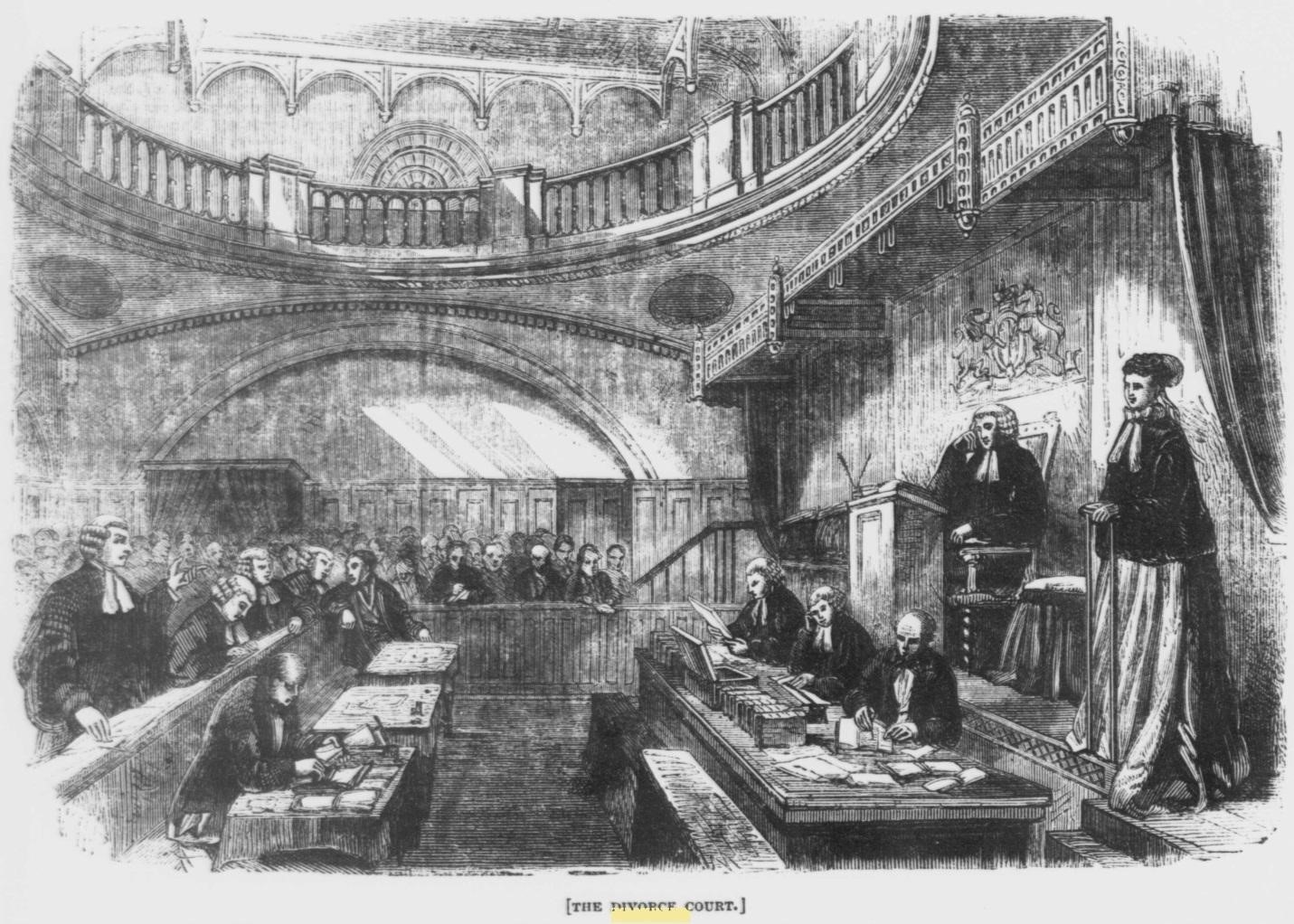
 

Jen Wood 1Divorce became a civil issue after the Matrimonial Causes Act of 1857, and as soon as the courts opened for business, the London Times reporters were there, documenting each divorce case. With each new case heard, sales increased and publishers realized they had a fresh and constantly renewable form of scandal that would sell papers. Claiming ‘democracy of print’ or the important role of making political and judicial figures accountable to the public, the London Times and other newspapers would use divorce cases to titillate their readers.  Both the press and the public would attend regular open divorce hearings, crowding into the courtroom to bear witness to the spectacle. Petitioners for divorce were required to offer all of the proof they had concerning the affairs of the accused, and the accused would then have to defend themselves. Giving testimony, especially for a woman was a difficult undertaking, where being “put on the stand” often meant standing before a packed courtroom revealing the most intimate aspects of her life. Divorce proceedings became such a popular form of entertainment that people had a hard time getting a seat in the courtroom.[ii] It was alright if you couldn’t see it in person, however, because multiple London newspapers would report all of the scandalous testimony in detail.

For instance, in 1891 the case of Russell v Russell made headlines.   Lady Russell petitioned for a judicial separation due to her husband’s cruelty.  Countess Russell claimed that Earl Russell threatened to shoot her on multiple occasions, and on the night of June 10th he:

Insisted on his wife leaving his bed, and on leaving it she fell on the floor.  A nurse found her lying there naked, and the respondent’s explanation was that, she having fainted, he threw water over her and she became so wet that he had to take off her nightdress.  After that she felt she could live with him no longer.[iii]

The charge of cruelty, however, would be overshadowed by her claim of her husband’s homosexual relationship with Herbert Roberts, head mathematics master at Bath College.  The Times reported that Earl Russell:

insisted upon a man named Roberts sleeping in the house for three or four days and nights, and after the respondent had undressed, going up to Robert’s bedroom, remaining with him for several hours, and again in the morning.  Upon the petitioner expostulating with him upon his conduct the respondent told the petitioner to go to the devil and mind her own business.[iv]
Jen Wood 2


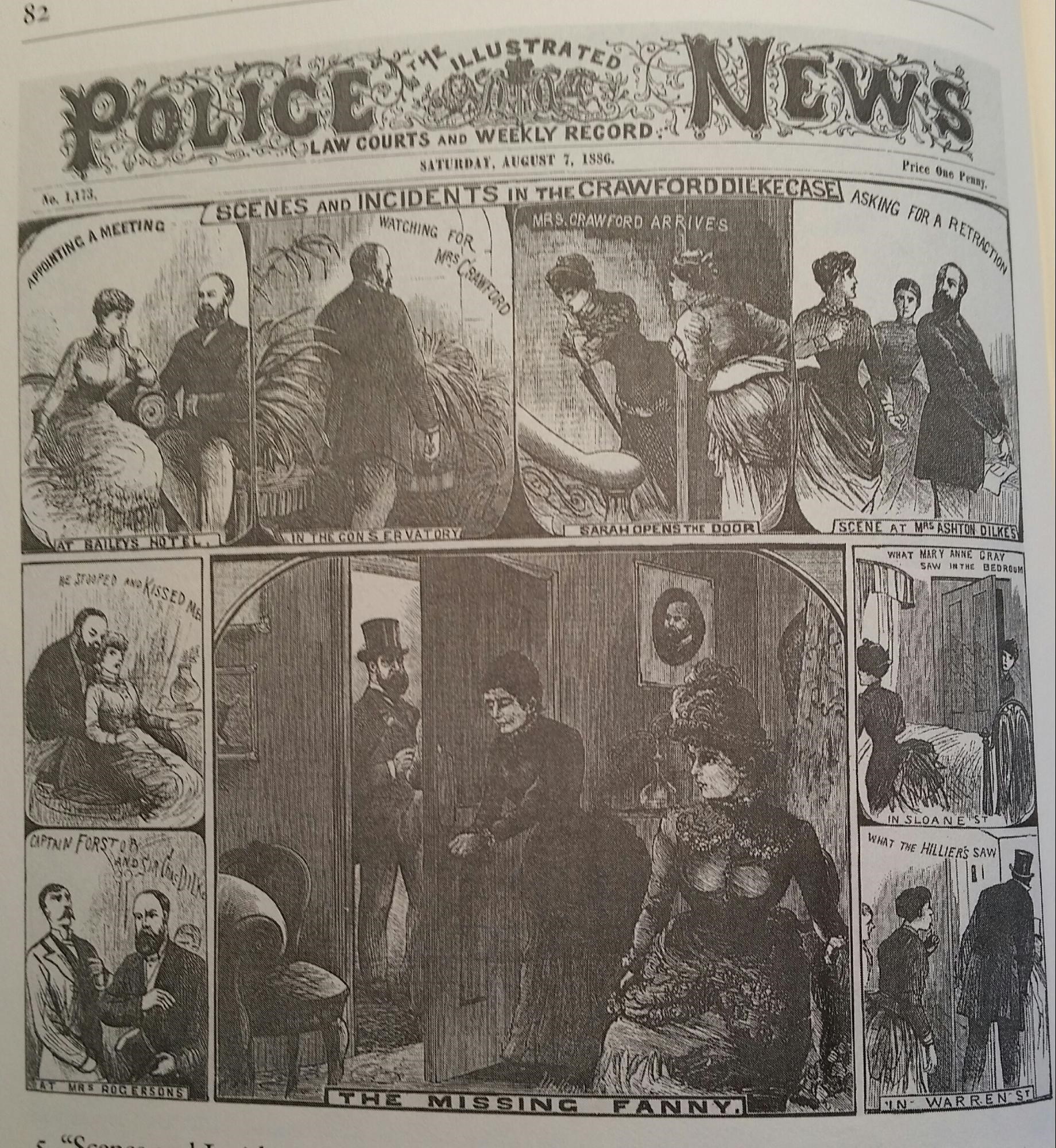
The scandal involved with the Russell case was intense.  Anyone reading the newspapers would know the activities going on within their home and the testimony would leave no question as to the character of all the parties involved. Despite the final ruling of the Russell case, Earl Russell would forever be associated with a homosexual relationship and cruel behavior leaving plenty of fodder for gossips in all level of society.   For those cases that were especially popular, newspapers such as the Illustrated Police News (Fig.2) would use illustrations allowing the scandal to be not only visualized for audience members, but for those who were illiterate, the pictures would allow them to join in on the gossip.


Some people found the newspaper reports to be vulgar and a danger to public morality.   Even Queen Victoria implored the courts to cease the flow of news reports.

None of the worst French novels from which careful parents try to protect their children can be as bad as what is daily brought and laid upon the breakfast-table of every educated family in England, and its effect must be most pernicious to the public morals of the country.[v]

While the Queen’s opinion was taken into account, court officials hoped that the printing of these court cases would act as a deterrent to those tempted to wander off the path of marital virtue.  They would argue that the newspaper accounts acted as an informal education on what not to do in a marriage.[vi]  Even those most opposed to the passage of the divorce act believed that the publications of the hearings were to the ultimate benefit to the public as a whole.[vii]

Many respectable people internalized the lessons intended by the courts, reassuring them about their own honorable lives –“I’d never do that”– and helped them set limits of expected behavior.[viii] This ability of the reader to distance themselves from those on trial was what kept newspapers safe from the obscenity laws and what allowed readers to feed on the scandal without feeling influenced by it. By placing those at the center of the controversy outside the regular sphere of everyday life, it distanced the reader from temptation of the immoral act of adultery.  It especially helped if those unlucky few on trial were of a higher social station.[ix] Despite their belief in scandal for the public good however, divorce numbers continued to increase in the last half of the nineteenth century.[x]


Fiction, though, was held to different standards. While novelists often used stories and headlines from the newspapers as a means of inspiration and proof of relevancy, they also sought to use their medium as a way to push back against this double standard that existed between fiction and journalism.[xi] The obscenity laws were keenly felt among Dixon and her peers, and more successful authors chose pamphlets and essays to argue their case.  George Moore spent his own money to publish Literature at Nurse, or Circulating Morals, as a way of criticizing circulating libraries, specifically Mudies, for their censorious natures, noting that “the character of strength, virility, and purpose, which our literature has always held, the old literary tradition coming down to us through a long line of glorious ancestors, is being gradually obliterated to suit the commercial views of a narrow-minded tradesman.”[xii] Moore displays disgust at Mr. Mudie’s decision to discontinue carrying his novels based on the letters of a couple of disapproving “ladies in the country”.[xiii]  Moore’s newest novel A Mummer’s Wife was censored because it was told from the point of view of the wife who cheats on her husband and subsequently divorces him for another man.


Eliza Lynn Lynton also had words about the double standard but contemplated a different solution, namely that “a great nation should be candid and truthful in art as well as in life, and mature men and women should not sacrifice truth and common sense in literature for the sake of the Young Person.”  She advocated for age specific genres and “locked bookcase(s).”[xiv]
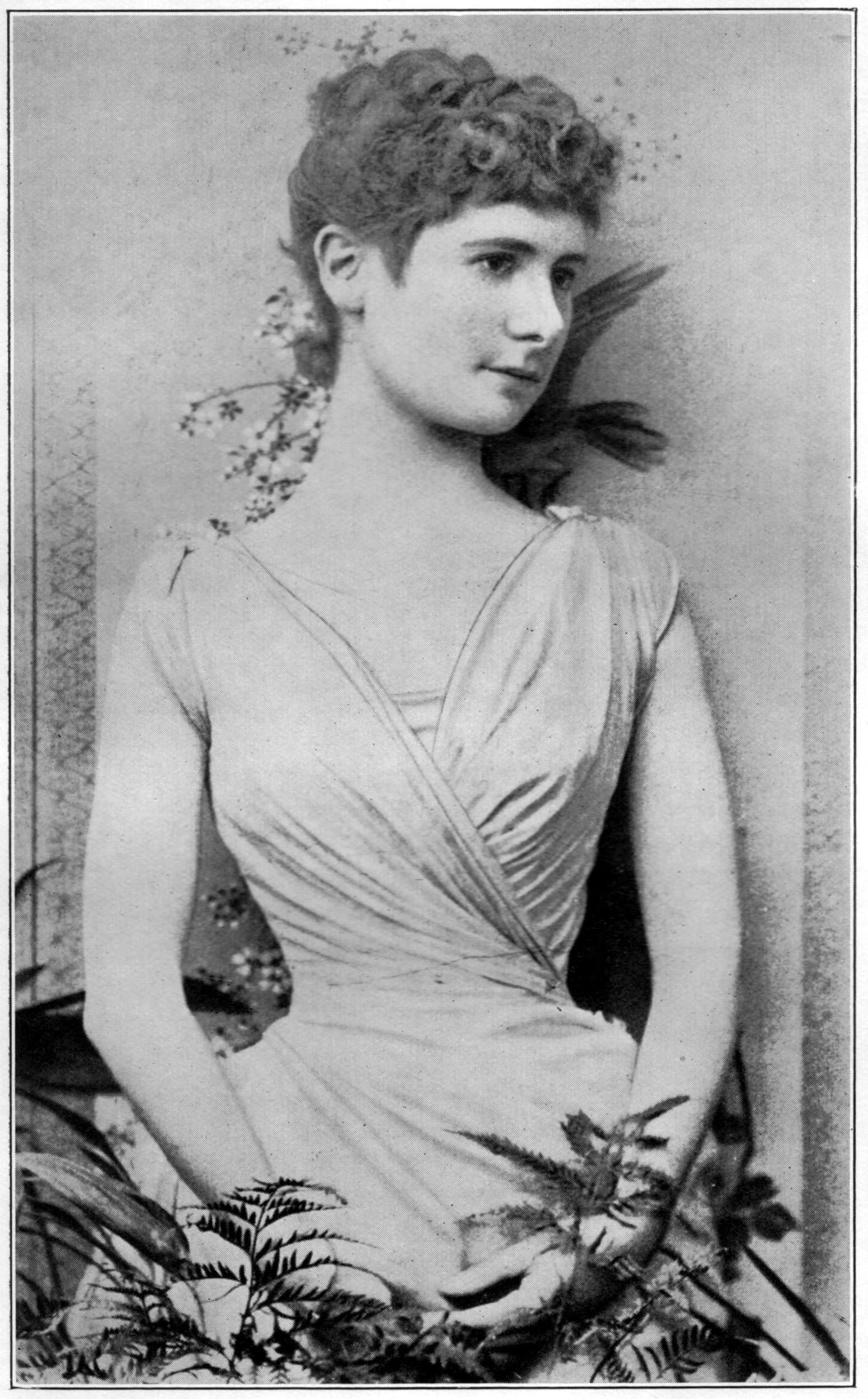
Jen Wood 3Ella Hepworth Dixon would use her novel as a similar vehicle for protest against “circulating library” standards. Mary Erle, the protagonist of The Story of a Modern Woman, is an orphaned young woman responsible for the care of her younger brother. Though she aspires to be an artist, she takes up journalism and fiction writing as a faster means of supporting her small family. Educated and raised in polite society, Mary remains free to mingle among those with whom she was raised despite her misfortune. Her friends exist in both the upper classes of London as well as the working class and because of her situation; she is able to afford her readers the perspective of both worlds. Dixons first exploration of divorce comes in the form of Lady Blaythewaite, a secondary character, who hovers in the background of Dixon’s tale. In the story, Lady Blaythewaite is known for her beauty and her jewels but she is introduced as a soon to be divorcee. “She brings the case, of course, but she won’t get it.  They’re betting on it at the clubs.”[xv]  Dixon shows how Lady Blaythewaite had become the object of scandal in polite society by the whispered talk about her at the theater, and later by the way Dixon portrays the actual divorce through the medium of newspapers.

When Mary goes to discuss her novel with the editor of Illustrations magazine, she has to pass the Strand, an area near the center of London where newspaper boys shouted headlines to passersby.  Mary would stop to read the headlines. “The Great Divorce Case. Cross-Examination of the Plaintiff. Unabridged Report. Ladies Ordered Out of Court. Sketches of the Co-Respondents.”[xvi] Dixon would compare the Blaythewaite divorce case to a disease that would infect all of London, influencing conversation wherever people met.  “Spesh–shul! Extra spesh–shul! The great divorce case! Extraordinary evidence! Cross-examination of Sir Horace Blaythewaite!”[xvii] Not unlike real life and the Russell divorce case, the Blaythewaite divorce became highly publicized and incredibly detailed fodder for newspapers.  Dixon’s very next scene brings home the jarring contradiction in the publishing industry at the time.

When Mary sits down to discuss the manuscript of her novel, the editor rejects her ending as too scandalous. As George Moore’s case suggests, in an effort to avoid violating the 1857 Obscene Publications Act, editors often censored their writers prior to publication. Mary’s editor attempts to curb her discussion of potential adultery:

You’ve put the most extraordinary things in this last chapter. Why, there’s a young man making love to his friend’s wife.  I can’t put that sort of thing in my paper.  The public won’t stand it, my dear girl.  They want thoroughly healthy reading.” “Do they?” said Mary, who could not help remembering the columns of unedifying matter which had lain on the breakfast table that morning, nor the newsboys vending the latests details of the great scandal, served red hot, at the street corners. “I thought,” she continued quietly, “that the public would take anything – in a newspaper.” [xviii]

Dixon uses the voice of the editor to stand in for the censorship and morality laws that regulated the print industry for fiction. Dixon goes on to push this double standard home when the editor, during their meeting, takes a phone call about the Blaythewaite case and urges his photographer to get as many photos as possible of Lady Blaythewaite and asks for a “couple of pages of drawings” in an attempt to boost revenue through scandal[xix].  Oblivious to his own contradiction, the editor continues with Mary telling her that “the fact is…novels are-er-well-novels.  The British public doesn’t expect them to be like life.”[xx]  Mary goes on to defend the literary world when she argues, “But even the people in the country parsonage must occasionally see life as it is — or do they go about with their eyes shut?”[xxi]  It is in this line that Dixon spells out her frustration with English morality and the double standard in publishing.


So, why was it acceptable to read about scandalous divorce cases in the papers but not in literature?  The assumed audience of novels was impressionable young women. It would be incorrect to presume that young women didn’t also read newspapers, but novels took a different, more important role with their readers.  Fictional literature, worked to close that distance between the reader and the story. Where newspapers allowed the reader to place the subject of adultery at a distance so as to ridicule and objectify, novels did the opposite.  Authors asked their readers to empathize, to identify, and to imagine themselves as aligned with their characters, thus eliminating any gap between the two. Where newspaper stories were merely scandalous, literature was dangerous.  If an impressionable reader could empathize with a character, they could then imagine themselves doing the actions of the characters. Because of this, stories that dealt with scandal and adultery attempted to place the main character as the victim of the crime instead of the perpetrator.

Despite Mary’s failure to conclude her serial with an adulterous scene, Dixon does so in her novel.  The Story of a Modern Woman begins with Mary’s courtship with an ambitious family friend, Vincent Hemming.  Hemming makes clear he intends to marry her.  However, when he impulsively chooses to marry another woman for her money, Mary is left heartbroken.  At the end of the novel, Vincent confesses his mistake and pleads with Mary to run away with him. “You are above the prejudices of our false civilisation, you are capable of being a true woman, of giving up something for the man you love.”[xxii] What Vincent pleads with Mary to give up is her pride and place of respectability in English society. He suggests they move somewhere far away so that she would not have to deal with the opinion of others or the scandal that his divorce case might incur. Mary refuses Vincent, yet despite her resistance, she is still “conscious of the fascination, the odious fascination which belongs to sin.”[xxiii] Dixon plays here with that fine line of protagonist as victim.  She allows Mary to imagine for a moment that she could exist outside of social prejudices.  In the end however, Dixon rallies for the plight of women and their helplessness at the hands of men and society.  “…the impotence, the helplessness of woman, struck her with irresistible force.  She was the plaything, the sport of Destiny, and Destiny always won the game.”[xxiv] Mary’s choice allowed Dixon to remain on the right side of the censors while still candidly exploring the subject of adultery.


The obscenity laws and editors fearful of conviction dictated the rules of publishing in nineteenth century England, and those in control of the systems held tight reigns on what was and was not accepted as publishable material.  Newspapers like the London Times flaunted their ability to freely publish erotic stories thus ensuring daily readers, while authors such as Dixon pushed against their restraints in ways that represented the reality of publishing while simultaneously upholding the straw man of adultery. Dixon understood the difference between the two audiences and their ability or inability to distance themselves from the subject at hand, and she wrote with those audiences in mind. She didn’t hesitate to reveal, however, the double standard at play in the publishing world with her realistic story of frustration in the face of contrasting principles. The loophole in the obscenity laws regarding newspapers would hold fast in England until 1926 when, instead of the courts loosening their grip on censorship, they deemed it no longer proper nor educational to report on divorce cases.[xxv]


End Notes:

[i] The Stanford Companion to Victorian Fiction (Stanford: Stanford UP, 1989):2.

[ii] Horstman, Allen. Victorian Divorce. Croom Helm Ltd, 1985. 89.

[iii] London Times, December 2, 1891, pg3; issue 33497

[iv] Ibid.

[v] Victoria, Queen of Great Britain.  The Letters of Queen Victoria: a selection from Her Majesty’s correspondence between the years 1837-1861, published by the authority of His Majesty the king ed. Arthur Christopher Benson and Viscount Esher.

[vi] Ibid. 94.

[vii] Savage, Gail. “Erotic Stories and Public Decency: Newspaper Reporting of Divorce Proceedings in England.” The Historical Journal Vol.41, no. 2 (1998) 512.

[viii] Horstman, Victorian Divorce. 97.

[ix] Ibid.

[x] Savage, Gail. “The Operation of the 1857 Divorce Act, 1860-1910 a Research Note”. Journal of Social History, Vol. 16 no. 4 (1983) 104.

[xi] Rubery, Matthew.  The Novelty of Newspapers: Victorian Fiction After the Invention of the News. Oxford University Press, 2009. 163.

[xii] Moore, George. Literature at Nurse, or Circulating Morals. 1885.

[xiii] Ibid. 3.

[xiv] Lynton, Eliza Lynn. “Candor in Fiction”. 1890.

[xv] Dixon, Ella Hepworth. The Story of a Modern Woman. Broadview Press, 2004. 138.

[xvi] Ibid. 145.

[xvii] Ibid.

[xviii] Ibid. 146.

[xix] Ibid. 147.

[xx] Ibid.

[xxi] Ibid. 146.

[xxii] Ibid. 183.

[xxiii] Ibid.

[xxiv] Ibid. 184.

[xxv] Savage, Gail. “Erotic Stories”. 528.


List of Images:
[1] “The Divorce Court” Image. “The Mordaunt Divorce Case,” London Journal, 26 March 1870. 196-197.  This illustration depicts The Mordaunt Divorce Case.  This was an incredibly sensational divorce case as Lady Harriet Mordaunt confessed to having had affairs with several men, including the Prince of Wales. She had a daughter that was suspected to be from one of the men she named.  She was later examined and found to have puerperal mania or postpartum psychosis and her husbands divorce was dismissed on these grounds. Lady Mordaunt lived the rest of her life in an asylum.
[2] “Scenes and Incidents in the Crawford Dilke Case.” Illustrated Police News, 7 August 1886. This illustration shows how cases could be visualized in detail almost fictionalizing the story through illustration.
[3] “Ella Hepworth Dixon” Image. Circa 1888 (from her autobiography, As I Knew Them, 1930).
Filed Under: Research Blogs

Digital Methodologies: Using Semantic Vector Spaces for Identity Research

June 5, 2017


Quintus van Galen is a PhD candidate at Edge Hill University, working on the application of computerised textual analysis to historical questions in periodical studies. His thesis will focus on the methodological viability of such analyses within historiography, by the use of a case study on imperial identity in Victorian newspapers. When not working on his own research, he teaches methodology to undergraduates, and acts as an assistant for Bob Nicholson’s digital projects.

Quintus would be happy to answer any questions you have regarding LSI and what it can do for your research at vangaleq@edgehill.ac.uk or through twitter @QVgalen


When I graduated with an MA in History in 2015, I was part of the first cohort that started their programmes after the genesis and widespread adoption of digital archives in the early 2010s. We had been part of the first generation to have access to full-text web-searchable databases for our dissertations. Many of our generation, myself included, gratefully used those resources and many would not have been able to complete their dissertation without them. While on archival research in India, I could cross-reference documents found there with those in Kew, Brussels or The Hague with just a few mouse-clicks. Yet there was one thing our training left us unprepared for when using these fonts of knowledge – the incredible amount of material they contained. The methodologies that have served historians so well for as long as historiography has existed were always meant to cope with a dearth of information, in the implicit understanding that there was always some source that was unknown or unavailable to the historian. Now, it seems we are swamped by sources the moment we hit the search bar.

One possible solution to this textual overload comes in the form of ‘distant reading’. A term popularized by Franco Moretti in 2005, it offers the historian a way to analyse a large collection of texts and gaining a clearer understanding of the way these texts influenced each other – and society. The simplest way to preform distant reading for historical research, on both a practical and conceptual level, is the N-gram method. First conceived in the 1990’s, these are graphs measuring occurrences of a string of words of length n over a set of documents over time. They are commonly used in the branch of historiography known as culturonomics, which seeks to analyse of culture based on statistical evidence.

The research for my PhD will use N-grams in a primarily exploratory role. By adding the tables of the category under investigation (for example, a year of a specific periodical) and deriving the relative word frequencies from these we can construct N-gram graphs, which can answer very specific research questions. While no n-gram corpora exist (publically) for periodicals, short grams are easy to generate.[i] In the initial stages of the project, I built a simple 1-gram viewer. This allowed me to do two things: to get a very rough overview of the content of the digitised periodicals and its evolution over time, and to choose subsets for further programs to work with in a less biased way.

But there are questions N-grams cannot answer. They look at grams in isolation, therefore they lose the contextual meanings of the words they chart. An N-gram to research the adoption of the American term ‘skedaddle’ in Victorian newspapers would indeed show its adoption in the British vocabulary, but would also show the brief reign of the racehorse of the same name – without distinguishing between the two. The list of context-sensitive terms is almost endless. Without contextual semantic information embedded in the rest of the sentence, it is impossible to know which you are mapping. Collocate searches can provide some solace, but only to a degree.

The solution is to no longer consider words as solitary semantic units, but to include their contexts in the analysis. This is easier said than done, and only recently have computers become ‘smart’ enough to deal with semantic ambiguities; the most accessible way of achieving this is by using semantic vector spaces. These programs apply the saying “you shall know a word by the company it keeps”, and encode each word as a vector containing its relation with all other words in the corpus. Among others, one such method is Latent Semantic Indexing (LSI).

My PhD research focusses in on the perceptions of Imperial identity in the British press, and the way the press helps construct this identity. As part of this process, I am using LSI to discover whether there is an evolution in the topics discussed in British newspapers, and if different newspapers generally report on different topics. Both of these questions require the use of a large dataset of digitised newspapers, which is fortunately available in the form of the British Library Nineteenth Century Newspaper Archive.

To answer these questions, a slice is made in the newspaper corpus to narrow it down to a time period, newspaper, or keyword-topic. In this case, the Gensim LSI algorithm was applied to a sample of one thousand newspaper articles which contained the keywords ‘empire’ and either ‘border’ or ‘frontier’, with the aim of discovering trends in the narrative about the edge of the Empire. The reason for this relatively small sample size is that the analysis program is still in heavy development, and using more articles would incur exponentially longer processing times. Eventually, the goal is to use a sample around the ten to one-hundred thousand mark. The output is a list of the strongest semantic clusters. Very few historians have employed the technology yet, so its full potential is still unknown. However, promising experiments on the Dutch Newspaper corpus Delpher have seen the technique used to calculate the most important words in a text, and subsequently determine the associations between these words and the entire text. My PhD project was in large part inspired by those experiments.

Several of these are clearly garbage – a sure sign the OCR-cleaning algorithm is slacking at its job. Some of the associations are expected in a dataset such as this, for example, the Boer War. This is a good sign, because it means the program is to some extent working like it should. There are, however, several interesting observations that can be made from these. For one, about half of the clusters contain some form of reference to the military, the backbone of the Empire; seven clusters containing “Troops”, and three mention staff officer ranks (Colonel and General). Additionally, there are clear clusters of enemies, most notably the Russians (who are strongly associated with the Turks and the French), and above all the Boers. It needs to be stressed though, that the importance given to this latter group is a reflection of the overrepresentation of the late 1890’s in the sample. Of particular interest is the cluster I interpreted as discussing the national budget, which contains strong associations with “Army” and “Tribes”. These findings seem to suggest that the British Empire was indeed strongly defined in the papers by its military actions on the frontiers, supporting scholarship by Makenzie, Potter, Williams and others.

The second interesting find is the lack of “Britain” or “England” in the clusters. “British” occurs in only two clusters: once with “Government” and “War”, and once with “Africa” and “Turkish”. This absence might be explained by the theory of Banal Nationalism: there was no need to explicitly state a paper was discussing the British Empire – this was known by the reader by virtue of it being the only ‘Empire’ worth mentioning as such. A closer reading will have to be carried out to verify this, but this suggests the importance of the British press in ‘Flagging the Empire’ on a daily basis cannot be overestimated.

Going forward, the biggest obstacle to overcome is the lack of quality in the OCR, and improving this will be the first step towards producing better analyses. Fortunately, there are various options available to deal with this issue, so there are multiple avenues to explore. Once this is dealt with, I hope to apply LSI to various slices of the newspaper archive (by time, newspaper, or topic), which should allow for tracking trends over these categories. This should provide both an insight in the viability of LSI as a historical research tool, and allow an overview of the entirety of newspaper reporting without having to resort to sampling.


[i] The n-grams that do exist for the BLNP dataset have to remain within institutions for copyright reasons. They have been built and operated with great success by the University of Bristol. See: Lansdall-Welfare et al, ‘Content analysis of 150 years of British periodicals’, DOI: 10.1073/pnas.1606380114


References:

Michel et al. ‘Quantitative Analysis of Culture Using Millions of Digitized Books’,  Science, December 2010.

Nicholson, B. and Johnes, J., ‘Sport History and Digital Archives in Practice, in G. Osmond and M. Philips (eds.), Sport History in the Digital Era (University of Illinois Press: Chicago, 2015). Pp. 53-74.

Lansdall-Welfare et al. ‘Content analysis of 150 years of British periodicals’, PNAS, January 2017.

Williams, K., Read All About It! A history of the British Newspaper (Abingdon: Routledge, 2010).

Potter, S. (ed.), Newspapers and Empire in Ireland and Britain: Reporting the British Empire, c.1857 – 1921 (Dublin: Four Courts Press, 2004).

MacKenzie, J., Propaganda and Empire: The Manipulation of the British Public Opinion 1880-1960 (Manchester: Manchester University Press, 1984)

Billig, M., Banal Nationalism (London: SAGE, 1995).

http://lab.kb.nl/tool/frame-generator

http://radimrehurek.com/gensim/


Filed Under: Research Blogs

Finding Mr. Poe: Intertextuality and Periodicity between Edgar Allan Poe and Charles Dickens

March 9, 2017


Katie Bell is a PhD student at the University of Leicester. Her thesis is titled “The Diaspora of Dickens: Death, Decay and Regeneration”, the focus of which is the intertextuality of Dickens’s works and 20th century American texts of the Southern Gothic genre. The American authors examined in her thesis are William Faulkner, Flannery O’Connor and Carson McCullers.  She is based in the United States where she is also a volunteer docent for The Wren’s Nest, the home of Atlanta author Joel Chandler Harris most famous for his ‘Br’er Rabbit’ tales.  She can be found on Twitter @decadentdickens


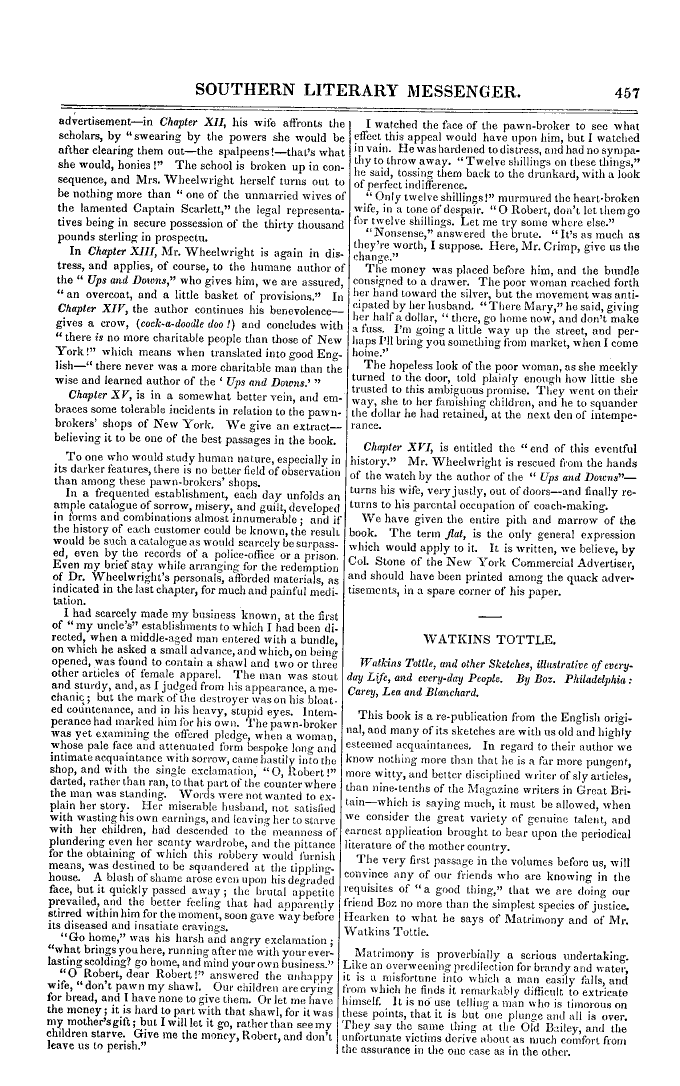
Edgar Allan Poe is remembered as an eccentric loner, a poet, and a writer of gothic “tales.”  He earned his living (albeit a meagre one) as a journalist, writing more literary criticism than poems or tales.  As a critic, he quickly gained the nick-name of “the man with the tomahawk,” a racist epithet but one which was meant to make light of his cutting negative critiques, for which his reviews became popular for giving.[1]  From 1835 until his death in 1849, Poe wrote approximately one thousand critical pieces and defined the American “standard for book reviewing.”[2]  In these pieces Poe criticised many American newspapers for “puffing” second–rate American books simply because they were American, and he identified himself as being one of the first American fans of Charles Dickens when he reviewed Sketches by Boz in June of 1836.  Poe had never heard of Dickens (or Boz) prior to his review (Sketches was Dickens’s first collection, so few readers knew of him), and Poe wrote of Dickens: “we know nothing more than that he is a far more pungent, more witty, and better disciplined writer of sly articles, than nine-tenths of the Magazine writers in Great Britain.”[3]

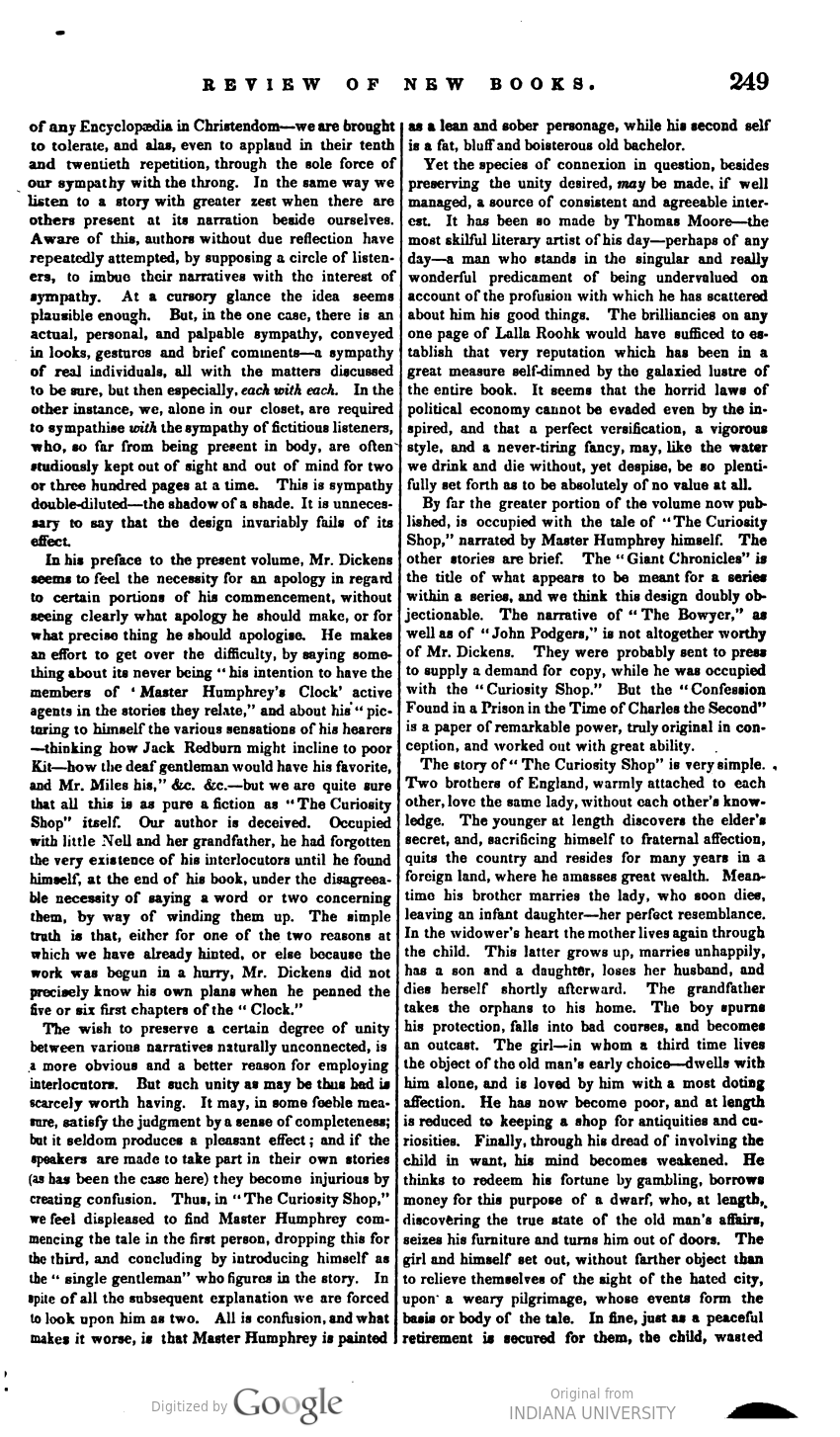
Watkins Tottle  In the Saturday Evening Post, Poe went on to attempt to solve the mystery of the murder in Barnaby Rudge after having read only the first three available chapters, which he did for the most part. Through his reading and critique of Barnaby Rudge, Poe crafted the framework necessary for a finely tuned detective story which would come into his work with his character Dupin later that year.  Dickens and Poe met briefly in Philadelphia on Dickens’s 1842 American tour, and there is no concrete evidence of what the two discussed (partly due to Poe’s tendency towards fabrication and Dickens’s later burning of his personal letters), but from most accounts, it is understood that the two got on very well.  Poe felt the most important aspect of Barnaby was the relationship between Barnaby and Grip.  In Poe’s first review of the available chapters of Barnaby he wrote of Barnaby and Grip that:

[Grip’s] croakings are to be frequently, appropriately, and prophetically heard in the coarse of the narrative, and whose whole character will perform, in regard to that of the idiot [Barnaby], much the same part as does, in music, the accompaniment in respect to the air. Each is distinct. Each differs remarkably from the other…This is clearly the design of Mr. Dickens¾although he himself may not at present perceive it.[4]

This relationship between Barnaby and Grip is revisited in “The Raven” and Poe picks up where he felt Dickens left off; Poe’s raven is the answer to the questions that the narrator of the poem poses and the echo of his deeper self.

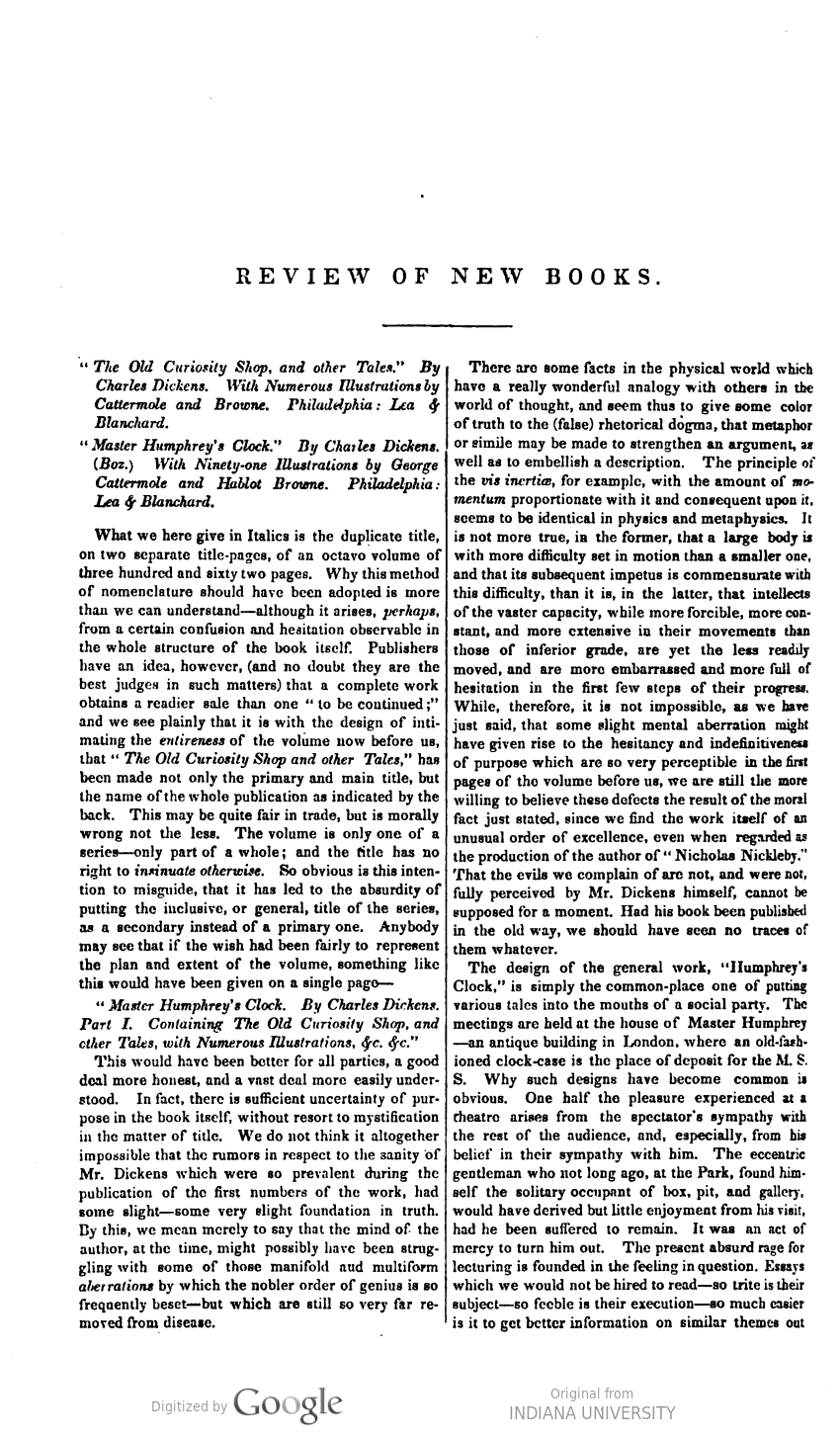
Master Humphrey 1Before he had “The Tell-Tale Heart” published in The Pioneer in 1843, he was taken with Dickens’s Master Humphrey’s Clock (1840) and reviewed the collection favourably in 1841.  He specified that of all the tales held within Humphrey, “A Confession Found in a Prison in the Time of Charles the Second” was the most “power[ful].”  He wrote, “The other stories are brief…The narrative of ‘The Bowyer,’ as well as of ‘John Podgers,’ is not altogether worthy of Mr. Dickens.  They were probably sent to press to supply a demand for copy…But the ‘Confession Found in a Prison in the Time of Charles the Second’ is a paper of remarkable power, truly original in conception, and worked out with great ability.”[5]


Master Humphrey 2Many are not aware of this lesser known Dickens piece, as the way in which we currently read The Old Curiosity Shop is not in its original serialised form within Humphrey, therefore, the short stories which come between the larger texts (Curiosity Shop and Barnaby) are lost for most modern readers. To summarise the story, a retired soldier finds himself the adoptive father of his nephew, whose eyes and gaze he fears for an inexplicable reason.  Ultimately, the narrator becomes so overwhelmed with this little boy’s gaze that he is driven to murder him and bury his body in the garden.  Friends of the narrator come to call, and he entertains them with food and drink upon the very spot the boy is buried.  The denouement is that a neighbour’s errant bloodhounds enter the party having sniffed out the boy’s remains, and dig up the body in front of the narrator and his guests, thus exposing his evil deed.  The narrator ends his piece by stating he is writing this account while sitting in jail awaiting his execution.

Modern-day readers will be more aware of the plot of Poe’s “The Tell-Tale Heart,” in which he explores the mind of a killer who becomes obsessed with “the evil eye” of a perceived oppressor.  After killing the old man with which he lives, the also unnamed narrator buries him under the floorboards of their shared house, invites investigating police officers in and offers them refreshments on the very spot the old man is buried. His undoing is that the narrator continues to hear the beating of the old man’s heart and also believes the police officers hear the beating as well, and are ignoring it in order to make “a mockery of [his] horror.”[6]

“The Tell-Tale Heart” was extremely well received by both its American and British readers; it was a “sensation.”[7]  Reviewing it for the New York Tribune in July 1843, Horace Greeley (the founder and editor of the Tribune) noted it “a strong and skilful, but to our minds overstrained and repulsive, analysis of the feelings and promptings of an insane homicide.”[8]  The success of “The Tell-Tale Heart” is due in part to the extent to which Poe utilized the then undefined Freudian term “uncanny,” but also to the powers of Poe’s editorial skills: his talents at seeing how to best manipulate a plot into a “tale.” As well, it is due to a seed planted by Dickens in his early work with Master Humphrey’s Clock, which we can trace back through Poe’s thoroughly written reviews of Dickens’s works.  Poe “tomahawked” most every writer in his reviews, but he never once had a negative word to say about any of Dickens’s pieces. Re-reading “Confession” through the eyes of Poe, we can see how deeply Dickens was interested in the psyche of a madman at this early point in his career, and that he sought to explain the motives of a killer.  Poe was undoubtedly paying tribute to Dickens with “The Tell-Tale Heart,” but he does so in a way that gives a rebirth to Dickens’s work and allows for a new interpretation to emerge, chiefly that Dickens’s “Confession” is one of the first pieces in which an author sought to explain the “why-done-it” as opposed to the “who-done-it” of horror stories.

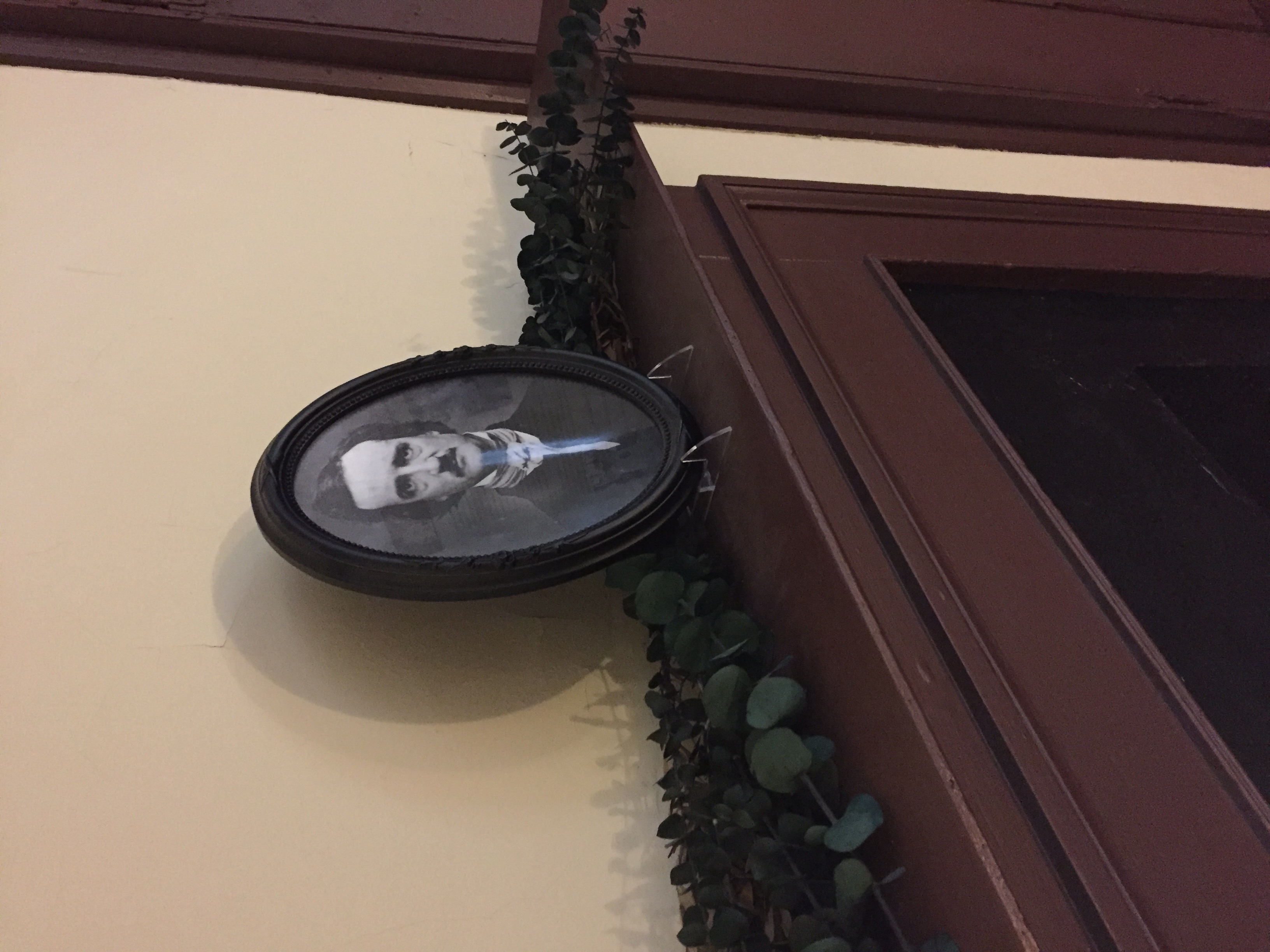
Poe House Baltimore


[1] Hutchisson, James M. Poe. University of Mississippi Press, 2005, p. 62.

[2] ibid., p. 57.

[3] Poe, Edgar Allan. “Critical Notices.” Southern Literary Messenger, Vol. II, no. 5, June 1836, p. 447.

[4] Poe, Edgar Allan. “Original Review.” Saturday Evening Post, May 1, 1841.

[5] ¾. “Review of New Books.” Graham’s Magazine, May 1841, p. 249.

[6] Poe, Edgar Allan. “The Tell-Tale Heart.” The Annotated Poe, edited by Kevin J. Hayes, The Belknap Press of Harvard University Press, 2015, p. 265.

[7] Hayes, Kevin J. Annotations of “The Tell-Tale Heart,” by Edgar Allan Poe, The Annotated Poe, edited by Kevin J. Hayes, The Belknap Press of Harvard University Press, 2015, p. 259.

[8] ibid.


Images:

Image 1:

“Critical Notices” Southern Literary Messenger, Vol. II, no. 5, June 1836, pp. 445-460. Made available through Making of America Journal Articles, www.quod.lib.umich.edu

Images 2 and 3:

“Master Humphrey’s Clock By Charles Dickens. Part I. Containing The Old Curiosity Shop, and other Tales, with Numerous Illustrations, &c. &c.” Graham’s Magazine, May 1841, pp. 248-251. Original image held by Indiana University, made available through the Hathi Trust, Digital Library, www.catalog.hathitrust.org.

Image 4:

Image of Poe from the Edgar Allan Poe House, Baltimore, Maryland.  Photograph by the author. www.poeinbaltimore.org


Works Cited:

Poe, Edgar Allan. “The Tell-Tale Heart.” The Annotated Poe, edited by Kevin J. Hayes, The Belknap Press of Harvard University Press, 2015. 259-265.

“Critical Notices.” Southern Literary Messenger, Vol. II, no. 5, June 1836, pp. 445-460.

“Original Review.” Saturday Evening Post, May 1, 1841.

“Review of New Books.” Graham’s Magazine, May 1841, May 1841, pp. 248-251.

Hutchisson, James M. Poe. University of Mississippi Press, 2005.

Filed Under: Research Blogs

‘The Private Space of Police and Prison’ by Sam Saunders (Liverpool John Moores University)

January 6, 2017


Sam Saunders is a current PhD candidate at Liverpool John Moores University, where he is researching the role of the periodical press on the construction and evolution of Victorian detective fiction. His research explores non-fiction periodical discussions on the police and crime, as well as early examples of serialised crime fiction. Sam has previously written for the British Association for Victorian Studies and is a regular contributor to the Huffington Post UK. He is also completing articles for the Journal of the Police History Society and the Law Crime and History Journal, due to be published later this year.

You can find him on twitter @samfordsaunders or by email at s.j.saunders@2014.ljmu.ac.uk


The Private Space of the Police and the Prison: Periodicals and the Voyeuristic View of Victorian Law Enforcement

In this post, I intend to highlight the voyeuristic aspects of nineteenth century crime fiction and articles on crime published in mid-nineteenth century periodicals, and relate this to the chronology of crime fiction. I will explore the interest in making the private world of criminality and law enforcement public, and suggest how this aspect of periodical writing can help augment our understanding of the crime fiction genre and its evolution.

One of the earliest places where we can see a voyeuristic interest in readers of crime literature is eighteenth and early nineteenth century execution broadsides. This has already received some scholarly attention; in her book The Rise of the Detective in Early Nineteenth Century Popular Fiction, Heather Worthington argues:


…the broadsides made their appeal to the voyeuristic interests of the masses, exposing the gory and sometimes salacious details of the crimes and making public what had been private.[i]


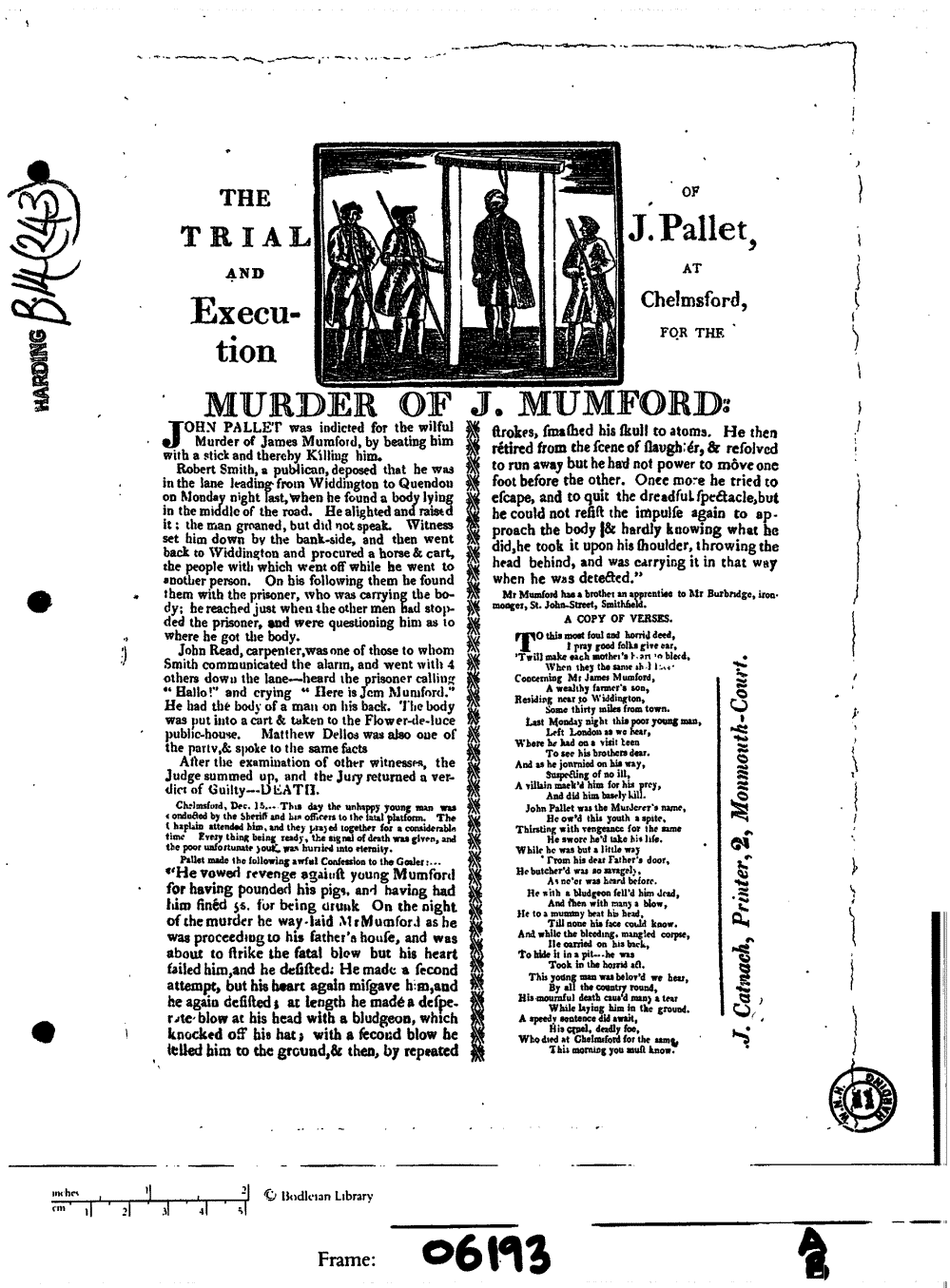
Worthington here refers to execution broadsides when she argues that they appealed to the voyeuristic interests of the masses and presenting a public view of hitherto ‘private’ spaces. However, this can also be readily applied to Newgate Calendars and other early crime writing designed to ‘render the private public’. Execution broadsides were popular throughout the late eighteenth and early nineteenth centuries, written and sold by peddlers at public executions. They were single-sheet, heavily sensationalised accounts of the lives of criminals, their crimes that led them to the gallows and a usually graphic description of the executions or other punishments. They also usually included a crude woodcut of the execution taking place, and the prose was often accompanied by a piece of penitent verse, usually printed surrounding the details of the crime and a crude, generic woodcut of the execution taking place (see fig. 1).

sam-aunders-fig-1
Figure 1: Broadside detailing the execution of J. Pallet. Bodleian Library, University of Oxford, online resource available at http://ballads.bodleian.ox.ac.uk/static/images/sheets/10000/06193.gif (dated between 1813-1838)


On one hand, execution broadsides publically demonstrated ‘sovereign or state power … encapsulated in pictures and prose and the spectacle of execution reached a wider audience than would have been possible in reality.’[ii] This complements the purpose of the public execution itself, however the broadsides’ alternative purpose was to entertain, and the provision of moral, social or religious instruction remained more a pretence as opposed to the main reason for broadside publication.[iii]

This tension between information and entertainment highlights the execution broadside as a space where a public desire to see ‘inside’ the private arena of the criminal world can be identified.  Execution broadsides complemented a spectacle that was already publically visible, and the detail as to why this particular person had been condemned by the state was therefore a matter of public interest.

Picking up on the broadside’s popularity, The Ordinaries of Newgate began publishing their own versions from inside the prison. These accounts of criminal misdeeds and executions were known collectively as the Accounts of the Ordinaries of Newgate, and were much less sensationalised than common broadsides. The Ordinaries’ access to criminals also gave them an extra edge over the broadside; they could obtain information that a street-seller could only speculate about.[iv] Their widespread popularity reveals a public desire to see inside the private space of the prison – contextual information surrounding a criminal and a highly public execution proved very popular.

Both publications were eventually collated and published as a volume – publications known as The Newgate Calendar(s). The first of these to appear under this name appeared in 1773.[v] These became less focused on executions, and more interested in criminals’ lives. Each story was focused on a specific criminal, their crime and their punishment, and again we see a form of crime-writing that renders a private space public – in this case the life and misdeeds of a stranger, either contemporary or historical. These accounts also often depicted a narrative of the proceedings that took place inside the court-room, another private space that this kind of writing rendered public.

Some issues of the Newgate Calendars were subtitled ‘Comprising Interesting Memoirs the Most Notorious Characters who have been Convicted of Outrages on The Laws of England’. The concept of a ‘memoir’ suggests a link to a form of writing that emerged in the mid nineteenth century that continued the voyeuristic interest of readers – police memoir fiction. One of the first examples appeared in 1827, titled Richmond, or, Scenes in the Life of a Bow Street Runner and is attributed to Thomas Sturr, though it was anonymously published. The text surrounds the life of John Richmond, a Bow Street Runner – one of the first organised groups of law-enforcement prior to the establishment of the Metropolitan Police in 1829.  It was not published in a periodical, but as a three-volume novel. However, it fits into the memoir-style category by relating Richmond’s life and his experiences in the Runners as if he were relating a tale to the reader after he had left. For example, Richmond reflects on his memories of joining the Runners:


My first adventure in my new capacity [as a Runner] gave me a strong interest in the sort of life I had now adopted, and compensated for many of the awkward and disagreeable feelings which I had to undergo. I was by this time tolerably well acquainted with London; but was personally a stranger to police transactions, and everything at Bow Street was new to me.[vi]


There are, however, some aspects that distinguish Richmond from later police memoir writing. It is too biographical – the first half is devoted to Richmond’s childhood and early-adult experiences – his adeptness at playing pranks, his schooling, his first love-interest (who tragically dies early on) and his experiences of early adulthood living amongst gypsies. These details are not completely irrelevant; by using this contextual information the novel creates a sophisticated plot-relationship between the two halves of the story, using details from the first to create the second. For example, the loss of Richmond’s first love-interest disassociates him from emotional ties and allows him to undertake the antisocial occupation of a police officer free from emotional attachments. Secondly, Richmond’s life among gypsies prior to starting as a Runner gives him connections in the criminal underworld which he uses as accomplices or for information in his exploits.

This novel is therefore a sophisticated yet isolated example of a police memoir, as later examples of this genre published in the mid-century and in periodicals cannot as effectively use the early life of the character as effectively to set up their narratives. Despite its isolation both chronologically and formulaically, it is an example of a police memoir that continues the theme of allowing readers to see inside a private space, and as such deserves recognising as a milestone in the genre’s development.

In the 1850s and 1860s, police memoir fiction became a popular feature in periodicals, frequently emerging in the pages of a variety of titles. A prolific author was the largely unknown William Russell – distinct from the more widely remembered William Clark Russell. Russell was a writer living in London throughout the 1850s, contributing significant amount of fiction to periodicals and magazines – notably Chambers’s Edinburgh Journal and The Sixpenny Magazine before its untimely demise.

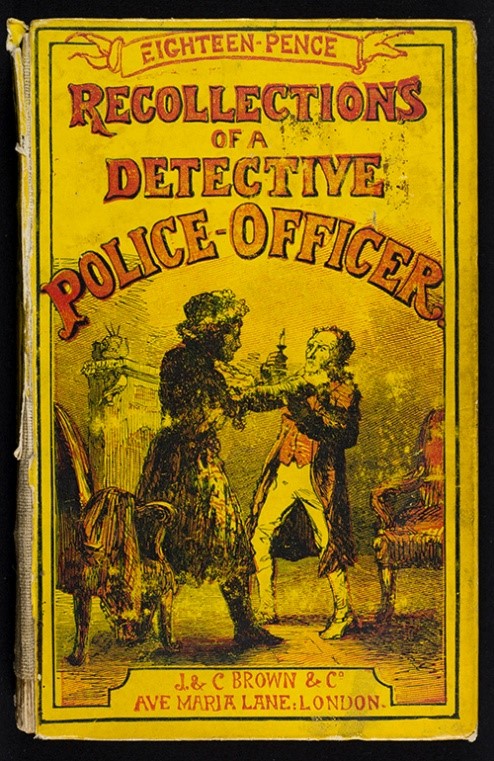
Russell’s earliest example was published in Chambers’s Edinburgh Journal between 1849 and 1853, entitled Recollections of a Police Officer. It was an example of pseudo-non-fictional insight into the police force, designed to appeal to the reading public’s curiosity about the police and provide a literary window into the police force. The serialised publication in Chambers’s proved popular enough for the stories to be collected into a three-volume collection in 1856 (see fig. 2). However, it was retitled Recollections of a Detective Police-Officer.

sam-saunders-fig-2
Figure 2 – Recollections of a Detective Police Officer, London; J&C Brown and Co. (1856) – available at http://www.indiana.edu/~liblilly/etexts/detective/images/pr5271-r8-r22_00001.shtml

Crucially, the collection of the stories into one three-volume edition added the opportunity to justify, or perhaps explain, the idea behind the creation. In a newly-added preface, Russell argues:


I, therefore, offer no apology, for placing these rough sketches of the police experience before the reader. They describe incidents more or less interesting and instructive of the domestic warfare constantly waging between the agents and the breakers of the law…[vii]


Russell informs us that these stories are specifically designed to give the reader an inside-view into how the police operated, and he remained interested in this genre as it developed. Perhaps his most widely distributed example of memoir fiction was Experiences of a Real Detective, published in The Sixpenny Magazine in 1862. In the first instalment, published in March 1862, Russell argues:


“Detective” literature, if it may be so called, appears to have acquired a wide popularity, chiefly, I suppose, because the stories are believed to be, in the main, faithfully-told, truthful narratives. I have read them all, and need hardly say have discovered mistakes that proved to me that the best, most popular of them were the handiwork of a literary man, not the records of an actual experience. I have frequently made remarks in this sense to my friends, several of whom thereupon suggested that I should publish my own real experiences.[viii]


This is an aggressive passage with which to open a new set of stories about the exploits from within the police force. It suggests a growing awareness by the author that detectives and police officers are proving to be popular figures in cheap, accessible and widely published literature. Secondly, the idea of ‘detective literature’ here specifically refers to memoir fiction, suggesting that the perceived nature of ‘detective fiction’ at this time was memoir fiction. The passage specifically points to the fact that the point of the genre was to relate the experiences of a real police officer to the reader. This is unlikely to be true, however it suggests the fact that these narratives were specifically designed to appeal to the voyeuristic interests of readers.

Police memoir writing performed two overall tasks. It began to blend non-fiction with fiction, as it was influenced by much earlier genres of non-fictional crime literature. By looking ‘inside’ the police force, a police memoir style of writing offered a new perspective to experience criminality for readers by following the police officer, rather than the criminal. These memoir writing narratives did however keep an element of the ‘non-fiction’ marketing that these earlier genres also maintained.

The second task that memoir writing performed was help to proliferate understanding of the operational structure and social remit of the police force as an everyday organisation after 1856.The police were often seen as a physical manifestation of Governmental influence in far flung regions away from London, and police memoir-writing allowed readers to get a more first-hand, internal view of the force. It also helped to lay the foundations for later, more recognisable detective fiction.


Endnotes

[i] Worthington, H., The Rise of the Detective in Early Nineteenth Century Popular Fiction, Basingstoke: Palgrave Macmillan (2005), p. 7

[ii] Ibid., p. 7

[iii] Ibid., pp. 6-8

[iv] Ibid., p. 7

[v] Knight, S., Form and Ideology in Crime Fiction, Basingstoke: Macmillan (1980), p. 9

[vi] ‘Richmond’ (attrib. T. S. Surr), Richmond, or, Scenes in the Life of a Bow Street Runner, New York: Dover Publications (1976) (orig. published 1827), p. 89

[vii] Russell, W., Recollections of a Detective Police-Officer, London: J&C Brown and Co. (1856), p. vi

[viii] ‘Experiences of a Real Detective’, The Sixpenny Magazine, March 1862, p. 325


Bibliography

‘Experiences of a Real Detective’, The Sixpenny Magazine, March 1862, p. 325

‘Richmond’ (attrib. T. S. Surr), Richmond, or, Scenes in the Life of a Bow Street Runner, New York: Dover Publications (1976) (orig. published 1827), p. 89

Knight, S., Form and Ideology in Crime Fiction, Basingstoke: Macmillan (1980), p. 9

Russell, W., Recollections of a Detective Police-Officer, London: J&C Brown and Co. (1856), p. vi

Worthington, H., The Rise of the Detective in Early Nineteenth Century Popular Fiction, Basingstoke: Palgrave Macmillan (2005), p. 7


Filed Under: Research Blogs

January 4, 2017

The Gale Dissertation Research Fellowship in Nineteenth-Century Media

The Research Society for Victorian Periodicals (RSVP) is pleased to announce that the eighth annual Gale Dissertation Research Fellowship is now open for applications. Made possible by the generosity of publisher Gale, part of Cengage Learning, the award is in support of dissertation research that makes substantial use of full-text digitized collections of 19th-century British magazines and newspapers. A prize of $1500 will be awarded, together with one year’s passworded subscription to selected digital collections from Gale, including 19th Century UK Periodicals and 19th Century British Library Newspapers.


Deadline:  February 1, 2017, for awards beginning in 2017
Award notification:  Not later than April 1, 2017.

Purpose: The purpose of the Gale Dissertation Research Fellowship is two-fold: (1) to support historical and literary research that deepens our understanding of the 19th-century British press in all its rich variety, and (2) to encourage the scholarly use of collections of full-text digital facsimiles of these primary sources in aid of that research.

Eligibility:

In order to be eligible for the award applicants must be enrolled as a postgraduate student at the time of entering the competition. They may be based in any academic discipline, but must be working on a doctoral dissertation or thesis that centrally involves investigation into one or more aspects of the British magazine and newspaper press of the 19th century. Preference will be given to projects that are interdisciplinary in approach, and that propose to use innovative methods of exploration that are uniquely possible with online collections. The digitized collections used in this research may include those created by any publishers or projects, whether commercial or non-commercial. Applicants who were unsuccessful in previous years are encouraged to apply again if they continue to meet the above criteria.

This year’s winner: RSVP is delighted to announce that the Gale Dissertation Research Fellowship for research to be undertaken in 2016 has been awarded to Amelia Joulain-Jay, a PhD. student in History at Lancaster University, for her work on using Geographical Information Systems and Corpus Linguistics methods to investigate how places were represented in nineteenth-century British newspapers.
Applications: Applicants should send a c.v. and the names and contact information of two scholars who are familiar with the applicant and his or her dissertation project; it is expected that one of these will be the student’s dissertation director. The project description (approx. 500-800 words) should concisely explain the aims of the proposed research and the key importance of the role of full-text digitized collections in that research. Applications for the Gale Fellowship for dissertation research to be undertaken in 2017 must be submitted in electronic form and sent to galefellowship@rs4vp.org by February 1, 2017. Any queries about the application may be sent to the same address. Notification will take place by email not later than April 1, 2017. The successful applicant will be expected to submit a brief report to RSVP at the conclusion of the funded portion of the project, describing the results of the research.

https://archive.rs4vp.org/2708-2/

Filed Under: Graduate News

Call for Papers – RSVP 2017

October 3, 2016


We are delighted to announce that the call for papers is now open for our next conference Borders and Border Crossings (website link to follow). The conference will take place at Freiburg University, Germany, 27th – 29th July 2017.

Call for Papers

Victorians reached out not only to rule the world but even more so to explore it in travel, scientific endeavour or in search of new experiences. Victorian periodicals reported on these experiences, and gave advice or warnings. As the 2017 conference is taking place in the border country of Germany, Switzerland and France, its special interest will be on borders and border crossings. Though geographically part of Europe, Britain has always seen the continent very much as ‘beyond’ its borders and travels to the continent, as much as travel around the globe, as a form of ‘border crossing’. Papers might explore engagements with the continent as explorations of a culturally superior or fascinating as well as repelling or perhaps threatening foreign ‘other’ and in connection with national self-perceptions as much as attempts to understand other cultures. Of particular interest for this conference are:

  • explorations of the European continent in travel reports,
  • historical accounts,
  • discussion of political systems,
  • report on revolutions (f. ex. in France, Germany, Italy),
  • war correspondence,
  • descriptions of national character,
  • the continent as location in fiction,
  • engagement with continental literature,
  • fine arts and music,
  • experiences of continentals in Britain,
  • fashion reviews,
  • visual depictions of the continent,
  • reports on royal houses
  • comparisons between Britain, Europe and other continents
  • American/European relations and American views of Europe in periodicals

Papers might also address

  • gender boundaries and their transgression
  • genre borders and border crossings (within periodicals as well as between periodicals and other media)
  • contacts and exchanges between British and foreign periodicals.

The programme committee invites proposals for a special session on women’s history and Victorian periodicals in memory of Sally Mitchell, a longstanding member of RSVP and pioneer in this field.

Suggestions for papers of a more general nature will also be considered.

RSVP is an interdisciplinary and international organization welcoming all scholars interested in the richly diverse world of the 19th-century British press. Please send a proposal (250 words maximum) and a short CV (no more than 200 words) to rs4vp2017@gmail.com by 31st January 2017. Individual presentations should be fifteen to twenty minutes, and proposals for panels of three are welcome. Please include a brief rationale for the panel along with an abstract and CV for each presenter.

Of particular interest to graduates – A limited number of travel grants will be awarded to graduate students; please indicate in your email if you would like to be considered for one of these grants.

Organisers

Prof. Dr. Barbara Korte, Dr. Stefanie Lethbridge. Both lecturers at the English department of Freiburg University.

Filed Under: Graduate News

  • Page 1
  • Page 2
  • Page 3
  • Go to Next Page »

Footer

Search Our Site

Visit Our Blog

Connect with Us

  • Facebook
  • Twitter
  • YouTube

Copyright © 2026 · Genesis Sample on Genesis Framework · WordPress · Log in