• Skip to primary navigation
  • Skip to main content
  • Skip to footer
RSVP

RSVP

The Research Society for Victorian Periodicals

  • Home
  • About
    • Join RSVP
    • Privacy Policy
  • Grants and Prizes
    • Award Calendar
    • Curran Fellowships
    • Linda H. Peterson Fellowship
    • Patrick Leary Field Development Grant
    • Colby Book Prize
    • Sally Mitchell Dissertation Prize
    • Rosemary VanArsdel Prize
    • VPR Expanding the Field Prize
    • Conference Travel Awards
  • Conference
    • Past Conferences
  • VPR
  • Resources
    • Teaching Materials
    • RSVP Digital Salon Resources
    • RSVP Bibliography
    • VanArsdel Bibliography
  • News & Events
  • Contact

periodicals research

Discoveries and Surprises in The Salvation Army’s Prolific Press

March 27, 2020

by Flore Janssen

The Salvation Army and its Archive

At first glance The Salvation Army may seem like a world unto itself. The global church and charity grew out of the East London Christian Mission begun by preachers William and Catherine Booth in 1865. It is characterised by its own uniform, customs, and vocabulary. Its ministers are ‘officers’ with military-style ranks, its members are ‘soldiers’, its churches are ‘corps’. Its religious services feature their own repertoire of songs and take place in halls or ‘citadels’ in which a ‘mercy seat’ is a requirement. Yet in spite of this institutional singularity, the organisation, its emblematic red shield, and its magazine the War Cry are recognised around the world.

Outreach, social as well as religious, has been at the heart of The Salvation Army’s activities from its beginnings. The organisation has always responded to issues and events that concern the communities in which it works. As a result, the collections at The Salvation Army’s International Heritage Centre in London touch on a wide range of unexpected subjects including labour disputes, war-time civilian internment, and cookery. The Heritage Centre blog highlights surprising topics from women’s suffrage to vegetarianism.

Salvation Army Periodicals

The Heritage Centre’s large collection of periodicals issued by The Salvation Army around the world since the 1860s often bridges the gaps between the organisation’s internal workings and the wider world. As well as public-facing periodicals like the War Cry and its many international and multilingual variants, the collection includes publications aimed at The Salvation Army’s own vast and diverse membership. Examples include the Local Officer (1897–1908), targeted at non-ordained Salvationists holding positions of responsibility in their local corps, and the Salvationist, launched in 1986 ‘for everyone linked to The Salvation Army’.
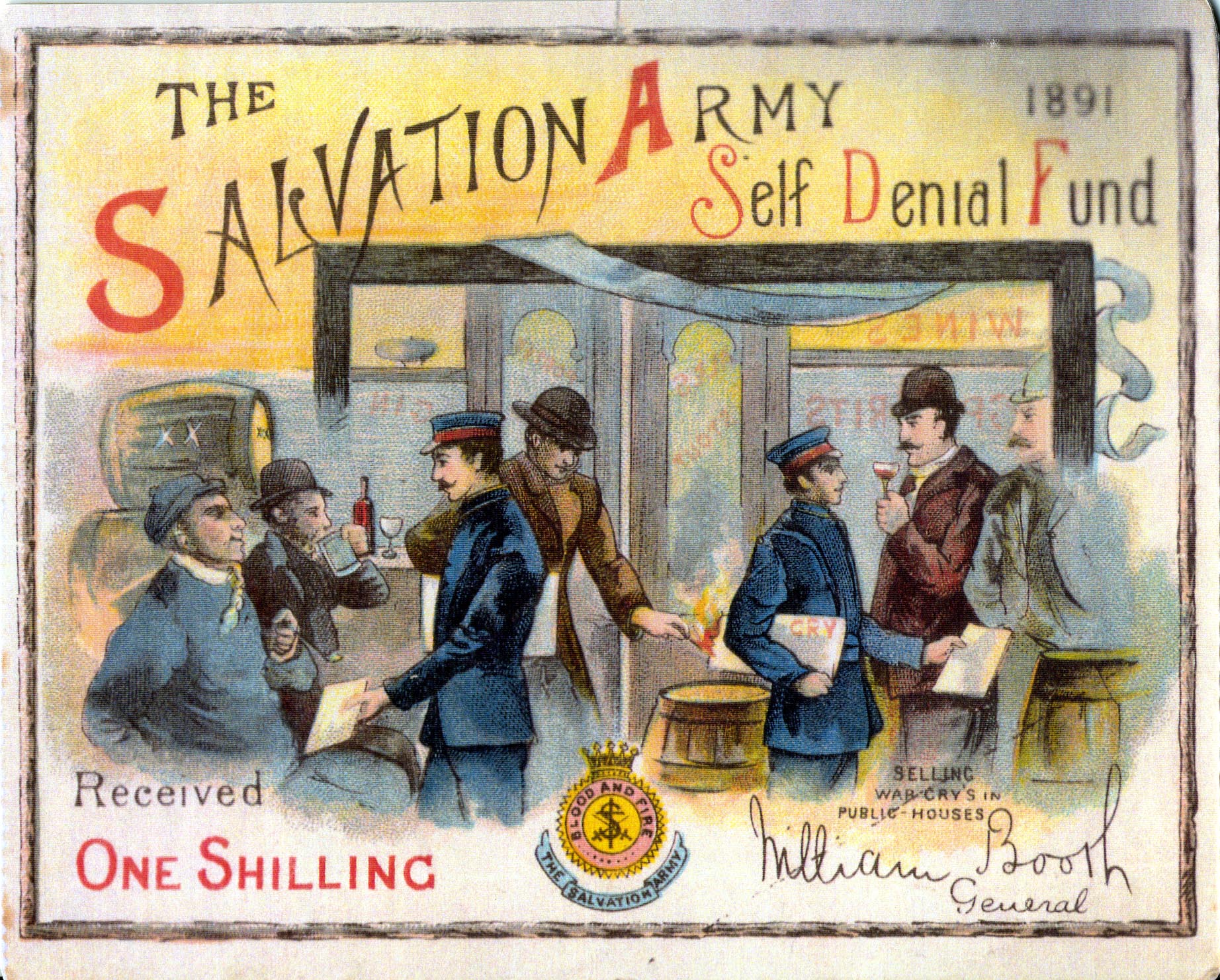
Illustrated card acknowledging one shilling donated to The Salvation Army Self Denial Fund 1891, depicting Salvationists selling War Crys to hostile drinkers in a pub.
Figure 1: Donation acknowledgment featuring an illustration of War Cry-selling in a pub, 1891. All images in this post are from The Salvation Army International Heritage Centre’s collection.

The Salvation Army press has always aimed for a wide appeal, and this is mirrored in the variety of its content. The War Cry marked its 140th anniversary in December 2019 and continues to be sold to the public for the nominal price of 20p. Today, a typical issue may contain a review of a blockbuster film or popular TV show, an article on a community project, a cartoon, puzzles, and a recipe section. Many of these features have been established for decades to provide readers with information, spirituality, entertainment, and practical advice.

Recipes helped readers discover vegetarianism in the nineteenth century or cook under rationing during WWII. Book reviews guided Salvationists’ reading from the time when the organisation’s religious principles proscribed novels. Short and serial fiction narrated stories of redemption or illustrated social problems. Religious and social themes were explored through poetry and songs, sometimes with sheet music. The free legal advice column ‘Poor Man’s Lawyer’ first appeared in the Darkest England Gazette (1893–4) but survived this short-lived platform to be carried forward into its successor the Social Gazette (1894–1917) and later into the War Cry.
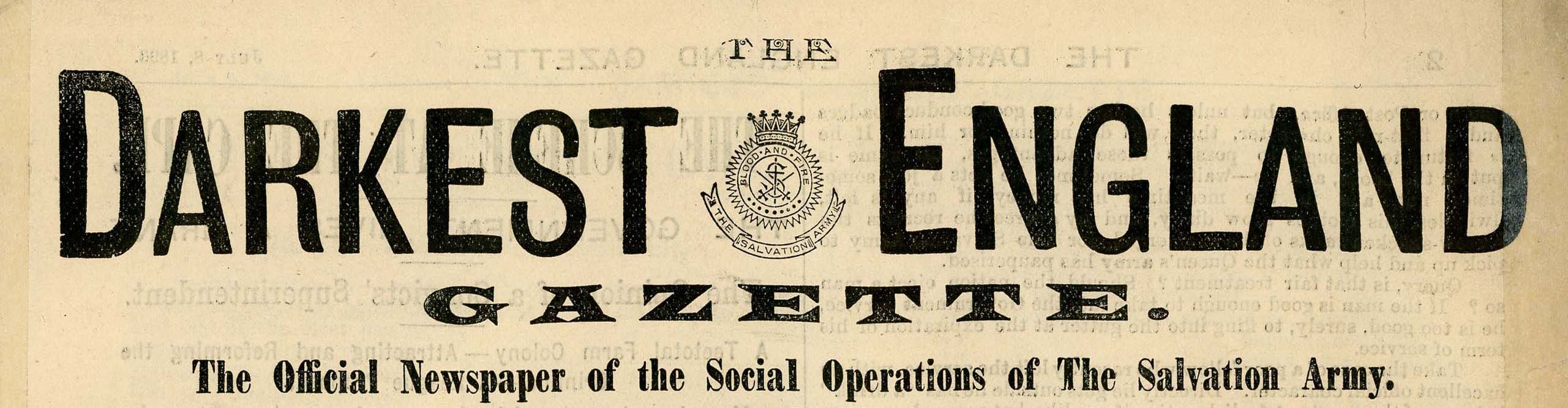
The Darkest England Gazette: The Official Newspaper of the Social Operations of The Salvation Army.
Figure 2: Masthead of the Darkest England Gazette.

The Darkest England Gazette

As Digital Humanities Project Officer I work closely with the Darkest England Gazette, a weekly publication dedicated to The Salvation Army’s ‘social operations’. It is one of the first periodicals included in the Heritage Centre’s pioneering digitisation project and various issues and articles are already available as part of our Digital Collections.

Identifying contributors to the magazine requires detailed research both within the collection and in unexpected places outside it. The Salvation Army’s record-keeping systems were not formalised in the late nineteenth century so we sometimes have little reliable information about people named in the Gazette. As a result, rather than use our archive catalogue to identify officers from this early period, the periodical is providing us with information about them.

The Gazette’s focus on different aspects of the social work helps us to associate names with specific social projects and institutions. For example, we can now tell that an article about the rehabilitation of ex-prisoners signed F. S. is likely to have been the work of Ensign Fred Symons who worked in The Salvation Army’s first Prison-Gate Home, the ‘Bridge’ near King’s Cross in London, where released prisoners were offered accommodation and work.

On the other hand, some contributors who were prominent figures during the period are given no introduction in the periodical and have to be identified through wider research. Leading animal welfare campaigner Edith Carrington contributed articles and letters about vivisection to the Darkest England Gazette, but she seems to have had no other connection to The Salvation Army and does not appear in our records. Other research revealed that regular Gazette illustrator F. W. Boyington also illustrated sensation fiction for children.[1] While the nineteenth-century Salvation Army would certainly have disapproved of this, some Gazette illustrations do make use of this sensational style (Fig. 3).
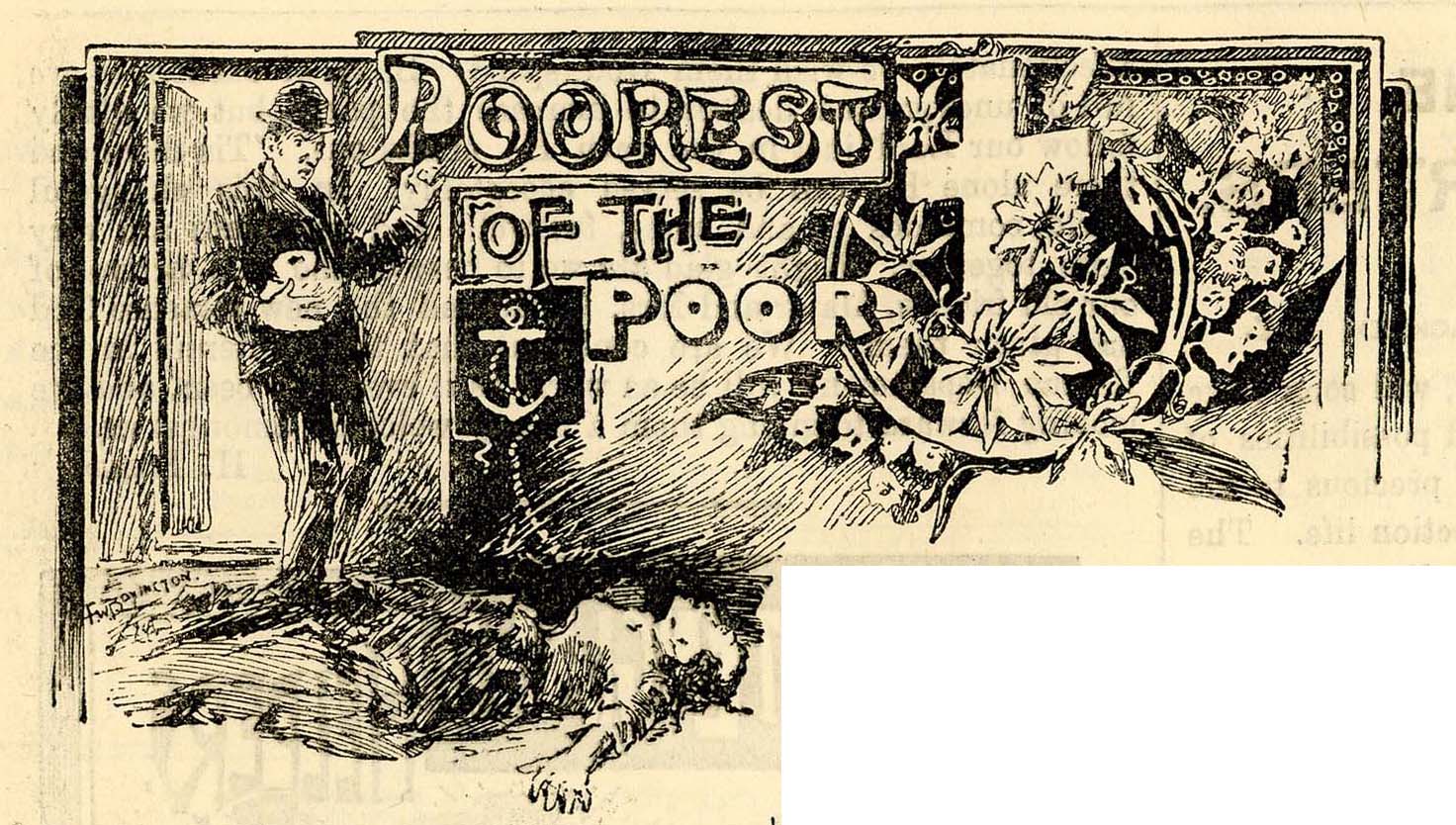
Illustration for an article titled ‘Poorest of the Poor’ showing a man entering a room to discover a dead woman lying on the floor.
Figure 3: F. W. Boyington, ‘Poorest of the Poor’, Darkest England Gazette, 24 March 1894, p. 8.

Research Leads in Periodicals

The long-standing, prolific, and diverse Salvation Army press is often one of the first avenues we recommend to researchers to explore. It covers an astonishing range of subjects, many of which surprise researchers who had not associated them with The Salvation Army. The topics are addressed in a wide variety of genres, from reportage to poetry and fiction, and the style of articles is as likely to be sensational or humorous as didactic or zealous. Discoveries in the periodicals may spark detailed investigations into our own archival collection or reveal links to other sources and repositories. In this way our periodical holdings frequently defy preconceptions about what can and cannot be found in the archives of The Salvation Army.

About the Author

Flore Janssen is Digital Humanities Project Officer at The Salvation Army International Heritage Centre. She conducted research for her own PhD (Birkbeck, 2018) in the archive and now works primarily with the historical periodicals in the collection. She also holds a Visiting Postdoctoral Research Fellowship at the Institute of English Studies, University of London.


[1] See for instance Popular Children’s Literature in Britain, ed. by Julia Briggs, Dennis Butts, and M. O. Grenby (London: Routledge, 2016).
Filed Under: Research Blogs Tagged With: from the archives, periodicals research

Introducing the Atlas of Digitised Newspapers and Metadata

March 6, 2020

By Emily Bell and M. H. Beals

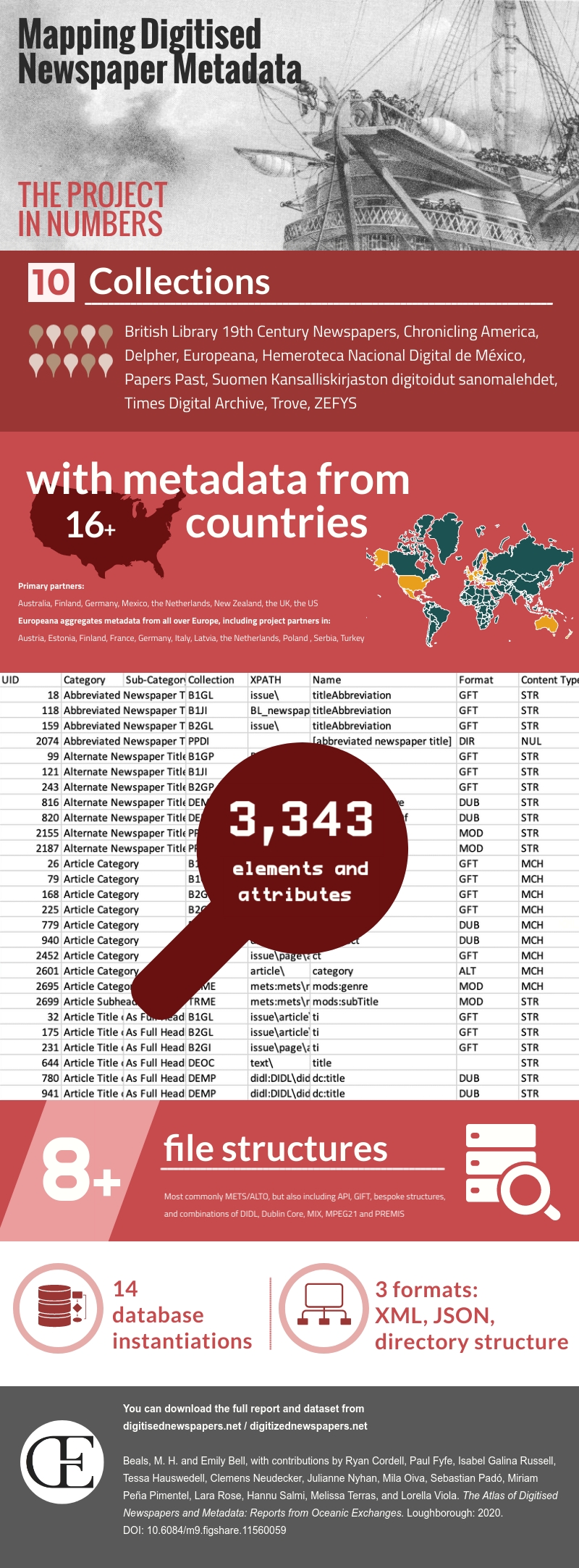
Infographic showing the data we worked with to create the Atlas of Digitised Newspapers and Metadata
Fig. 1. Infographic showing the data we worked with to create the Atlas of Digitised Newspapers and Metadata.

Just as the nineteenth-century newspaper was a messy object, filled with an ever-changing mix of material in an innumerable number of amorphous layouts, working with the structures of digitised newspapers is no different. While a user approaching a digitised newspaper collection through a glossy web interface and inputting keywords might not realise it, there are decades of decision-making processes still influencing what exactly it’s possible for that user to search for, and what they will find.[i] And if you’ve ever wondered why there isn’t one enormous search engine for newspapers and periodicals that aggregates global collections and makes them available in one place… well, this blog post will start to introduce the scale of the problem.

In January 2020, the ‘Oceanic Exchanges: Tracing Global Information Networks in Historical Newspaper Repositories, 1840-1914’ project, an AHRC/ESRC-funded ‘Digging into Data’ project that brought together a consortium of cultural historians, computational linguistics, literary scholars, digital curators, humanists, and computer scientists, launched a new resource for periodicals scholars (and anyone working with digitised newspapers): the Atlas of Digitised Newspapers and Metadata.[ii]

Working closely with the British Library 19th Century Newspapers, Chronicling America, Delpher, Europeana, the National Digital Newspaper Archive of Mexico, Papers Past, the National Library of Finland, the Times Digital Archive, Trove and ZEFYS, the project aimed to gain a clearer understanding of the ways these collections were built, both in terms of the institutional decision-making (i.e. selection decisions, funding and so on) and the metadata structure of newspapers within the collections.

Each of the databases contains a (theoretically) standardised collection of data, metadata, and images; however, the precise nature and nuance of the data is often occluded by the processes that encoded it. For example, if you’re looking for headlines only (as opposed to titles), you need a distinction that simply isn’t there. No true universal standard has been implemented, or even proposed, to facilitate cross-database analysis, encouraging digital research to remain within those existing institutional or commercial silos.

Optical Character Recognition and Optical Layout Recognition (also known as document layout analysis) also don’t currently allow for any sense of how the elements they analyse might change over time. Titles versus headlines is a good example. Headlines weren’t common in the UK until at least the 1870s, though they were introduced earlier in the US. Once headlines come in, it’s much easier to identify them as bigger blocks on the page (a spatial feature as much as a semantic one) but there is a large amount of variation between countries and even individual titles.

What we’re essentially pushing for is historically informed metadata that takes into account that the newspaper changed, and is still changing. This is to prevent an oversimplification that technology sometimes encourages: for example, most archives only digitise one newspaper edition per day, so those researching morning, afternoon and evening editions will find that many databases simply don’t have them.

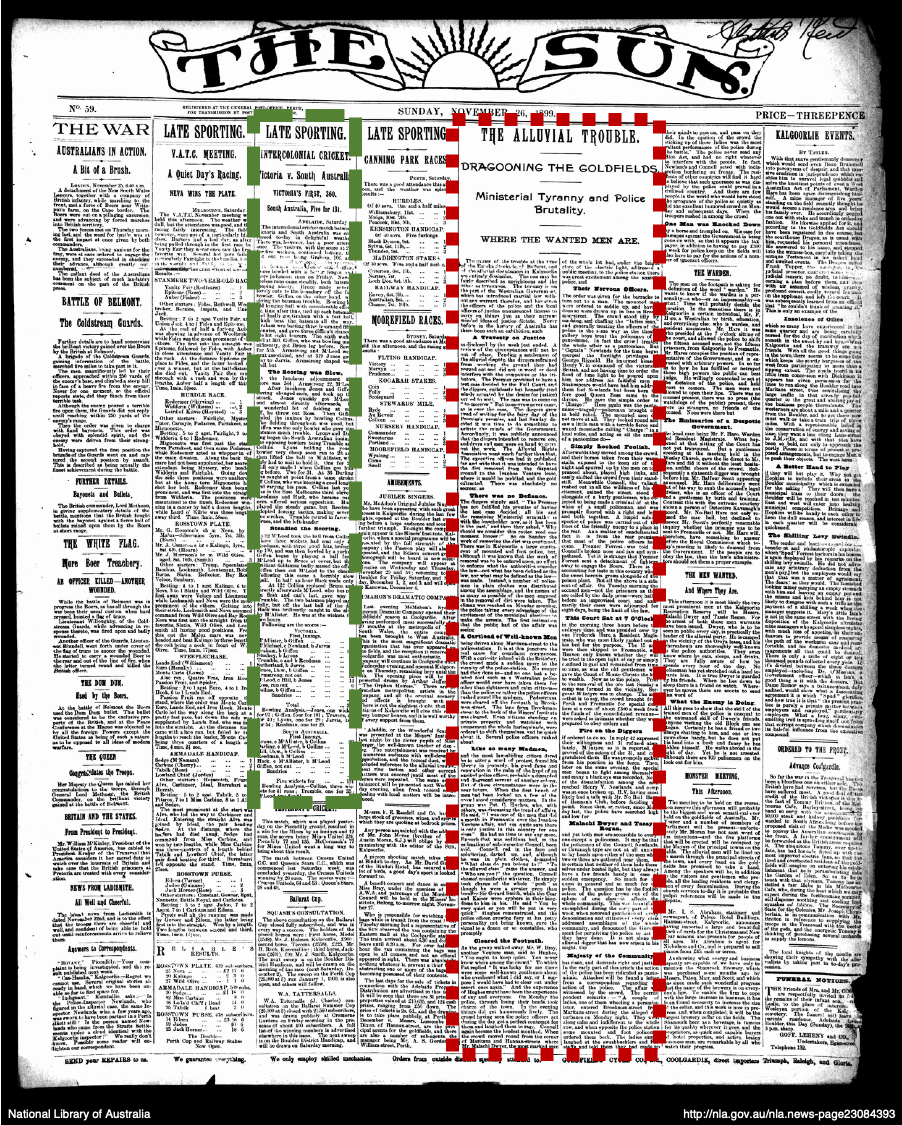
Picture of The Sun newspaper showing one article within a column containing several articles, and one article split into several columns.
Fig. 2. The Sun, 26 November 1899: 1. Web. 14 Feb 2020, http://nla.gov.au/nla.news-page23084393. Showing one article within a column containing several articles, and one article split into several columns.

Our open access report draws on ontologies of the file formats and ontologies and taxonomies of the newspaper itself, digitisation guidelines, the libraries’ websites, scholarly literature, grey literature (including digitisation strategies and annual reports), interviews with staff conducted in 2018, some shrewd use of rumours about institutional decision-making, and retro-engineering we’ve done ourselves. It offers abbreviated histories of the ten newspaper databases, including the chronology of their development, a discussion of each one’s aims and offerings, and a report on its current status and availability.

We tried to map all of the metadata fields – over 3300 different lines – directly, to find the same data in the different databases. This raised ontological issues not only in developing hierarchies and links between the fields of the various databases, but in understanding the vocabulary employed to describe elements and characteristics of the physical newspaper as well. In order to decide the structure, you need to consider the hierarchy of the newspaper. For example, is an article a smaller unit than a column? Or is a column a unit within an article (see fig. 2)? Does that remain the same throughout the nineteenth century and across different periodical types? Is a supplement part of an issue, or is it separate?

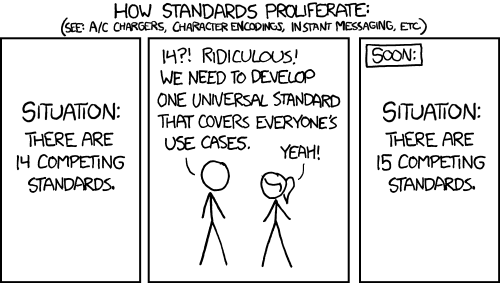
Image of xkcd cartoon, "Standards"
Fig. 3. ‘Standards.’ https://xkcd.com/927/.

What we found was that it isn’t possible to reconcile these problems without falling into the trap of trying to create our own standard, and digitisers and researchers recognise that actually the messiness is inherent in the newspaper as a complex and evolving form, rather than it simply being a problem of messy metadata. Simple concepts like “title”, “publisher” and “article” became very complicated, very quickly – for example, was it a standardised title, or the title as printed on the physical object, or a variant title? Did it include the subtitle and/or motto? Was the “article” the document type or the genre (i.e. in contrast to classified adverts and images?). The heart of the report is a newspaper glossary that takes this very technical detail about digitised newspapers and brings it into conversation with researchers and press history. This is to allow people to understand a) how the term is being used in different ways by different groups and b) to help people map the type of information they really want with the data that is available in these collections.

The Atlas is (we hope) a first step in a multidisciplinary conversation, and one with a primarily Anglophone focus. We’re now hoping to encourage new tools and approaches to collections using our dataset, and we’ve opened the Atlas to contributors. We hope RSVP members will explore it, and we’d be pleased to hear any feedback about how it might be used and expanded.

Download the Atlas:
Beals, M. H. and Emily Bell, with contributions by Ryan Cordell, Paul Fyfe, Isabel Galina Russell, Tessa Hauswedell, Clemens Neudecker, Julianne Nyhan, Mila Oiva, Sebastian Padó, Miriam Peña Pimentel, Lara Rose, Hannu Salmi, Melissa Terras, and Lorella Viola. The Atlas of Digitised Newspapers and Metadata: Reports from Oceanic Exchanges. Loughborough: 2020. DOI:10.6084/m9.figshare.11560059.


[i] Tessa Hauswedell, Julianne Nyhan, M. H. Beals, Melissa Terras and Emily Bell. ‘Of global reach yet of situated contexts: an examination of the implicit and explicit selection criteria that shape digital archives of historical newspapers.’ Arch Sci (2020). https://doi.org/10.1007/s10502-020-09332-1.

[ii] M. H. Beals and Emily Bell, with contributions by Ryan Cordell, Paul Fyfe, Isabel Galina Russell, Tessa Hauswedell, Clemens Neudecker, Julianne Nyhan, Mila Oiva, Sebastian Padó, Miriam Peña Pimentel, Lara Rose, Hannu Salmi, Melissa Terras, and Lorella Viola. The Atlas of Digitised Newspapers and Metadata: Reports from Oceanic Exchanges. Loughborough: 2020. DOI:10.6084/m9.figshare.11560059.

Filed Under: Research Blogs Tagged With: mining the archive, periodicals research, research projects

Footer

Search Our Site

Visit Our Blog

Connect with Us

  • Facebook
  • Twitter
  • YouTube

Copyright © 2026 · Genesis Sample on Genesis Framework · WordPress · Log in