• Skip to primary navigation
  • Skip to main content
  • Skip to primary sidebar
  • Skip to footer
RSVP

RSVP

The Research Society for Victorian Periodicals

  • Home
  • About
    • Join RSVP
    • Privacy Policy
  • Grants and Prizes
    • Award Calendar
    • Curran Fellowships
    • Linda H. Peterson Fellowship
    • Patrick Leary Field Development Grant
    • Colby Book Prize
    • Sally Mitchell Dissertation Prize
    • Rosemary VanArsdel Prize
    • VPR Expanding the Field Prize
    • Conference Travel Awards
  • Conference
    • Past Conferences
  • VPR
  • Resources
    • Teaching Materials
    • RSVP Digital Salon Resources
    • RSVP Bibliography
    • VanArsdel Bibliography
  • News & Events
  • Contact

RSVP News & Events

What’s So Funny About Buddhism? Unexpected Humour in the Late Victorian Popular Press by Emily Eiben (Ludwig-Maximilians-Universität München)

November 20, 2015


Emily Eiben is a PhD candidate in the department of Religious Studies at the Ludwig-Maximilians-Universität München. Her project focuses on the popularisation of Buddhism through the British periodical and newspaper press in the years 1875 to 1895 – between when the Prince of Wales visited the Buddha’s tooth in Ceylon in 1875 and when Sarah Bernhardt starred in a Buddhist-themed stage play in London in 1895. She is particularly fascinated by the way that pop culture and the media joined forces to create an enthusiastic new audience for a once little-known ‘heathen’ religion and the ways that this enthusiasm was fuelled by the British colonial encounter.

You can contact Emily at Emily.Eiben@campus.lmu.de.


What’s So Funny About Buddhism? Unexpected Humour in the Late Victorian Popular Press
joke 3

When I began exploring the depiction of Buddhism in the British newspaper and periodical press at the close of the nineteenth century, I was astounded by the diversity and sophistication of views I encountered in my sources. What really blew me away, though, was the surprisingly wide array of jokes, satires, and comics that the late Victorians produced about Buddhism and Buddhists. The Victorians thought Buddhism was funny? This was new. This comedic material—some of it still surprisingly funny 130 years later—shed a whole new light on the playfulness, wittiness, and sophistication of the Victorians’ encounter with Buddhism. More than any other discovery in the digital archives, my immersion in the unexpected humour of the newspaper and periodical press profoundly altered my understanding of my subject.


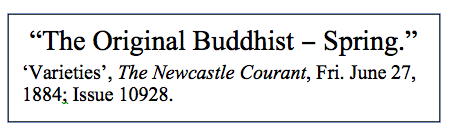
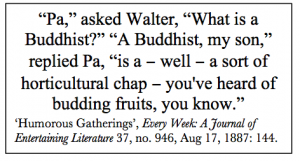
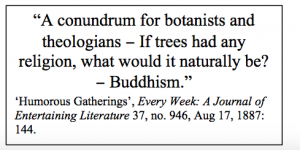
On the one hand, I stumbled across a plethora of groan-inducing one-liners about tree buds and ‘bud’-dhas, like the ones above, that feature a simple, straightforward style of humour based on the apparently universal Victorian penchant for puns and homonyms. This style of humour was designed to appeal to all ages, classes, and literacy levels; here were jokes that could be read aloud in the club, to a seatmate on the omnibus, or to the children on a Sunday afternoon. These one-liners encapsulated the ubiquity of talk about Buddhism in the 1880s; in my dissertation, they help me to demonstrate its total and seamless integration into everyday speech language and contexts.
joke 1But barbless and family-friendly was notthe only type of Victorian humour, of course, and many periodicals took a sharply satirical view of their contemporaries’ interest in Buddhism. This Victorian penchant for satire has received renewed academic attention in recent years, especially as digitisation has made it possible to locate larger amounts of comic material from a wider variety of sources. (Most will know of Bob Nicholson’s project, with the support of the British Library, to create a “Victorian Meme Machine” – see his blog here. I can’t wait to explore it!) In my dissertation I examine a number of sharply satirical pieces involving Buddhism that appeared in some of the most widely-read popular comic papers in the in the 1880s, such as Fun, Punch, and Judy. These are not one-liners and puns, but elaborate comedic setups whose decoding requires deeper analysis of their context. In many of the satires, the new interest in Buddhism presents itself as a lively and competitive option for an increasingly choosy (if overwhelmed) public – faced with the task of evaluating increasingly diverse options in the marketplace of religious ideas.

In one of my favourite specimens, the comic paper Fun sharpened its knives on the Victorian national-cultural obsession with the discovery of Buddhist relics in a satire from 1889 titled ‘The Latest Discovery.’[1] The satirical ditty is a direct commentary on British archaeologist James Campbell’s discovery near Asoka (India) in late 1888 of a fingernail supposedly belonging to the Buddha. The discovery was first reported in England by the Daily Telegraph, and the story was quickly picked up by the other major dailies—The Spectator and The Times—and then by evening society papers such as the Pall Mall Gazette. Fun‘s piece, published a scant week after the serious newspaper reports, appears close on the heels of the discovery and is obviously eager to take the wind out of its sails and make the whole episode look ridiculous. Fun‘s humorous ‘take’ on a serious archaeolojoke 4gical find transformed how I viewed the Victorians’ responses to such discoveries.
I also unearthed a plethora of quotes and quips that were strongly suggestive of how Buddhism formed part of the common cultural currency of the period. In many cases, a mere reference to the Buddha sufficed to imply a world of meanings. Most amusingly, in the political realm, both Disraeli and Gladstone were compared to Buddha when they wore passive or bored expressions in Parliament: “The Prime Minister [Disraeli] moves on sublimely indifferent to all that irresponsible and frivolous outsiders can speak or print. He appears, like Buddha, to be absorbed in contemplating with imperturbable self-satisfaction, his own perfections of his policy, and nothing can disturb his blissful reveries.”[2] The allusion was not party-specific: Gladstone, too, was described in 1883 as possessing that “bland passivity with which the image of the Buddha contemplates the prostrations of his adorers.”[3] (The likeness does seem more fitting for Gladstone than for Disraeli!) These short quips rely on a familiar interpretation of Buddhism that draws mainly on the remarkably persistent popular understanding of Buddhist nirvana as a passive cessation of interest and activity, if not a complete annihilation of personality. Here, too, was more evidence of exactly what I was hoping to prove in my dissertation: that Buddhism had been absorbed into the quotidian language of everyday men and women.

The jokes I found were instrumental in changing my approach to my subject and in deepening my appreciation of the sophistication with which the late Victorians tackled the cultural developments of their day. Specifically, these comedic materials assisted me in gauging the extent to which Buddhism had penetrated popular discourse, offering valuable evidence for understanding both the depth of knowledge as well as the types of associations that circulated in popular culture. Satire, in particular, is tightly bound to popular culture in a mutually (de)constructive way and offers unique insights into contemporary cultural concerns. Most of the jokes I discuss in my dissertation work with, and play off, other contemporary discourses; most are only obliquely funny (if at all) until one probes the social context of the joke and the frameworks of knowledge that undergird it.
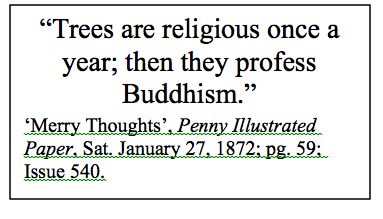
joke 2

Finally, these comic materials bear powerful witness to the active role played by the mass media and popular culture in shaping contemporary opinions. The jokes I mention here are creative and constructive (rather than merely derivative); they use contemporary forms and formats to comment on what was, at the beginning of the Victorian era, still a highly specialised topic for academics and missionaries. Comic magazines such as Punch and Fun as well as family magazines such as All the Year Round, played a central role in translating serious, abstruse Buddhism into the language of popular culture. This insight was instrumental in transforming how I understood the late Victorians’ talk about Buddhism. The wry, winking humour of the popular periodicals provided a much-needed antidote to the moral seriousness and intellectual intensity that one finds in more ‘serious’ periodicals, and reminded me again and again that—contrary to popular contemporary stereotypes—the Victorians may actually have had a better sense of humour than we do. It was in their jokes, of all places, that the Victorians really came alive to me, practically leaping off the pages into the present with a sense of humour that works across time.


[1] “The latest discovery.” Fun. April 3, 1889, 149.

[2] “Summary of the Week.” Manchester Times (Manchester, England), Saturday, August 9, 1879; Issue 1129.

[3] Aberdeen Weekly Journal (Aberdeen, Scotland), Friday, October 12, 1883; Issue 8944.
 

Filed Under: Research Blogs

Call for Contributors: RSVP Bibliography 2013-15

October 14, 2015

CALL FOR CONTRIBUTORS – RSVP Bibliography 2013–2015

The Research Society for Victorian Periodicals is seeking contributors to its biennial bibliography, which will be published in Victorian Periodicals Review in fall 2016. Contributors to the bibliography are asked to adopt three to ten scholarly journals from a list, identify articles published between December 2013 and December 2015 that have direct relevance to the study of Victorian journalism, and compile a list of annotated entries. All contributors are acknowledged in the published bibliography. Entries will be due May 2, 2016. If you are interested in contributing to this project or can recommend someone, please email biblio @ rs4vp.org for the complete guidelines and list of journals.

Katherine Malone, Ph.D., Assistant Professor of English, South Dakota State University

Bibliographer, Research Society for Victorian Periodicals

biblio @ rs4vp.org /

Filed Under: RSVP News

CFP 5th Annual Conference of ESPRit @ LJMU 2016

October 14, 2015

CALL FOR PAPERS

The 5th International Conference of the European Society for Periodical Research (ESPRit), www.espr-it.eu

7-8 July 2016
Liverpool John Moores University, UK

From the Black Dwarf to the little magazines of the European avant-gardes, from protest literature of the industrial revolution to the samizdat publications of the Soviet Bloc, from Punch to punk, periodical publications have long been associated with a challenge to dominant and mainstream culture. For ESPRit 2016 we return to this aspect of periodical culture, exploring the counter-cultural role of periodicals with particular emphasis on comparative and methodological points of view. Proposals are invited on topics that include, but are not limited to, the following areas:

  • Periodicals as sites for the genesis and dissemination of counter-cultural ideas, programmes, and manifestos
  • The assimilation of periodical counter cultures into the tradition
  • Theoretical and methodological approaches to the periodical as counter culture and as establishment
  • The agency of periodicals at threshold moments of social, political, and cultural change
  • Illegal and underground publications
  • The interplay between established periodicals and radical newcomers
  • Change and disruption in the history of long-standing periodicals

ESPRit encourages proposals that speak both within and across local, regional and national boundaries and especially those that are able to offer a comparative perspective. We also encourage proposals that examine the full range of periodical culture, that is, all types of periodical publication, including newspapers and specialist magazines, and all aspects of the periodical as an object of study, including design and backroom production.

Please send proposals for 20-minute papers (max 250 words), panels of three or four papers, round tables, one-hour workshops or other suitable sessions, together with a short CV (max. one page), to 2016esprit@gmail.com. The deadline for proposals is 25 January 2016.

Filed Under: RSVP News

CFP “Copying and Copyright in 19th-Century British Newspapers and Periodicals”

October 4, 2015

“Copying and Copyright in 19th-Century British Newspapers and Periodicals”

Conference and special issue of Victorian Periodicals Review

Université Paris Diderot, 16-17 March 2017


Despite the importance that newspapers, magazines, and other periodicals had for authors and readers in nineteenth-century Britain, the scholarship on copyright during this period remains book-centered.

Most studies of serials pay little attention to questions of copyright, and most studies of copyright barely mention serials. What features of newspapers and periodicals made them different from books, and to what extent did these differences matter to authors, readers, legislators, and judges? What rules did writers, editors, and publishers develop to regulate (or not) the copying and republication of texts and images? How did norms related to plagiarism and authorial attribution change during this period? What effects, if any, did legislation and case law have on the practices of publishers or the expectations of readers?

As part of a multi-year project on “Copyright Law and Publishing Practice” funded by the Institut universitaire de France (IUF), this conference seeks to bring together scholars from several disciplines (history, literature, law, art history, musicology, etc.) working on the full range of material published in nineteenth-century serials (fiction, poetry, biography, essays, news, musical scores, engravings, half-tones, etc.). Confirmed participants will be asked to draft their contributions in advance of the conference and then to revise their articles for publication in a special issue of Victorian Periodicals Review. Although the following list is not exhaustive, we invite proposals for:


–              Case studies that focus on a single publication, a slice of legislative history, a court case, or a dispute as it played out in the press;

–              Studies that chart changes in author-publisher relations or copyright registrations; shifts in cultural norms related to excerpting and copying texts and images; evolving attitudes toward literary property and public access; the role of technology, business practice, and/or political culture in shaping contemporary understandings and uses of copyright.

–              Whatever the precise subject, it is hoped that authors will consider the relationship between law and publishing practice.


Contributions that discuss newspapers or periodicals in the British colonies, or the international dimensions of copyright, would also be welcome.


Interested scholars should submit a 1-page abstract of their proposed article and a short CV (2 pages) by 1 April 2016. Proposals will be vetted by an interdisciplinary committee, with decisions made by 30 June 2016. During the conference, plenty of time will be set aside for discussion of the draft essays, and senior scholars in law and the humanities will provide feedback in view of preparing the final publication. Some funding will be available to cover lodging in Paris during the conference.

Please send proposals to:

Will Slauter

Laboratoire de recherches sur les cultures anglophones (LARCA), Université Paris Diderot Institut universitaire de France (IUF)

Email: wslauter@univ-paris-diderot.fr

Filed Under: RSVP News

RSVP ANNUAL CONFERENCE CFP 2016 – UNIVERSITY OF MISSOURI-KANSAS CITY

October 4, 2015

BIGGER, Better, More! — Growth and Expansion in the Victorian Press
University of Missouri-Kansas City, September 9–10, 2016

The Research Society for Victorian Periodicals invites proposals for its 2016 conference on the theme of growth and expansion in the Victorian press. We encourage broad interpretation of what “Bigger, Better, More!” means for Victorian newspapers and magazines, with possible topics including:

• Proliferation of news events, headline stories, scandals
• Serialization, sequels, symposia, rejoinders,
recurring columns
• Developments in printing technology, formats,
editorial vision
• Increased readership, population, urban and imperial
expansion
• Economic growth, profits, investments, windfalls,
boom-and-bust cycles
• Excess, hyperbole, filler
• Malignant growth, plagues, floods, parasites
• Natural growth, plants, parks, green spaces
• Education, maturation, age, experience, longevity
• Emerging taxonomies, catalogs, indexes, censuses
• Developing networks, movements, professional and
amateur organizations, bureaucracies
• Growth of periodical studies, methodologies, pedagogies, archives

RSVP is an interdisciplinary and international organization welcoming all scholars interested in the richly diverse world of the 19th-century British press. Please send a proposal (250 words maximum) and one-page CV to rs4vp2016@gmail.com by February 1, 2016. Individual presentations should be fifteen to twenty minutes, and proposals for panels of three are welcome; be sure to include a brief rationale for the panel along with an abstract and CV for each presenter. A limited number of travel grants will be awarded to graduate students and independent scholars; please indicate in your email if you would like to be considered for one of these grants.

We are pleased to announce that the eighteenth annual Michael Wolff Lecture will be given by James Mussell, Associate Professor of Victorian Literature at the University of Leeds and author of Science, Time and Space in the Late Nineteenth-Century Periodical Press (2007) and The Nineteenth-Century Press in the Digital Age (2012)

The RSVP conference also features the Robert and Vineta Colby Lecture, given by the winner of the Colby Prize for the year’s best book on the Victorian press. This year’s recipient will be announced in spring 2016.

For more information, please visit the conference website: rsvp2016-kc.com.
Find RSVP on the web at rs4vp.org and follow us on Twitter @RS4VP, #RSVP2016.

Filed Under: Conference News, Members News, RSVP News

Is Our Memory of the Great Marriage Debate a Failure? by Emma Burris-Janssen (University of Connecticut)

October 2, 2015


Emma Burris-Janssen is a third-year PhD student at the University of Connecticut. Her research interests centre on gendered violence and trauma, which is how she became acquainted with the work of Mona Caird and the Great Marriage Debate of 1888, and she is currently working on a larger project connecting Mona Caird’s work on marriage with that of Thomas Hardy. Her dissertation will bring these research interests into tighter focus by examining figurations of criminalised abortion in the British periodical press (particularly medical journals) and the British novel from 1861-1967. As this project is in its early stages, reading recommendations are more than welcomed!

You can contact Emma via email at emma.burris-janssen@uconn.edu or via Twitter @CairdTooMuch.

Is Our Memory of the Great Marriage Debate a Failure?

ripper street
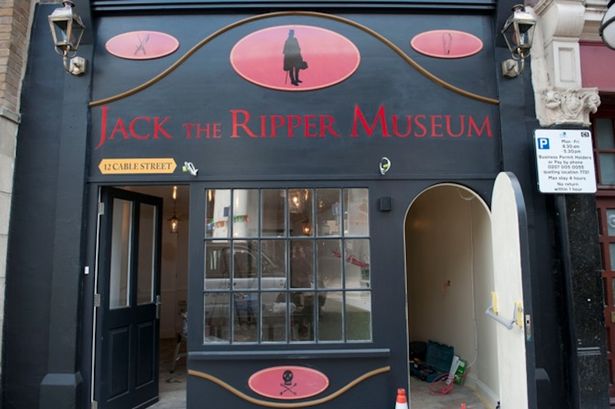
The newly open and controversial Jack the Ripper Museum, Cable Street, London.

Some weeks ago, the building of a museum dedicated to celebrating the women of London’s East End was supposed to be nearing completion. Instead, as Lisa Mckenzie observes in her blog post for Times Higher Education, “what [has] opened on 12 Cable Street is a museum that […] sell[s] T-shirts and coffee mugs featuring a black silhouette of the Ripper stood in a pool of blood, reducing the women of the East End to a red smudge.” Quite rightly, the Jack the Ripper Museum’s opening has stirred public protest and created a controversy, with the designers of the museum recently calling the fruit of their own labours (they too thought they were building a women’s history museum) so much “salacious, mysogynist rubbish.” What is at issue here is memory. How are the women of the nineteenth-century East End to be remembered? Are they to be remembered as voiceless, victimised bodies laid bare to the prurient public gaze? Or, are they to be remembered as agential subjects who started and sustained numerous grassroots rights movements?

Of course, this is not the first time that the sensationalised image of the Ripper has threatened to silence a more nuanced representation of women’s histories. In 1888, a similar battle was waged in the pages of the Daily Telegraph with the Ripper murders eventually overwhelming the Great Marriage Debate – a public dialogue partly spurred by the words of early feminist journalist and novelist Mona Caird. As Judith Walkowitz puts it in her classic book City of Dreadful Delight, the “two media events, the marriage debate and the Whitechapel horrors, tensely coexisted for four weeks, but the balance of interest and fascination began to shift from West of East, from left to right. Finally, after 29 September the marriage correspondence ceased publication, and the Ripper murders took over the whole newspaper” (168). But, the problem of how we remember Mona Caird and the Great Marriage Debate does not start or end with the Ripper murders.

is marraige a
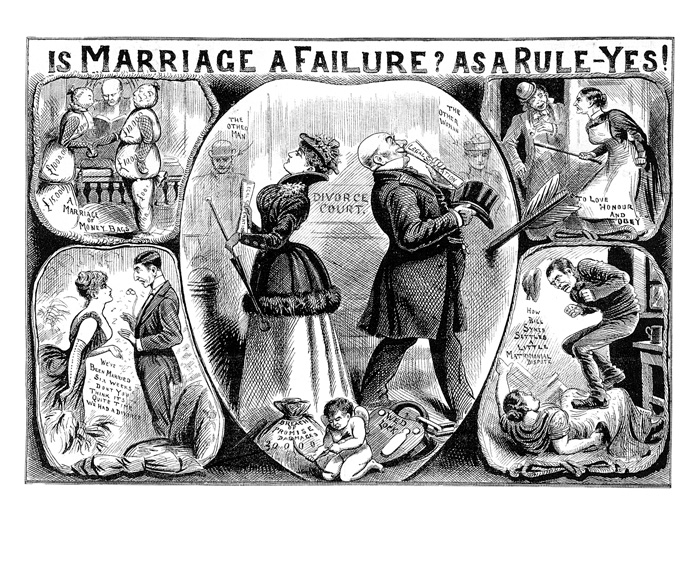
Is Marriage a Failure? Front-page engraving from the Illustrated Police News, 4 April 1891. (© The British Library Board)

Though August of 1888 is now better remembered as the month of the first Ripper murder, it was also the month that Mona Caird published her article entitled “Marriage” in the “wicked” Westminster Review. Because Parliament wasn’t in session and there wasn’t much to print, the much more popular Daily Telegraph decided to use Caird’s article as an excuse to pose the question that would spark the Great Marriage Debate of 1888: Is Marriage a Failure?

An estimated 27,000 readers responded, giving their personal views on the institution. Some used the opportunity as a vehicle for publicly airing grievances about such cardinal sins as a husband’s tendency to place his feet on the mantelpiece (oh, the horror!). Others wrote desperate pleas for help – for someone to bear witness to the daily cruelties, insults, and abuses they had to suffer at the hands of their spouses. Still others took the opportunity to declare their pious, undying loyalty to the institution.

Even before the intervention of the Ripper murders, the terms for remembering Caird’s “Marriage” essay were problematic, as it is unlikely that many of the Daily Telegraph’s letter writers would have read Caird’s original article in the Westminster Review. Even in the official 1888 collection of the Daily Telegraph’s Great Marriage Debate letters, Caird’s original article was not reprinted in full. Instead, the collection’s editor, Harry Quilter – a conservative barrister, who was far from sympathetic to the concerns of “New Women” like Caird – directed interested readers to the relevant edition of the Westminster Review if they wanted more than an extracted version of Caird’s piece. In the meantime, a “brilliant” paper by one Mrs. Lynn Linton (an opponent of women’s rights with whom Caird tangled in 1892 in the pages of the Nineteenth Century) was provided to the reader in full. While Quilter labels Caird’s text “rather vague and high-falutin’,” he commends Linton’s for its “vigorous common sense, its absence of sentimental feeling, and its concentration of wide experience,” all of which make it “well worthy of the closest attention, while as a piece of literary workmanship it is more than admirable” (13-14). And, it is this very collection of the Daily Telegraph’s letters that is still regularly referenced in discussions of Caird and the Great Marriage Debate.

127 years after the publication of Caird’s controversial essay, I still find myself swimming in questions about the way its content – and the public reaction to its content – has filtered into popular memory: How accurate is Quilter’s edited memorial to the Great Marriage Debate? What is re-membered in its pages? What is forgotten? And, beyond that, how accurately did the Daily Telegraph itself depict the nature and content of the 27,000 letters that allegedly flooded its editor’s desk? What has become of those letters? Do they still exist? What can they tell us about the relationship between the public and private spheres during this period? What can all of this tell us about which women’s experiences are remembered and which are erased?

In a discussion of memory, women’s rights, and Mona Caird, I can do no better than leave you with Caird’s own last words from the “Marriage” essay that eventually became so notorious. I have always found these lines to be haunting because of what they could not possibly have foreseen. There’s such a delicate optimism to them – an optimism that has too often been denied in the various rememberings, forgettings, and distortings of the piece:

We see a limitless field of possibility opening out before us; the adventurous spirit in us might leap up at the wonderful romance of life! […] We shall begin, slowly but surely, to see the folly of permitting the forces of one sex to pull against and neutralise the workings of the other, to the confusion of our efforts and the checking of our progress. We shall see, in the relations of men and women to one another, the source of all good or of all evil, precisely as those relations are true and noble and equal, or false and low and unjust. With this belief we shall seek to move opinion in all the directions that may bring us to this “consummation devoutly to be wished,” and we look forward steadily, hoping and working for the day when men and women shall be comrades and fellow-workers as well as lovers and husbands and wives, when the rich and many-sided happiness which they have the power to bestow one on another shall no longer be enjoyed in tantalising snatches, but shall gladden and give new life to all humanity. (252)


Works Cited

Caird, Mona. “Marriage.” 1888. “Criminals, Idiots, Women, and Minors”: Victorian Writing by Women on Women. 2nd ed. Ed. Susan Hamilton. Toronto: Broadview Press, 2004. Print.

Mckenzie, Lisa. “Why I Am Protesting Against the Jack the Ripper Museum.” Times Higher Education Blog. Times Higher Education, 5 August 2015. Web. 10 August 2015.

Quilter, Harry. Is Marriage a Failure? London: Swan Sonnenschein & Co., 1888. Hathi Trust. Web. 19 October 2014.

Walkowitz, Judith. City of Dreadful Delight: Narratives of Sexual Danger in Late-Victorian London. Chicago: University of Chicago Press, 1992. Print.

Filed Under: Research Blogs

  • « Go to Previous Page
  • Page 1
  • Interim pages omitted …
  • Page 20
  • Page 21
  • Page 22
  • Page 23
  • Page 24
  • Interim pages omitted …
  • Page 31
  • Go to Next Page »

Primary Sidebar

Blog Categories

  • Awards News (39)
  • Conference News (25)
  • Graduate News (36)
  • Members News (63)
  • Research Blogs (14)
  • RSVP Digital Events (28)
  • RSVP News (141)
  • Teaching & Learning News (11)
  • Uncategorized (13)
  • VPR News (18)

Footer

Search Our Site

Visit Our Blog

Connect with Us

  • Facebook
  • Twitter
  • YouTube

Copyright © 2026 · Genesis Sample on Genesis Framework · WordPress · Log in