• Skip to primary navigation
  • Skip to main content
  • Skip to footer
RSVP

RSVP

The Research Society for Victorian Periodicals

  • Home
  • About
    • Join RSVP
    • Privacy Policy
  • Grants and Prizes
    • Award Calendar
    • Curran Fellowships
    • Linda H. Peterson Fellowship
    • Patrick Leary Field Development Grant
    • Colby Book Prize
    • Sally Mitchell Dissertation Prize
    • Rosemary VanArsdel Prize
    • VPR Expanding the Field Prize
    • Conference Travel Awards
  • Conference
    • Past Conferences
  • VPR
  • Resources
    • Teaching Materials
    • RSVP Digital Salon Resources
    • RSVP Bibliography
    • VanArsdel Bibliography
  • News & Events
  • Contact

Uncategorized

CFP: Special Issue of Victorian Periodicals Review – Essays in Honor of Sally Mitchell

January 31, 2018

CFP: Special Issue of Victorian Periodicals Review 

Essays in Honor of Sally Mitchell

CFP-VPR Special Issue for Sally Mitchell[1] copy

Proposals due March 1, 2018

Completed Essays due September 1, 2018


Sally Mitchell (1937-2016) was a pioneering feminist scholar and teacher in the field of Victorian studies whose work opened new avenues for the study of women’s writing, cultural history, and journalism. Throughout her career, periodicals were at the heart of her research, which included groundbreaking work on women’s penny papers and popular reading, an innovative study of The New Girl, critical biographies of Dinah Mulock Craik and Frances Power Cobbe, indispensable histories such as Daily Life in Victorian England and Victorian Britain: An Encyclopedia, as well as edited editions and anthologies of Victorian women’s writing. To honor her contributions to our field and highlight her continued legacy in Victorian periodical studies, we plan to publish a special issue of VPR in Fall 2019.

Contributions to the special issue should be 5,000 to 9,000-word essays (including notes and bibliography) focused on any topic inspired by Sally Mitchell’s work on the periodical press. Essays might explore the Victorian press in relation to:

  • • Victorian women writers and women’s reading
  • • The “new girl” and girls’ culture
  • • Daily life and social history
  • • Popular fiction and literary history
  • • Feminist activism, networks, and mentoring
  • • New directions in biography
  • • New approaches to teaching with periodicals

Please submit a 200-word abstract and a CV by March 1, 2018 to guest editor Katherine Malone at katherine.malone@sdstate.edu.

 You can download a PDF version of the CFP here.

Completed essays will be due September 1, 2018.
Filed Under: Graduate News, RSVP News, Uncategorized, VPR News

RSVP Field Development Grant Accepting Proposals Now

January 3, 2017

In 2017 the Research Society for Victorian Periodicals will award one RSVP Field Development Grant to a single researcher or a team of researchers pursuing a project that would facilitate research by other scholars. Two smaller awards may be given if the right projects present themselves. The amount of the award will be up to $27,500. Please see the Field Development Grant page of our website for more details. The deadline for applications is February 1, 2017.

Filed Under: Awards News, Members News, RSVP News, Uncategorized

‘Trilby-Mania’ by Erica Haugtvedt (Ohio State University)

July 18, 2015


Erica Haugtvedt is a Ph.D. candidate at Ohio State University. Her research focuses on early forms of transmedia and participatory culture emerging from engagement with Victorian serial narratives published in numbers or in periodicals. She is fundamentally interested in the emotional dynamics of serial reading. Her article ‘The Sympathy of Suspense: Gaskell and Braddon’s Slow and Fast Sensation Fiction in Family Magazines’ will appear in the Spring 2016 issue of Victorian Periodicals Review.

You can contact Erica on Twitter @EHaugtvedt and at haugtvedt.3@osu.edu


Trilby-Mania: Serial Fiction Merchandising during the fin de siècle

‘For we’ve got Trilby jugs and Trilby mugs and Trilby chairs and lamps / We’ve all got Trilby plates of meat, and carry Trilby gamps— / This Trilby craze will end my days—at home we’re all insane / We’ve Trilby, Trilby, Trilby, Trilby on the brain’ goes the chorus to the 1896 music hall song, ‘Trilby on the Brain’ (Sewell).

Published two years after George Du Maurier’s Trilby was serialized in Harper’s New Monthly Magazine in eight parts from January to August 1894, the song captures the Trilby-mania that chiefly overtook the United States—but also overflowed into Britain—in the mid to late 1890s. The song is parodic, but its catalogue of Trilby items is not far off from the reality that Emily Jenkins and L. Edward Purcell have documented.

Trilby-1894-Horsman-from-Du-Maurier-story_Fotor
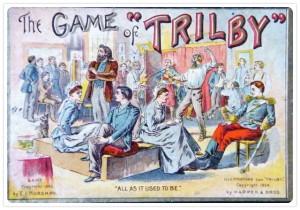
Figure 1: an example of Trilby mania merchandise

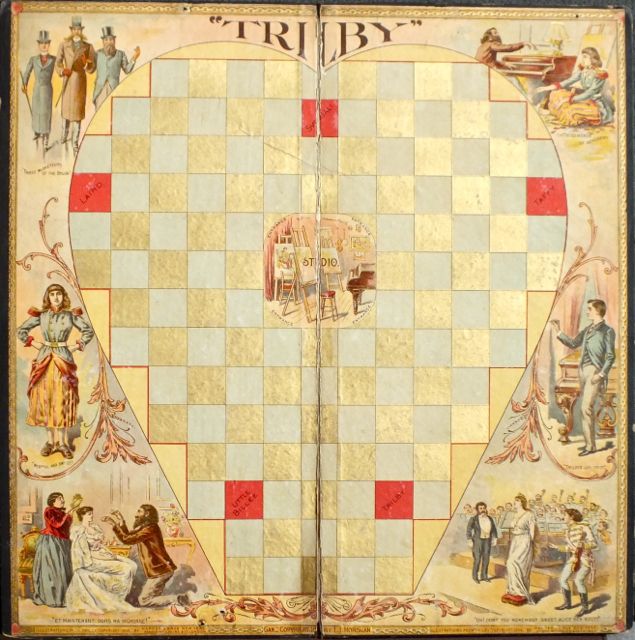
Trilby was co-opted for advertising restaurants, sausages, toothpaste, soap, shoes, jewelry, dolls, board games, and more. The expansiveness of Trilbyana begs the question: what is the relation between these things in the marketplace and Trilby? In my thesis I contend that the reaction to Trilby in the mid-1890s indexes the ways in which advertisers and consumers curated their engagement with the serially published novel. Not only does Trilby-mania anticipate aspects of fiction franchise marketing and merchandising of a later time, but the consumption of Trilby-emblazoned items emblematizes how readers exported condensed versions of Trilby’s meanings beyond the boundaries of the magazine in order to signify readers’ own values in a cultural environment in which Trilby was, for a while, the shared topic of conversation.

In my research project I argue that Trilby-mania depends upon a logic of proliferation, remediation, and convergence that operates in periodical literature, advertising, and consumerism during the Victorian period. In the merchandising of Trilby, marketers glancingly associate their products with aspects of the novel. Why market Trilby toothpaste unless the association is assumed to garner some positive attention, to present the toothpaste as an alluring alternative to non-Trilby branded items? Trilby, after all, has ‘thirty-two British teeth as white as milk and as big as knuckle bones,’ (Harper’s New Monthly Magazine February 1894, 335). The toothpaste thus implicitly promises to remake the consumer in Trilby’s image.

At the same time, as Michel De Certeau has argued, the consumer cannot be fully reduced to the image reflected in the advertiser’s intended messages. Consumption confronts production with its ‘ruses, its fragmentation (the result of the circumstances), its poaching, its clandestine nature, its tireless but quiet activity, in short by its quasi-invisibility, since it shows itself not in its own products (where would it place them?) but in an art of using those imposed on it’ (De Certeau, Practice of Everyday Life 31). Much like the reading activities of flesh-and-blood readers, the uses consumers make of these products are ephemeral, but their ephemerality does not necessarily render these activities less significant but rather more difficult to trace. Whereas De Certeau is eager to dismiss the evidence of advertising slogans, I turn to them to infer how the advertiser intended to market Trilbyana to a consumer audience.

68639a483b18cd56319894f0cafec889
Figure 2: the Trilby boardgame

What can we learn from the merchandised products derived from nineteenth-century periodical literature? I want to suggest that attending to fiction merchandising in the nineteenth century allows us to better understand the dynamics of mass media and mass reading then and now. Franchise merchandising seems to better belong to the twentieth and twenty-first centuries, yet examples such as Trilbyana testify to the important influence of the Victorian period on the ways in which we now engage with fiction franchises. Indeed, I suspect that Trilbyana can tell us more about how we process and value stories beyond the reading experience ‘proper’—how we integrate narratives into our lives through accumulating and displaying things. Indeed, there is an obvious analogy between serial fiction and the culture of consumption in which Trilbyana participates: both are products of an industrial age, both operate through capitalist profit motive. Yet, I want to suggest that the meanings of Trilbyana (and serial narrative) do not end with profit. There’s more here. And while the meanings that readers/consumers derive from the things they purchase are not unified, the plurality of different products and different slogans derived from Trilby reflects the divergent uses that fin de siècle readers made of the novel.

TrilbyDoll_TheSketch_Dec25_1895 copy
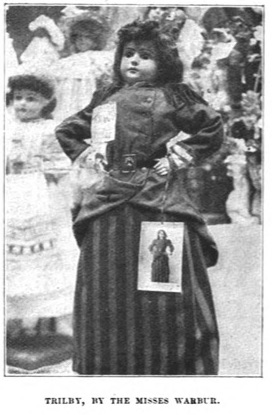
Figure 3: Trilby doll by ‘The Misses Warbur’

This endeavor is not without its considerable methodological hurdles. As I expand my archive to non-print objects, I intensify the struggle with massive materiality that Victorian periodical studies already confronts in the expansive and seemingly-ever-expanding (increasingly digitized) print archive. The directed digital search presents challenging obstacles to the kind of research I am trying to do. In the Spring 2014 issue of VPR, Linda Hughes wrote on the merits of reading the Victorian periodical ‘sideways’—reading for ‘spatio-temporal convergences in Victorian print culture’ (13). I am looking for spatio-temporal convergences between print and the marketplace that operates around it. Hughes writes: ‘The promiscuity of print, that is, its accessibility, variety, and multiple partnerings with readers, also drives its capacity to set dialogues in motion and to exceed ideological containment, scholarly modeling, and the control of authorities’ (5). While the massiveness of the nineteenth-century periodical archive is overwhelming, this very “promiscuity” is part and parcel of the wonder and excitement I find in periodical studies. I think it’s time to explore the convergences to be found outside of the printed page. Such a move is contiguous with the values this field has already demonstrated through pioneering media history and theorizing the historical experiences of reading in time. A good challenge has never stopped us before.


Works Cited

De Certeau, Michel. The Practice of Everyday Life. Trans. Steven F. Rendall. Berkeley: University of California Press, 1984.

Du Maurier, George. ‘Trilby.’ Harper’s New Monthly Magazine. Vol. 88 (January-August 1894). University of Michigan. Digitized by Google Books. Hathi Trust Digital Library. Web. 2 July 2015.

Hughes, Linda. ‘SIDEWAYS!: Navigating the Material(ity) of Print Culture.’ Victorian Periodicals Review 47.1 (Spring 2014): 1-30.

Jenkins, Emily. ‘Trilby: Fads, Photographers, and Over-Perfect Feet.’ Book History 1 (1998): 221-267.

Purcell, L. Edward. ‘Trilby and Trilby-Mania: The Beginning of the Bestseller System.’ The Journal of Popular Culture 11.1 (Summer 1977): 62-76.

Sewell, J.W. ‘Trilby on the Brain.’ London: Francis, Day & Hunter, 1896. Music Collections: H.3980.a(67.). British Library, London, United Kingdom. 8 May 2014.


Filed Under: Research Blogs, Uncategorized

RSVP 2015 Conference in Ghent makes international news

July 13, 2015

RSVP’s 2015 conference in Ghent was a fascinating experience — splendid papers and plenary lectures in a gloriously historic setting. We’ll be posting more about it soon. The biggest news out of the conference, however, was this: scholar and bookdealer Jeremy Parrott revealed at RSVP, for the first time anywhere, his discovery of a “marked set” of All the Year Round. This hitherto unrecorded “deluxe edition” in scarlet binding has handwritten marginalia identifying (almost) all of the contributors by name, next to each one’s contribution. Between 300 and 400 contributors of some 2500 articles, stories, and poems, are now conclusively identified for the first time. As if this were not exciting enough news, experts like Michael Slater and John Drew have been able to confirm that many of these annotations are in Dickens’s own hand. In his paper, Dr. Parrott made a persuasive case that this was Dickens’s own personal set of the magazine, probably kept in his private office at the magazine’s offices in Wellington Street.

The atmosphere in the room when Dr. Parrott delivered his news was electric. As this group of scholars knows better than any other, a “marked set” of any Victorian magazine is an extremely rare and precious thing. Beginning with the astonishing achievements of the Wellesley Index to Victorian Periodicals and continuing today in the Curran Index, RSVP-affiliated scholars have scoured the globe for such sets, and have used these and every other kind of resource — letters, diaries, reprints, ledgers, stylistic analysis, and much else — to discover, once and for all, the names of the authors who contributed anonymously to these hugely popular and influential Victorian journals.

Obviously, there is a great deal of work for scholars to do — experts in Victorian periodicals, as well as Dickensians — before we can know all of the implications of this stupendous All the Year Round discovery. In the meantime, articles have already appeared in the Independent, the Guardian, the Telegraph, and more media coverage is on the way. This could prove to be a wonderful opportunity to let more non-specialist readers know about the fascinating world of Victorian magazines and newspapers, and about the decades-long efforts of scholars to pierce the veil of anonymity characteristic of Victorian journalism to more fully reveal the riches of that world to readers everywhere.

Victorian Periodicals Review, the journal of RSVP, will feature an article by Jeremy Parrott about his discovery in an upcoming issue.

Filed Under: RSVP News, Uncategorized

Postgraduate Research Blog Launch

June 12, 2015

We are delighted to announce the launch of our postgraduate research blog.

The Research blog area is a space for our postgraduate students to showcase their research projects and for the wider RSVP community to read and enjoy!

Each post will include the contact details of our featured writer. We encourage you to get in touch with them for further discussion of the topics raised.

Our inaugural post comes from Ann M. Hale (University of Greenwich) and is entitled ‘On Serendipity.’ You can read it here.

If you would like to write a blog post for the website please contact Helena Goodwyn at graduate@rs4vp.org.

Filed Under: Graduate News, Members News, RSVP News, Uncategorized

ESPrit Conference CFP – Politics & Periodicals

March 9, 2015

Deadline now extended until 1st June 2015.

Full details available at http://www.espr-it.eu/news/2015-esprit-conference/25-call-for-papers

Filed Under: RSVP News, Uncategorized

  • « Go to Previous Page
  • Page 1
  • Page 2
  • Page 3
  • Go to Next Page »

Footer

Search Our Site

Visit Our Blog

Connect with Us

  • Facebook
  • Twitter
  • YouTube

Copyright © 2026 · Genesis Sample on Genesis Framework · WordPress · Log in