• Skip to primary navigation
  • Skip to main content
  • Skip to footer
RSVP

RSVP

The Research Society for Victorian Periodicals

  • Home
  • About
    • Join RSVP
    • Privacy Policy
  • Grants and Prizes
    • Award Calendar
    • Curran Fellowships
    • Linda H. Peterson Fellowship
    • Patrick Leary Field Development Grant
    • Colby Book Prize
    • Sally Mitchell Dissertation Prize
    • Rosemary VanArsdel Prize
    • VPR Expanding the Field Prize
    • Conference Travel Awards
  • Conference
    • Past Conferences
  • VPR
  • Resources
    • Teaching Materials
    • RSVP Digital Salon Resources
    • RSVP Bibliography
    • VanArsdel Bibliography
  • News & Events
  • Contact

RSVP News

Call for Guest Editors of VPR

September 9, 2021

Victorian Periodicals Review invites proposals from guest editors for special themed issues to be published in 2022, 2023, and 2024. Individuals or co-editors should submit proposals to Katherine Malone by October 15, 2021. 

Proposals should include a short description of your topic and its relevance to Victorian periodical studies, along with a brief bio for each editor. A full list of VPR’s past special issues is available on our website.

If your proposal for a special issue is accepted, the guest editor(s) will:

  • Solicit essays (either by CFP or invitation)
  • Select five to seven articles for publication
  • Oversee the revision process
  • Write an introductory essay, and
  • Forward the files to the VPR Editor

We look forward to reading your submissions!
Filed Under: RSVP News

Your How-To Guide to Our 2021 Virtual Conference

September 6, 2021

How-To Guide Contents:
Registration
Viewing presentations
Zoom links
Session format
Chairing instructions
Zoom tech assistance instructions


How does this virtual conference work?

The conference will hold virtual sessions via Zoom, from 8-11 September, at the times indicated on the conference schedule. Attendees can view, listen to, and read presenter materials in advance of the regular sessions on the conference website. The regular sessions themselves will be primarily devoted to discussion among presenters and attendees. Keynote talks will also take place over Zoom, but there are no advance materials for these events.

The Zoom link for each session is posted to the password-protected page for that session on the conference website (see below for more information). There is no need to register for individual sessions ahead of time.

Please review the schedule as posted on the conference website to plan your participation, as some changes have been made in recent weeks.

How do I register for the conference?

Select the Registration tab of the conference website; simply enter your name and email address and hit submit. You will receive an automated email notification that includes the password to access all password-protected areas of the website. Please note that this message will not include the links to the Zoom sessions. See the next question for information about Zoom session links.

Where can I view the schedule
and the presentation materials themselves?

Visit the tab for each day of the conference (Day 1, Day 2, Day 3, Day 4) for the daily schedule of presentations. Click on the title of a panel to be taken to the presentations (videos, podcasts, papers) themselves. Registrants will be prompted to enter a password. This password will have been sent to you automatically upon registration. If you have not received it or cannot find it, please contact RSVP’s Communications Coordinator, Alison Hedley.

Please view, listen to, and read presenter materials in advance of the session; presenters will not be giving full papers during the session, but will give a brief overview followed by Q&A discussion.

How do I access the session “room” on Zoom?

The link the Zoom room for each panel or event appears at the top of the password-protected page for this panel. Please note that there are different rooms/Zoom links for every event. When you click on the Zoom link at the beginning of the event, you will be directed to a Zoom waiting room; one of the session hosts (the chair or the tech assistant) will let you into the meeting.

We recommend having the most recent version of Zoom downloaded on your computer to limit technical hiccups.

For information on Zoom use and troubleshooting, please see Zoom’s video tutorials; to quickly find the answer to a specific question, use the search function of the Zoom Help Center.

What is the format of regular sessions?

Please review the schedule as posted on the conference website in case any changes have been made to a panel.

The sessions themselves are structured to facilitate engaging discussion. To listen to the full version of each paper, participants can access presenters’ materials in advance on the conference website (see above). Sessions will take the following format:

– The chair will introduce the speakers, their bios, and conference presentation titles
– Speakers will give a recap of their presentation in 5 minutes or less
– The chair will then open the floor to Q&A from audience members
– The panel will be 60 minutes in total

How do I chair the panel I’ve volunteered for?

Thank you for agreeing to chair a panel! Please be sure to read/view/listen to the presentations in your session in advance. If you have not already done so, email your session panelists to solicit brief biographical statements. You should have received an email from RSVP’s Communications Coordinator with information about how to contact panelists; please refer to this email or contact Alison Hedley.

Please review the schedule as posted on the conference website in case any changes have been made to your panel.  Plan to arrive at your session 15 minutes early so that one of the conference’s local organizers can make you a co-host of the Zoom room. This will give you essential administrative privileges, such as the abilities to enable screen sharing and adjust room settings if/as needed. Please see above for the format of regular sessions. Your role involves introducing panelists and sharing or reading their bios; moderating discussion, and keeping the session to time.

OPTIONAL: If you wish, you can copy and paste panelist bios into Zoom’s chat function rather than reading each statement aloud prior to each paper brief. If the session has many presenters, this option has the benefit of opening a bit more time for discussion. If your panel chooses this option, please let attendees know to look for presenter bios in the Zoom chat window.

Wherever possible, another RSVP member has volunteered to serve as a tech assistant/backup in your session in case of any problems with Zoom. Their duties are listed below. If you do not have tech backup and you run into Zoom tech issues: you may find your solution on the Zoom Help Center; otherwise, send a text message to +1 215-629-6773, clearly stating the session for which you require support.

How do I offer the Zoom assistance I have signed up for?

Thank you for offering Zoom assistance for a session! Please arrive 5-10 minutes early for the session so that a local organizer or the panel chair can make you a co-host.

Your role involves the following tasks:

– managing attendee questions that are posed in the chat function (jumping into discussion if/when appropriate to articulate these questions)
– adding any appropriate links in the session chat as needed (such as the link to the session webpage on the conference website)
– taking over for the chair if their wifi cuts out;
– any other tech troubleshooting you might be able to offer if needed (perhaps with assistance from the Zoom Help Center). For any major technical difficulties, please send a text message to +1 215-629-6773, clearly stating the session for which you require support.

Filed Under: Conference News, RSVP Digital Events, RSVP News

Curran Index Seeks PT Paid Research Assistant

August 11, 2021

We are delighted to announce that The Curran Index is recruiting a part-time, paid research assistant to help the current editors, Dr. Emily Bell and Dr. Lara Atkin, to expand the attribution data that is currently incorporated into the Index.

The Role

A Research Assistant is required to undertake archival work examining the Chambers Journal ledgers at the National Library of Scotland. The ideal candidate will be based in easy travel distance of the NLS and will have a research background in Victorian periodical studies, either studying for a PhD or post-doctoral.

The Work

You will be expected to examine the Chambers’s Journal Ledgers, particularly the notebooks containing details of the cash payments made to authors for contributions to the journal and other work between 1839-1903. High quality scans of these ledgers should be taken, and a research report produced highlighting any attribution data gathered from the ledgers that could be integrated into The Curran Index.

You will work independently but report to Dr. Lara Atkin and Dr. Emily Bell, co-editors of The Curran Index. This job is suitable for an advanced postgraduate or postdoctoral ECR, with a background in archival work and periodical studies, who is based within commutable distance from the National Library of Scotland. The timings for the work are flexible and can be fitted around existing research and teaching commitments.

How To Apply

More information on how to apply and a full job description can be found on the job listing at the University of Kent website.

 If you have any further questions, please email Dr. Atkin.

Filed Under: Graduate News, Members News, RSVP News

Peterson Award Winner Announced

June 17, 2021

RSVP is pleased to announce Mary Shannon as the 2021-2022 recipient of the Peterson Fellowship for her project on “Billy Waters, Periodicals, and Nineteenth-Century Popular Culture.” Committee members lauded her work on Billy Waters, a Black entertainer who received coverage in the transatlantic periodical press, as “a fascinating and timely project.” They also noted its potential to contribute to current critical conversations about “undisciplining” Victorian studies, about “vernacular culture” in its complexity, and about disability in the Victorian period.

Congratulations to Mary and thanks to all who submitted applications for this year’s award!

Filed Under: Awards News, RSVP News

Congratulations to Our Prize Winners!

June 16, 2021

We have a number of exciting announcements regarding our annual prizes and awards. Read on for project details for our Field Development Grant, Colby Book Prize, and inaugural Sally Mitchell Dissertation Prize. Congratulations to all our winners and many thanks to all who submitted projects for consideration!

Congrats to Our Field Development Grant Winner

This year’s recipients of the RSVP Field Development Grant are Dino Felluga, Adrian Wisnicki, and Kenneth Crowell, for their project, “Recovering BIPOC Voices from the Victorian Periodical Press.”

The decision committee deemed this project “a master class in decolonial recovery work that could offer a powerful intervention in the current state of the field’s methodological representation.”

Inaugural Sally Mitchel Dissertation Prize Winner

This year’s recipient of our first-ever Sally Mitchell Dissertation Prize is Ann Hale, for her project, “Business Matters: Legal Structures, Roles, People, and Places in the Nineteenth-Century Press—A Case Study of George Newnes Limited.”

The decision committee offered the following comments on Hale’s project:

“In her comprehensive and compelling study of George Newnes Limited, Ann Hale’s [dissertation] uncovers and assesses the vital role of business and legal frameworks in the periodical press. Her project enables readers to better appreciate the consequences of sole proprietorship, partnerships, and companies and the mutability of these legal and business structures. Drawing on an impressive array of documents, visualizations, maps, and other data as part of a Scalar Digital Supplement, she constructs a carefully scaffolded study that draws well on existing periodicals scholarship and literary theory, including the idea of the chronotope, Guillory’s ideas of remediation, and Linda Hughes’ ‘sideways theory,’ along the way bringing numerous hidden players in the publishing work to light and convincing her readers why, as her title tells us, ‘Business Matters.’”

Two other outstanding dissertations received honourable mentions from the decision committee: Victoria Clarke’s “Reading and Writing the Northern Star, 1837-1847” and Stephan Pigeon’s “The Labour, Law, and Practice of Circulating Journalisms in the British News and Periodical Press, 1842-1911.”

2021 Robert and Vineta Colby Book Prizes Announced

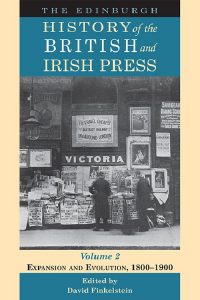
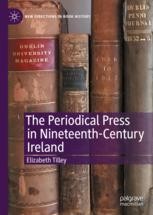
This year, two awardees were selected: The Periodical Press in Nineteenth-Century Ireland, by Elizabeth Tilley, and The Edinburgh History of the British and Irish Press: Volume 2, Expansion and Evolution, 1800-1900, edited by David Finkelstein. Both awardees have been invited to give a keynote lecture at this year’s RSVP conference.

The committee offered the following comments on the two texts:

Elizabeth Tilley, The Periodical Press in Nineteenth-Century Ireland (Palgrave, 2020)

In her monograph, Elizabeth Tilley focuses on monthly and weekly periodicals, selecting representative journals to give an overview of Irish periodical literature throughout the century, a subject that certainly deserves this type of focused attention. Her research (funded by a Curran Award in 2015) is impeccable, and her analysis is nuanced and detailed. Tilley often chooses to address little-known periodicals (domestic, trade, popular press, etc.), demonstrating their contributions to the Irish periodical field and their interactions with regional and national politics and economics, as well as showcasing their relevance to British periodical culture.

As part of this study, Tilley has included a lengthy appendix with excerpts from a series of articles by Christopher Clinton Hoey that were originally published in The Irish Builder in 1877-78. These excerpts give an overview of the Irish press during the period and provide an excellent resource for both scholarly research and teaching. In this way, Tilley’s volume is both monograph and scholarly edition, a notable and important resource for the field of nineteenth-century periodical studies.

David Finkelstein, ed., The Edinburgh History of the British and Irish Press: Volume 2, Expansion and Evolution, 1800-1900 (Edinburgh UP, 2020)

As part of a three-volume series from Edinburgh University press, David Finkelstein’s compendious collection includes contributions from forty-eight authors who address the development of British and Irish periodical culture throughout the nineteenth century. It is a remarkable resource that both draws from previous scholarship and contributes new knowledge to the field, with a wide range of topics and perspectives, and with welcome attention to diversity and transnational connections. The combination of overview essays accompanied by narrow and pointed case studies give the volume an impressive breadth and depth. It will be valuable for a wide range of readers, from those who are orienting and contextualizing as they first come to periodical studies, to those who are already specialists in the field.

David Finkelstein’s fine work editing and introducing the volume surely reflects a herculean effort, supported by original and engaging work by the forty-seven authors, who include both established and upcoming scholars. We are pleased to honor the work of all the writers as well as the editor, who together have made a contribution to nineteenth-century periodical studies that will remain a standard for many years to come.

Peterson Prize Winner TBD

Please note that the 2021 Linda H. Peterson Fellowship recipient will be announced shortly. We will share the announcement as it is available from the committee.

Filed Under: Awards News, RSVP News

Join Our Last #RSVPDigitalSalon of the Spring

May 4, 2021

How can I keep up with my research if I pursue an “alt-ac” career?

How would I do research without access to my institution’s library databases and subscriptions?

Where can I find like-minded scholars who share my interests if I’m not pursuing higher education as a career?

What does it look like to work with non-academic publishers? 

In short, what does it take to be an “independent” scholar? 

In the wake of Covid-19’s impact, many have asked the above questions as they face a future where academic austerity threatens to become the “new normal.” While not all scholars seek academic positions, those who do often wonder what it takes to continue producing rigorous and satisfying research apart from the university setting.

RSVP has long supported independent researchers of all kinds whose interests intersect with the wide world and long history of Victorian periodicals. Join us on 21 May at 6 p.m. UK / 1 p.m. EST for our last RSVP Digital Salon of the spring on “Doing Research as an Independent Scholar.”

Register for this event here. Registration is free and open to the public. You do not need to be a member of RSVP to attend.

Get Your Questions About Independent Scholarship Answered

During this more informal Q&A session, our panelists will answer your questions live and offer their insights on how to do research when one is not affiliated with a university. Our panelists include: 

Judith Flanders

Judith Flanders is a journalist and highly acclaimed author of both fiction and non-fiction. In addition to her Sam Clair Mysteries series, she writes regularly about history, theatre, dance, and the contemporary arts for the Sunday Telegraph, Wall Street Journal, Spectator, TLS, and theartsdesk.com. Her most recent non-fiction book, A Place for Everything: The Curious History of Alphabetical Order (2020), traces the history of using alphabetical order as a sorting system.

Helen Rappaport

Helen Rappaport is an international best-selling author, media consultant, and freelance historian who specialises in the period 1837-1918 in Britain and Russia. Her forthcoming books include a history of Russian emigration to Paris after the revolution in the US and a biography of Mary Seacole in the UK, both due out Spring 2022.

Marie Léger-St-Jean

Marie Léger-St-Jean is an independent scholar and digital humanist based in Montréal, where she edits Price One Penny: A Database of Cheap Literature, 1837-1860. Her research focuses on early Victorian fiction published in penny weekly numbers and its role as a nexus in a Western transmedia popular culture.

Patrick Leary

Patrick Leary is a former president and long-time member of RSVP. He is the founder/manager of the VICTORIA listserv, and he curates the Victoria Research Web, a treasure trove of Victorian research resources old and new. He also is the author of The Punch Brotherhood (2010), a prize-winning study of how oral culture shaped this iconic Victorian periodical.

Register and Submit Your Questions Now

Registration for this free event is open to all. You need not be a member of RSVP to attend and participate. And we highly encourage audience participation for this event! Our panelists are here to answer your questions about being an independent scholar. 

If desired, you can submit a question ahead of time. We will share your questions with the panelists in advance. We hope to see you there!

General questions about this or future Digital Salon events may be directed to our Vice President, Fionnuala Dillane.

Filed Under: RSVP Digital Events, RSVP News

  • « Go to Previous Page
  • Page 1
  • Interim pages omitted …
  • Page 4
  • Page 5
  • Page 6
  • Page 7
  • Page 8
  • Interim pages omitted …
  • Page 24
  • Go to Next Page »

Footer

Search Our Site

Visit Our Blog

Connect with Us

  • Facebook
  • Twitter
  • YouTube

Copyright © 2026 · Genesis Sample on Genesis Framework · WordPress · Log in