
• Skip to primary navigation
  • Skip to main content
  • Skip to footer
RSVP

RSVP

The Research Society for Victorian Periodicals

  • Home
  • About
    • Join RSVP
    • Privacy Policy
  • Grants and Prizes
    • Award Calendar
    • Curran Fellowships
    • Linda H. Peterson Fellowship
    • Patrick Leary Field Development Grant
    • Colby Book Prize
    • Sally Mitchell Dissertation Prize
    • Rosemary VanArsdel Prize
    • VPR Expanding the Field Prize
    • Conference Travel Awards
  • Conference
    • Past Conferences
  • VPR
  • Resources
    • Teaching Materials
    • RSVP Digital Salon Resources
    • RSVP Bibliography
    • VanArsdel Bibliography
  • News & Events
  • Contact

Research Blogs

‘Trilby-Mania’ by Erica Haugtvedt (Ohio State University)

July 18, 2015


Erica Haugtvedt is a Ph.D. candidate at Ohio State University. Her research focuses on early forms of transmedia and participatory culture emerging from engagement with Victorian serial narratives published in numbers or in periodicals. She is fundamentally interested in the emotional dynamics of serial reading. Her article ‘The Sympathy of Suspense: Gaskell and Braddon’s Slow and Fast Sensation Fiction in Family Magazines’ will appear in the Spring 2016 issue of Victorian Periodicals Review.

You can contact Erica on Twitter @EHaugtvedt and at haugtvedt.3@osu.edu


Trilby-Mania: Serial Fiction Merchandising during the fin de siècle

‘For we’ve got Trilby jugs and Trilby mugs and Trilby chairs and lamps / We’ve all got Trilby plates of meat, and carry Trilby gamps— / This Trilby craze will end my days—at home we’re all insane / We’ve Trilby, Trilby, Trilby, Trilby on the brain’ goes the chorus to the 1896 music hall song, ‘Trilby on the Brain’ (Sewell).

Published two years after George Du Maurier’s Trilby was serialized in Harper’s New Monthly Magazine in eight parts from January to August 1894, the song captures the Trilby-mania that chiefly overtook the United States—but also overflowed into Britain—in the mid to late 1890s. The song is parodic, but its catalogue of Trilby items is not far off from the reality that Emily Jenkins and L. Edward Purcell have documented.
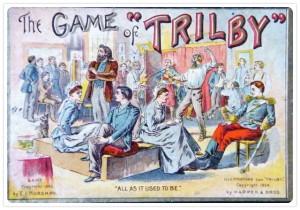
Trilby-1894-Horsman-from-Du-Maurier-story_Fotor
Figure 1: an example of Trilby mania merchandise

Trilby was co-opted for advertising restaurants, sausages, toothpaste, soap, shoes, jewelry, dolls, board games, and more. The expansiveness of Trilbyana begs the question: what is the relation between these things in the marketplace and Trilby? In my thesis I contend that the reaction to Trilby in the mid-1890s indexes the ways in which advertisers and consumers curated their engagement with the serially published novel. Not only does Trilby-mania anticipate aspects of fiction franchise marketing and merchandising of a later time, but the consumption of Trilby-emblazoned items emblematizes how readers exported condensed versions of Trilby’s meanings beyond the boundaries of the magazine in order to signify readers’ own values in a cultural environment in which Trilby was, for a while, the shared topic of conversation.

In my research project I argue that Trilby-mania depends upon a logic of proliferation, remediation, and convergence that operates in periodical literature, advertising, and consumerism during the Victorian period. In the merchandising of Trilby, marketers glancingly associate their products with aspects of the novel. Why market Trilby toothpaste unless the association is assumed to garner some positive attention, to present the toothpaste as an alluring alternative to non-Trilby branded items? Trilby, after all, has ‘thirty-two British teeth as white as milk and as big as knuckle bones,’ (Harper’s New Monthly Magazine February 1894, 335). The toothpaste thus implicitly promises to remake the consumer in Trilby’s image.

At the same time, as Michel De Certeau has argued, the consumer cannot be fully reduced to the image reflected in the advertiser’s intended messages. Consumption confronts production with its ‘ruses, its fragmentation (the result of the circumstances), its poaching, its clandestine nature, its tireless but quiet activity, in short by its quasi-invisibility, since it shows itself not in its own products (where would it place them?) but in an art of using those imposed on it’ (De Certeau, Practice of Everyday Life 31). Much like the reading activities of flesh-and-blood readers, the uses consumers make of these products are ephemeral, but their ephemerality does not necessarily render these activities less significant but rather more difficult to trace. Whereas De Certeau is eager to dismiss the evidence of advertising slogans, I turn to them to infer how the advertiser intended to market Trilbyana to a consumer audience.
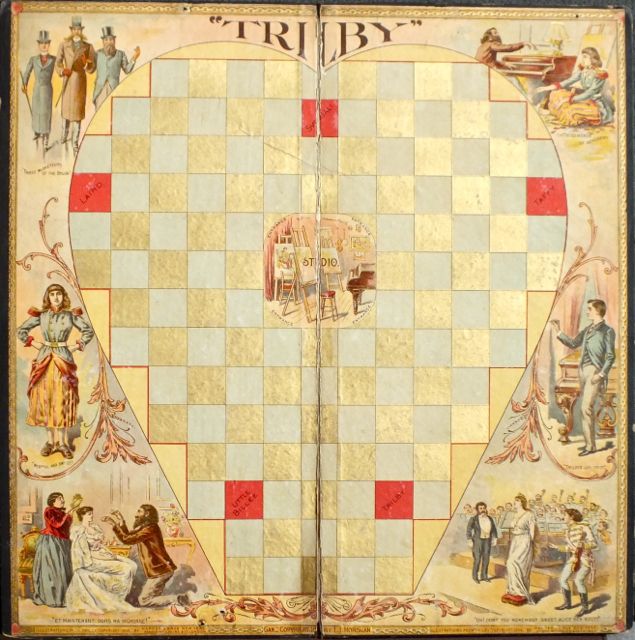
68639a483b18cd56319894f0cafec889
Figure 2: the Trilby boardgame

What can we learn from the merchandised products derived from nineteenth-century periodical literature? I want to suggest that attending to fiction merchandising in the nineteenth century allows us to better understand the dynamics of mass media and mass reading then and now. Franchise merchandising seems to better belong to the twentieth and twenty-first centuries, yet examples such as Trilbyana testify to the important influence of the Victorian period on the ways in which we now engage with fiction franchises. Indeed, I suspect that Trilbyana can tell us more about how we process and value stories beyond the reading experience ‘proper’—how we integrate narratives into our lives through accumulating and displaying things. Indeed, there is an obvious analogy between serial fiction and the culture of consumption in which Trilbyana participates: both are products of an industrial age, both operate through capitalist profit motive. Yet, I want to suggest that the meanings of Trilbyana (and serial narrative) do not end with profit. There’s more here. And while the meanings that readers/consumers derive from the things they purchase are not unified, the plurality of different products and different slogans derived from Trilby reflects the divergent uses that fin de siècle readers made of the novel.
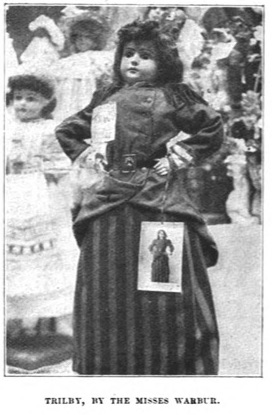
TrilbyDoll_TheSketch_Dec25_1895 copy
Figure 3: Trilby doll by ‘The Misses Warbur’

This endeavor is not without its considerable methodological hurdles. As I expand my archive to non-print objects, I intensify the struggle with massive materiality that Victorian periodical studies already confronts in the expansive and seemingly-ever-expanding (increasingly digitized) print archive. The directed digital search presents challenging obstacles to the kind of research I am trying to do. In the Spring 2014 issue of VPR, Linda Hughes wrote on the merits of reading the Victorian periodical ‘sideways’—reading for ‘spatio-temporal convergences in Victorian print culture’ (13). I am looking for spatio-temporal convergences between print and the marketplace that operates around it. Hughes writes: ‘The promiscuity of print, that is, its accessibility, variety, and multiple partnerings with readers, also drives its capacity to set dialogues in motion and to exceed ideological containment, scholarly modeling, and the control of authorities’ (5). While the massiveness of the nineteenth-century periodical archive is overwhelming, this very “promiscuity” is part and parcel of the wonder and excitement I find in periodical studies. I think it’s time to explore the convergences to be found outside of the printed page. Such a move is contiguous with the values this field has already demonstrated through pioneering media history and theorizing the historical experiences of reading in time. A good challenge has never stopped us before.


Works Cited

De Certeau, Michel. The Practice of Everyday Life. Trans. Steven F. Rendall. Berkeley: University of California Press, 1984.

Du Maurier, George. ‘Trilby.’ Harper’s New Monthly Magazine. Vol. 88 (January-August 1894). University of Michigan. Digitized by Google Books. Hathi Trust Digital Library. Web. 2 July 2015.

Hughes, Linda. ‘SIDEWAYS!: Navigating the Material(ity) of Print Culture.’ Victorian Periodicals Review 47.1 (Spring 2014): 1-30.

Jenkins, Emily. ‘Trilby: Fads, Photographers, and Over-Perfect Feet.’ Book History 1 (1998): 221-267.

Purcell, L. Edward. ‘Trilby and Trilby-Mania: The Beginning of the Bestseller System.’ The Journal of Popular Culture 11.1 (Summer 1977): 62-76.

Sewell, J.W. ‘Trilby on the Brain.’ London: Francis, Day & Hunter, 1896. Music Collections: H.3980.a(67.). British Library, London, United Kingdom. 8 May 2014.



Filed Under: Research Blogs, Uncategorized

‘On Serendipity’ by Ann M. Hale (University of Greenwich)

June 12, 2015


Ann M. Hale is a PhD candidate at the University of Greenwich. Her research focuses on the relationship between nineteenth-century legal periodicals and the development and consolidation of professional identity. She was awarded the 2014 Rosemary VanArsdel Prize for the best graduate student essay investigating Victorian periodicals and newspapers. Her prize-winning essay, ‘W.T. Stead and Participatory Reader Networks,’ appeared in the Spring 2015 issue of Victorian Periodicals Review. Hale and Dr. Shannon R. Smith are co-editing a special issue of Victorian Periodicals Review (Winter 2016) entitled ‘Victorian Periodicals: Moments of Challenge and Change.’

You can get in touch with Ann on Twitter @ann_m_hale and at  www.ann-m-hale.org


On Serendipity

Recently, I participated in a graduate conference at Senate House in London. I was there to talk about my research on English legal periodicals published between 1800 and 1900. As I walked into the room, I felt a shock of recognition. A painting hanging behind the speaker’s table depicted Lord Henry Brougham (1778–1868). Was it serendipity that Brougham’s portrait was behind me as I presented my work?

Lord Henry Brougham

Brougham surfaces repeatedly in legal periodicals from the first half of the nineteenth century. He is perhaps best known as a co-founder of and contributor to the Edinburgh Review (1802–1929). My interest in the man relates to his role as a barrister, Member of Parliament, and an advocate for law reform. The possibility of law reform posed a threat to the profession, its practices, and its autonomy. To wrap my arms around the role that a century’s worth of legal periodicals played in the formation and consolidation of professional identity, I am focusing on points at which the profession was under external or internal pressure—moments like Brougham’s advocacy for law reform. His ideas were discussed in both the legal and popular press, which allows for a comparison of how lawyers are represented within the profession versus how legal professionals are represented in popular media. After all, just as in the nineteenth-century, today’s popular media tends to generalize about the profession using high-income or celebrity exemplars, while internal professional discourse is far less reductive (although not entirely inclusive).[1]

Since encountering Brougham’s portrait, I have been thinking a lot about serendipity. In the 1754 letter in which Walpole coined the term, he wrote:

I once read a silly fairy tale called the Three Princes of Serendip: as their Highnesses travelled, they were always making discoveries, by accidents and sagacity, of things which they were not in quest of. […]

Walpole goes on to write that serendipity is ‘accidental sagacity (…no discovery of a thing you are looking for comes under this description).’ Scholarship is a search—an on-going quest—so serendipity is possible at any time. When I recognized the person in the painting, I was not seeking anything in particular. However, the conference was part of an ongoing academic quest. The Brougham portrait’s presence was serendipitous because it triggered an intellectual connection—the accidental sagacity. It would not have been serendipity had it not been for the prior accumulation of knowledge to facilitate the formation of unexpected links. As a friend put it, scholarship changes your perspective. You see the world differently. Serendipity is, in my opinion, a special variety of changed perspective.

I would not be working on nineteenth-century legal periodicals had it not been for serendipity. As a “recovering lawyer,” my own professional identity was shaped (and often marginalized) by bar publications. Both during my legal studies and after I was qualified to practice, the local bar magazine guided my attention to areas of professional concern and interest: key cases, changes in the law, colleagues’ professional accomplishments, book reviews, etc. As my role in the profession changed from student to practitioner to non-practicing member of the bar, my sense of professional affiliation also changed. Sometimes the periodical reinforced my sense of belonging; sometimes it highlighted my invisibility or marginality. Years later, as I was finishing an MA in Literature and considering whether to embark on a PhD focused on legal periodicals, I saw a Twitter post describing a studentship on nineteenth-century legal periodicals. Quest plus sagacity equaled an indication of what my academic future would be. Serendipity.

In my opinion, serendipity should be sub-divided into two categories: material serendipity and digital serendipity. Both types are equally important. If research is a virtual structure, digital serendipity occurs during the process of glimpsing through windows at the building’s partially-seen interior. In contrast, material serendipity takes place during a slow meander through the virtual building’s interior rooms, halls, stairways, and attics. It seems to me that the different approaches influence the experience of accidental sagacity.

Publishing, digitization, and academic trends point to digital serendipity becoming the more common experience of the two. In his 2008 VanArsdel Prize-winning essay ‘The Random Selection of Victorian New Media’, Paul Fyfe discusses the ‘serendipity of the database’ and the proliferation of data sources that facilitate ‘serendipitous discoveries and accidental insights’ (4, 12). The sheer volume of digitized material and number of searches run within databases surely must increase the likelihood of serendipitous discovery. The speed of database searches dwarfs the pace of searching through the material archive. The spread of digitization and the emergence of archival policies limiting access to original materials when digital versions exist may also limit access to the experience of material serendipity.

The protectionism of the legal profession means that nineteenth-century legal periodicals have not been digitized to the same extent as other nineteenth-century professional or popular publications. In his 1974 ‘Victorian Legal Periodicals’ article in VPR, Richard A. Cosgrove wrote: ‘In view of the number and variety of Victorian legal periodicals, the diligent scholar will find evidence on almost every conceivable topic’ (23). Forty-one years later, this rich wealth of publications remains under explored. One of the challenges that I have encountered since starting my PhD research is the sheer number of publications and their many title changes and mergers. I am developing a visual timeline (Figure 1) in conjunction with a detailed bibliography, which I plan to make available online.

Figure 1: Incomplete timeline of nineteenth-century legal periodicals (1800-1901)

The visualization makes it clear that legal periodicals were being published in the first two decades of the century, but longevity was not achieved until the third. I am particularly interested in the many short-lived publications, not only because they generally receive less scholarly attention, but also because in some cases they adopt popular media innovations that may not sufficiently further the formation of individual and collective professional identity.

My approach to nineteenth-century English legal periodicals differs in several ways from those of the primarily legal scholars who have taken up the subject previously. First, my interdisciplinary perspective combines literature, law, and periodical studies. Second, my definition of legal periodicals encompasses both professional and popular publications, such as George Newnes’s The People’s Lawyer (1885–1886). Third, I am employing both close and distant reading techniques. Of course, neither ProQuest nor Cengage include legal periodicals in their collections. The primary source for legal periodicals from the nineteenth century is HeinOnline, which caters to legal academics and practitioners. Its collection of English periodicals is not as extensive as its American collection. The lack of access to digital sources has limited to a certain extent my ability to employ distant reading techniques. But, it has not limited my access to material and digital serendipitous moments.

Serendipity in the material archive is a slow wander through every room of a virtual edifice—measured, physical, and often dusty. For example, when I was researching W. T. Stead, my MA supervisor suggested that I take a look at the Link (1888). Flipping through the periodical page-by-page, I was surprised to come across a legal advice column: “The Consulting Room of the Law and Liberty League.” I had never encountered a legal advice column before. A year or so later, after embarking on my PhD work, I decided to return to legal advice columns as a way of exploring how legal professionals represented themselves and the profession in the popular press. I unearthed a surprising number of columns through traditional and digital searching. Then, I had a moment of serendipity. A colleague in the US asked if I could look up a story in Cassell’s Saturday Journal (1883–1921) when I was next at the British Library. As I flipped through a crumbling volume to locate the first page of the story, I realized that the facing page included an Answers to Correspondents column with a section devoted to legal questions. Material serendipity … and a lap full of periodical crumbs.

Digital serendipity, in contrast, explores the virtual edifice by looking at the interior through a number of windows—it is fast, cerebral. For instance, my interest in representations of legal professionals in popular media led me to trace shifts in how briefless barristers are depicted. After exhaustive searches in the usual periodical, text, and newspaper databases, I decided to run a quick Google query. In no way did I expect to come across what I found—nineteenth-century porn. The pornography added an interesting dimension to my analysis of how underemployed barristers deviate from and challenge normative professional identity. Was finding briefless-barrister porn serendipity? Perhaps not. I was specifically searching for “briefless barrister,” and Walpole said serendipity does not apply if you come across something you are already seeking. However, my concept of the briefless barrister did not encompass the idea of pornography. Its connection to my topic was wholly unexpected. So, perhaps it was serendipity after all.

The desire to identify two forms of serendipity probably says more about the prevalence of change in academic research than the nature of serendipity. My own academic career has stretched from solely material to today’s material-digital blend. I do not want to see the balance shift to the digital alone. Both are equally important and useful, but they are far from identical. Identifying and appreciating the differences between moments of serendipity while working in the material archive and moments of serendipity experienced in the digital realm is my way of suggesting that the expansion of digital resources should not be accomplished through the sacrifice of access to the material. I want to be able to come across surprising connections like Henry Brougham’s portrait while running database queries, flipping through crumbling periodical volumes, or walking into a conference room to present my research.


[1] On April 23, 2015, the Telegraph published a story on lawyers’ earning potential. It featured a photograph of Amal Ramzi Clooney and the caption: “Law graduates can expect to start work on double the national average wage.” The newspaper holds up a very narrow band of lawyers as representative of the whole. The article gestures toward the expense of pursuing a law degree, but it completely ignores those who fall outside earnings averages, such as the public sector lawyers whose salaries have significantly fallen in recent years in light of budget cuts. After the article’s publication, a number of public sector lawyers spoke out against the article’s misleading portrayal of the profession. The following day, an article in The Times at least makes it clear that only a small group of “top” lawyers will achieve such salaries. The Times also mentions those “at the other end of the scale … who take criminal legal aid cases [and] have seen their incomes fall due to severe cuts to the legal aid budget.” This single contemporary example demonstrates why my work on professional identity in the nineteenth-century legal and popular press is important for understanding contemporary representations of professionals and their influence on professional identity.


Filed Under: Research Blogs

  • « Go to Previous Page
  • Page 1
  • Page 2
  • Page 3

Footer

Search Our Site

Visit Our Blog

Connect with Us

  • Facebook
  • Twitter
  • YouTube

Copyright © 2026 · Genesis Sample on Genesis Framework · WordPress · Log in