• Skip to primary navigation
  • Skip to main content
  • Skip to footer
RSVP

RSVP

The Research Society for Victorian Periodicals

  • Home
  • About
    • Join RSVP
    • Privacy Policy
  • Grants and Prizes
    • Award Calendar
    • Curran Fellowships
    • Linda H. Peterson Fellowship
    • Patrick Leary Field Development Grant
    • Colby Book Prize
    • Sally Mitchell Dissertation Prize
    • Rosemary VanArsdel Prize
    • VPR Expanding the Field Prize
    • Conference Travel Awards
  • Conference
    • Past Conferences
  • VPR
  • Resources
    • Teaching Materials
    • RSVP Digital Salon Resources
    • RSVP Bibliography
    • VanArsdel Bibliography
  • News & Events
  • Contact

webmaster@rs4vp.org

Michael Wolff

November 9, 2016

It is with enormous sorrow that we announce the death of Michael Wolff. He was of course a founding figure of the Research Society for Victorian Periodicals, and a crucial figure in the successful development of the Society over the past fifty years. His commitment to what is now Victorian Periodicals Review has been a major factor in the journal’s success. Beyond the Society, he has been a visionary and effective presence in the field of Victorian Studies more widely. His work with Jim Dyos on the magisterial volumes of The Victorian City  (1973), for example, gave direction and inspiration to a whole generation of cross disciplinary scholars working at a time when Victorian Studies was still finding its way. He has also been a consistent presence within theVICTORIA discussion list throughout its long history.

There will be many future occasions when we will want to mark and celebrate Michael’s work and his long association with the Society, and this short announcement is not the place to begin to do so. I feel his loss personally – I first met Michael in Leicester over forty years ago, and his quirky and occasionally mischievous support and advice throughout my career has meant much to me. I am sure that I was not the only young scholar who benefited from his kindness, knowledge and wisdom over the years. He will be much missed.

Brian Maidment
President, RSVP.

Filed Under: Graduate News, Members News, RSVP News

Call for Papers – Special Issue of Victorian Periodicals Review: “The Material Culture of Victorian Domestic Life and the Press”

October 30, 2016

Guest Editor, Julie Codell

The Victorian press actively shaped Victorians’ notions of domestic life around several topics: material culture, architecture, interior design, and the gendering of domestic space. Deborah Cohen’s Household Gods (2009) and Thad Logan’s The Victorian Parlour (2006) both articulate a critical analysis of Victorian domestic life joined with material culture studies to go beyond the stereotypes of cluttered rooms and gendered “separate” spaces. Recently Jane Hamlett’s Material Relations (2010) continues the exploration of how people lived at home through a study of their material goods. Scholars such as John Potvin have explored interior design in relation to orientalism, sexual orientation, and modernity in a flood of now well-established material culture studies sparked by Daniel Miller, Judith Attfield, and others. In addition to the many coffee table books on Victorian interiors and furnishings are new readings of Victorian authors Isabella Beeton, Charles Eastlake, and Mary Eliza Haweis on domestic taste and furnishings, as well as a neo-Victorian fascination with Victorian design, food, cooking culture, and household management.

Despite this literature, there are still many understudied areas in the periodical press:

  • working-class domestic lives,
  • rural home decoration and furnishing in relation to urban design and furnishings,
  • the ways Britons recreated British domestic life in the colonies,
  • prescriptions of family roles,
  • the home as both private and public,
  • the changing role of the manor house in the development of national cultural identity,
  • the physical organization of domestic space,
  • changes in laws, aesthetics, and gender and class relations (e.g., the 1882 Married Women’s Property Act, the 1870 Education Act, Aestheticism, the department store, the New Woman) that introduced new objects, designs, family relations, gender roles and spatial structures in the home,
  • advertising and illustrations of furnishings and the material page.

This list is not meant to restrict but to suggest topics. This CFP seeks to elicit essays on the press’s role in the production of domestic life as an ideal and a set of practices functioning across class and the geography of Britain and the colonies. We encourage authors to address the texture of conflicting views on how to conduct and represent domestic life within individual periodicals and across periodicals that contained different ideologies, intentions, and readerships. We welcome proposals on the structures and spaces of domestic life examined and prescribed in a range of periodicals—the women’s press, architecture journals, general periodicals, the art press and other specialized or trade periodicals.

Please submit a 300-word abstract outlining your proposed contribution by December 1, 2016, to julie.codell@asu.edu. Final drafts of essays selected for inclusion in the special issue will be due July 1, 2017. These essays should be 5,000–9,000 words in length (including notes and bibliography) and should be formatted in Chicago style.

Filed Under: Graduate News, Members News, RSVP News, VPR News

North West Victorian Print Culture Network Meeting

October 28, 2016

The fourth meeting of the North West Victorian Print Culture Network will take place on Wednesday November 23rd. between 1-30 and 5-30 in the Aldham Robarts Library at Liverpool John Moores University. Confirmed speakers include Peter Blake (Brighton) on G. A. Sala, Clare Horrocks (Liverpool John Moores), Kim Edwards- Keates (Bolton) and Nick Foggo (Liverpool) on his Liverpool Newspaper project. All are welcome. For programme and further details contact Brian Maidment.

Filed Under: Graduate News, Members News, RSVP News

Call for Papers: RSVP annual Conference ‘Borders and Border Crossings’

October 2, 2016

We are delighted to announce that the call for papers is now open for our next conference Borders and Border Crossings. The conference will take place at Freiburg University, Germany, 27th – 29th July 2017.

Below are some pictures of the ‘Jewel of the Black Forest’ as Freiburg is sometimes known!

[envira-gallery id=”2642″]

Photographs courtesy of Sandra Meyndt, Joachim Hirschfeld, Baschi Bender.


Filed Under: Conference News, Members News, RSVP News

Late-Victorian Literary Liverpool: A Symposium

October 2, 2016

Members of the RSVP community may be interested in attending the free event Late-Victorian Literary Liverpool: A Symposium.

On 29 October 2016, Liverpool Central Library will bring together scholars and collectors from the UK and the US for a one-day symposium about Liverpool as a literary and cultural centre at the end of the 19th century. A flyer for the event can be found here.


Filed Under: RSVP News

‘Corpus Linguistics’ by Amelia T. Joulain-Jay (Lancaster University)

September 26, 2016


Amelia Joulain-Jay is a PhD candidate in History/Linguistics at Lancaster University. For her PhD project, she has been exploring the promises and challenges involved in using corpus linguistics to derive historical insights from large amounts of digitised historical texts. She was awarded the 2016 Gale Dissertation Research Fellowship in Nineteenth-Century Media for this work. She will be delighted to answer (to the best of her abilities) any queries you may have about using corpus linguistics for your research on c19th newspapers.

You can contact her on Twitter via @joulain_jay or email her at a.t.joulain@lancaster.ac.uk.


Corpus Linguistics, and why you might want to use it, despite what (you think) you know about it


As part of the Spatial Humanities project at Lancaster University, and in collaboration with the Centre for Corpus Approaches to Social Sciences, the central aim of my PhD research project is to investigate the potential of corpus linguistics to allow for the exploration of spatial patterns in large amounts of digitised historical texts. Since I come from a Sociology/Linguistics background, my personal aim since the start of my PhD journey has been to try and understand what historical scholarship practices look like, what kinds of questions historians are interested in (whether they are presently being asked or not), how historians may benefit from using corpus linguistics, and also what challenges historians might encounter when trying to take advantage of corpus linguistics’ affordances. I don’t think I can over-stress how helpful coming to the RSVP conferences has been in this respect, and how grateful I am to the welcoming and helpful community of scholars I have encountered there.

I have chosen to write this post as an introduction to corpus linguistics for several reasons. First, on many counts RSVP members have asked me to explain to them what corpus linguistics consists of; I hope this post begins to answer that question. Second, I have sometimes encountered a reluctance to consider computerised text analysis methods. This reluctance is understandable and should be taken seriously. There are indeed very real challenges to working with computers in the Humanities and it is worth considering them. Ultimately, I hope to help bring corpus linguistics to the attention of those scholars who may find it useful.

The Humanities unavoidably involve messy data and the messy, fluid, categories which we try to apply to them. Computers on the other hand are all about known quantities and a lack of ambiguity. So why use computers in the Humanities? Computers are bad at what humans are good at: understanding. But they are also good at what humans are bad at: performing large and accurate calculations at remarkable speed. Generating historical insight cannot be done at the press of a button, but computers can assist us in manipulating the large amounts of data which are relevant to the questions we care about.

The most fundamental tool in corpus linguistics – the area of linguistics devoted to developing tools and methods to facilitate the quantitative and qualitative analysis of large amounts of text – is the concordance: a method which has been in use for centuries. A concordance is simply a list of occurrences of a word (or expression) of interest, accompanied by some limited context (see figure 1). Drawing up such a concordance manually is a very lengthy process, which can occupy years of an individual’s life. In contrast, once the data has been prepared in certain ways, specialised computer-based corpus linguistic tools can draw up such a concordance within a few seconds, even for tens of thousands of lines of text drawn from a database containing millions of words.[1] For just this simple feat, computers are invaluable for the historian. But why use corpus linguistics tools? After all, all historical digital collections come with interfaces which offer searchability through queries of some sort.

figure1-png
Figure 1: Search results for ‘police’ presented as a concordance

The answer to this question is simple: design. Corpus linguistic tools have been developed for linguists, who care about language and (linguistic) context, so the tools make it easy to switch between a concordance and lengthier sections of text around a particular concordance line (see figure 2). This is definitely faster and more practical than locating the correct page in the correct paper volume; it is also more useful than the format of results offered by most commercial database interfaces which assume that the user will be consulting results one at a time, with no simple way to relate results to each other (in the form of a concordance) or repeatedly switch from the results lists to the text itself. [2]

clip2
Figure 2: Clicking on the first concordance line in figure 1 gives access to more context

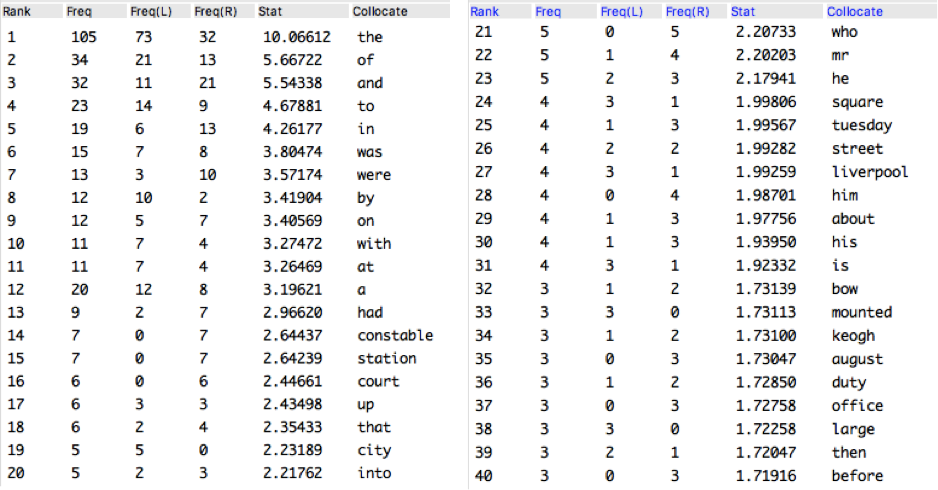
One of the most central concepts of corpus linguistics is collocation. The term has been defined in many different ways but these ultimately all refer to an observation about language: some words have a tendency to occur in proximity to other words. When we read concordances, we notice that certain words tend to occur together; these kinds of patterns often become precisely what is interesting about the texts we are looking at, and what we want to trace and analyse in a body of text. ‘What terms are used to describe this group of people, this location, this idea?’: this kind of question occurs in many different research contexts. Identifying words which frequently occur close to a word of interest is hence a useful endeavour, and a natural next step when working with a concordance. This can be done in an ad hoc matter whilst doing close reading; it can also be done more rigorously whilst close reading – this will involve keeping track of how often words occur.

This counting is a crucial step, because humans are not impartial – we tend to notice things that interest us and/or which are unusual. This makes our intuition and ad hoc observations a poor guide for frequency. To identify the most frequent patterns of co-occurrence, there is no other option but to count. It is not that the counts are interesting in and of themselves; instead, the counts describe the evidence which will support our conclusions. Corpus linguistic tools are designed to make the identification of such words easy (see figure 3), and they often include various statistics to help make this identification sounder by taking into account the frequency of all words in the data being considered. In addition, they make it easy to switch between lists of counts and concordance lines.

clip-45
Figure 3: Corpus linguistic tools make it easy to identify the words which occur most frequently close to other words such as ‘police’ in this case

This is not to say that corpus linguistics can answer all questions and solve all problems. The use of corpus linguistic methods in history poses some challenges, primarily that of lack of context. Current corpus linguistic tools offer no ways of retaining the visual characteristics of the original sources – font choices, layout, illustrations, all these are absent from the tools. In addition – and this challenge is not exclusive to corpus linguistic methods but is associated with all attempts to take into account large amounts of data – when working with large amounts of data, how do we generate, or even simply keep in mind, all of the relevant rich contextual information historians are accustomed to working with? Identifying/locating/generating important contextual information about every aspect of all these data pieces is very challenging, if not in some cases simply impossible.

Hence corpus linguistics, I suggest, could prove a useful addition to the historian’s toolkit, but by no means should it simply replace existing historical methods: in fact, it is probably most helpful in combination with other context-rich and perhaps more localised approaches. In this, as is probably the case for an increasing number of fields, I believe inter-disciplinary work holds great promise: as historians, linguists, computer scientists, and others share their experiences and approaches to tackling specific historical problems, we will surely uncover new layers of insights particularly surrounding patterns which operate across higher geographical- and time- scales than those it has previously been realistic to explore.

If I have succeeded in piquing your curiosity about corpus linguistics, you may be interested in the following links:

  • Laurence Anthony’s AntConc tool, the downloadable user-friendly concordance tool which is featured in the figures of this article. (Tutorials are available here.)
  • Lancaster University’s free Corpus Linguistics MOOC, which covers central corpus linguistic concepts, methods and tools as well as providing illustrations of applications to the Humanities and Social Sciences. (It does not assume prior knowledge of linguistics or corpus linguistics.)
  • Steven Pumfrey’s conceptual history article on using manual and corpus linguistics approaches to explore the shift in meaning of the word ‘experiment’ from a religious to a scientific meaning in the 1660s.
  • CASS’s briefing on Helen Baker’s research into the changing conceptions of poverty during the seventeenth century.


[1] Each concordance line corresponds to one instance of the search-term accompanied by some context; there are hence 10 concordance lines in figure 1.
[2] I am certainly not the first to point this out. Nicholson (2012: 242) has, for example, similarly pointed out that most such interfaces have been designed ‘with close rather than distant forms of reading in mind’.

Filed Under: Research Blogs

  • « Go to Previous Page
  • Page 1
  • Interim pages omitted …
  • Page 15
  • Page 16
  • Page 17
  • Page 18
  • Page 19
  • Interim pages omitted …
  • Page 25
  • Go to Next Page »

Footer

Search Our Site

Visit Our Blog

Connect with Us

  • Facebook
  • Twitter
  • YouTube

Copyright © 2026 · Genesis Sample on Genesis Framework · WordPress · Log in