
• Skip to primary navigation
  • Skip to main content
  • Skip to footer
RSVP

RSVP

The Research Society for Victorian Periodicals

  • Home
  • About
    • Join RSVP
    • Privacy Policy
  • Grants and Prizes
    • Award Calendar
    • Curran Fellowships
    • Linda H. Peterson Fellowship
    • Patrick Leary Field Development Grant
    • Colby Book Prize
    • Sally Mitchell Dissertation Prize
    • Rosemary VanArsdel Prize
    • VPR Expanding the Field Prize
    • Conference Travel Awards
  • Conference
    • Past Conferences
  • VPR
  • Resources
    • Teaching Materials
    • RSVP Digital Salon Resources
    • RSVP Bibliography
    • VanArsdel Bibliography
  • News & Events
  • Contact

communications@rs4vp.org

Digital Event on Periodical Studies Today: Multidisciplinary Analyses on 19 July 2024

June 18, 2024

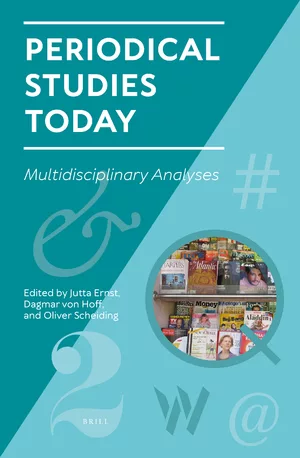
Please join the Research Society for Victorian Periodicals’ next Digital Event, a book launch of Periodical Studies Today: Multidisciplinary Analyses (Brill 2022). We will be joined by the editors (Jutta Ernst, Oliver Scheiding, and Dagmar von Hoff) and several contributors who will discuss periodicals as relational artefacts, highlighting editorial constellations, material conditions, translation, design, marketing, and the consumption of newspapers and magazines from the nineteenth to the twenty-first century. The meeting’s goal is to explore new and multidisciplinary ways to analyze periodicals.

Join Us July 19

Join us at the usual time – 8 a.m. PST / 11 a.m. EST / 4 p.m. GMT / 5 p.m. CET. As always, the event is free but registration is required to receive a zoom link.

Register Now

Our Participants

We will hear from the following editors and contributors to the volume:

  • Andreas Beck is Associate Professor of German Studies at Ruhr U Bochum, Germany, where he works on 18th-century comedies, architectural emblematics, and text-image relations in illustrated journals.
  • Jutta Ernst, Professor of American Studies at Mainz U, Germany, and co-founder of the research initiative “Transnational Periodical Cultures,” currently investigates the role of translation in 20th-century magazines.
  • Sabina Fazli is a postdoctoral research associate at the collaborative research center “Human Differentiation” at Mainz U, Germany, working on the representation of difference in contemporary magazines and zines.
  • Florian Freitag received his PhD in North American Literature from U Konstanz and has been a professor of American Studies at U Duisburg-Essen since 2019, where he works on theme parks, suburbia, and magazines.
  • Vincent Fröhlich is a postdoctoral researcher at the Institute for Media Studies in Marburg, Germany. He heads a research project on illustrated film magazines (“Seeing Film between the Lines”) and is co-founder and editor of the open access journal periodICON: Studies in the Visual Culture of Journals.
  • Hans-Jürgen Lüsebrink, Senior professor of French Cultural Studies and Intercultural Communication at Saarland U, Germany, is currently working on transcultural media history and on the translations of encyclopedias in the 18th to 20th centuries.
  • Mark Noonan is Professor of English at New York City College of Technology and former President of the Research Society for American Periodicals. His current book project is Revolutionary Ink: Colonial Printers of New York and the Promise of Democracy, scheduled for release in 2026.
  • Oliver Scheiding is Professor of American Studies at The Obama Institute, Mainz U, Germany. His research focuses on magazine studies, print culture, and print activism.
Filed Under: RSVP News

“Pick-A-Periodical” – Volume 9 of The Secular Chronicle

April 22, 2024

Please join the RSVP Digital Events committee for our next “Pick-A-Periodical” with Clare Stainthorp* leading us on a discussion of the Secular Chronicle (1872–79)

Date/time:  17 May at 8am PDT/ 10am CDT/ 11am EDT/ 4pm BST/ 5pm CEST

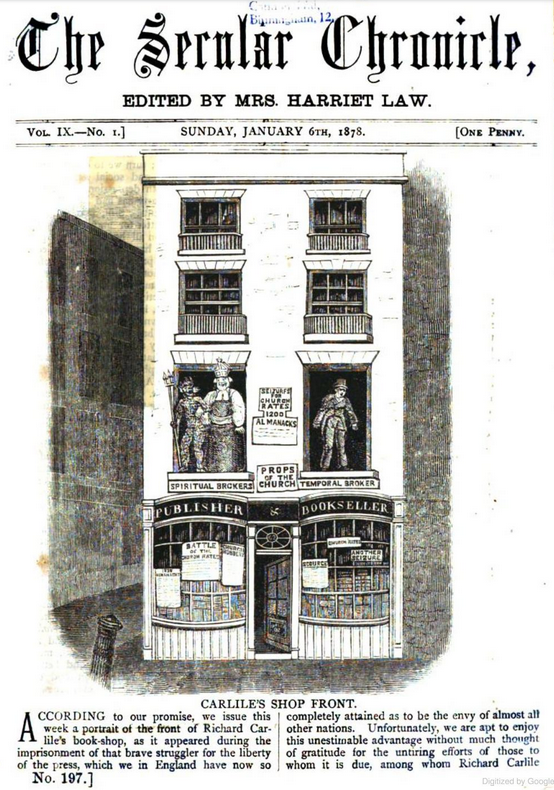
Front Page of The Secular Chronicle vol. 9, 6 January 1878.

Registration: as always, our events are free but registration is required to receive the zoom link

The Secular Chronicle (1872–79), founded by  George H. Reddalls served atheist, agnostic, and freethinking audiences in Victorian Britain. Upon Reddalls’s death in 1875, Harriet Law took over as editor, promising principled atheism, republicanism, socialism, and the expression of her belief in the emancipation of women as fundamental to social progress. In 1877 the Secular Chronicle was notable for being the first freethought periodical to print large-scale front-page illustrations; it is a vital record of working-class radicalism and prompts reflection upon how minority groups used periodicals to build a sense of community, or counterpublic.

Clare has asked that attendees browse volume 9 of the Secular Chronicle prior to the session, which can be found here. Questions to consider while browsing: What roles do different forms of content (illustrations, biographies,  essays, editorials, letters, jokes, poems, etc.) play? How does the form, structure, and content negotiate potential tensions between individual freedoms and aspirational community? How is the past, present, and future of the radical press (in terms of content, materialities, and distribution) conceptualised?

 *Clare Stainthorp is a Leverhulme Trust Early Career Fellow at Queen Mary University of London. Her research currently focuses on the nineteenth-century freethought press. Most recently, she has published an article in Media History about what Chatterton’s Commune, the Atheistic Communistic Scorcher (1884–1895) can tell us about the affordances and limits of the periodical form, and an article in Victorian Periodicals Review about the role of dialogue and debate in freethought periodicals. Her monograph, Constance Naden: Scientist, Philosopher, Poet, was published by Peter Lang in 2019.

Join us on May 17th

As always, RSVP Digital Events are free and open to all. Register below to receive the Zoom link.

Register Here

Filed Under: RSVP Digital Events

Now Accepting Curran Fellowship Applications and Colby Prize Nominations

November 17, 2021

The web portal for the 2022 Curran Fellowship applications and Colby Book Prize nominations is now open!

The deadline for Curran applications is Dec. 15, 2021. Applicant reference letters are due by Dec. 22, 2021. This set of travel and research grants is intended to aid scholars studying 19th-century British magazines and newspapers in making use of primary print and archival sources. The Curran Fellowships are open to researchers of any age from any of a wide range of disciplinary perspectives. They are made possible through the generosity of the late Eileen Curran, Professor Emerita of English, Colby College.

For detailed application instructions and information on eligibility, please see the Curran Fellowship webpage.

The deadline for Colby nominations is Jan. 31, 2022.The Colby Prize is intended to honor original book-length scholarship about Victorian periodicals and newspapers. The annual prize is awarded to a book published during the preceding year that most advances our understanding of the nineteenth-century British press.

For detailed instructions about nomination and information on book eligibility, please see the Colby Book Prize webpage.

Those who have applied to RSVP awards in past years will notice that we have migrated to a new online platform, SurveyMonkey Apply. If you have any questions about SM Apply or other aspects of applying for this fellowship, please direct your queries to RSVP’s awards contact email.

Filed Under: Awards News, RSVP News

VanArsdel Prize Winner Announced

September 22, 2021

The 2021 VanArsdel Prize has been awarded to Elizabeth Howard (PhD Candidate, University of Minnesota) for her essay, “‘Keeping Christmas’ on the Page: the Adelaide Observer, Alice in Wonderland, and the Australian Periodical at Play.”

The committee commented, “This is an excellently written, interesting essay that focuses on an understudied area to make an original contribution to the field of periodical studies. Its astute analysis of the Adelaide Observer highlights this newspaper’s status as a colonial/settler production but contains insights more broadly relevant to newspaper culture in the Victorian world.” 

The VanArsdel Prize, established in 1990 to honor Rosemary VanArsdel, is awarded annually to the best graduate student essay investigating Victorian periodicals and newspapers. The winning essay will be published in Victorian Periodicals Review. Congratulations, Elizabeth Howard!

Filed Under: Awards News, Graduate News, VPR News

Workshop: The Making of Transimperial Technological Networks

September 22, 2021

Logo of Bahishkrit Bharat, a Marathi periodical. The logo features the text of the journal title flanked by two lions in chains atop a banner.

Join us on 21 October 2021 at 5:30 pm BST / 11:30 am CST for a workshop titled, The Making of Transimperial Technological Networks: A Case Study of Select Marathi Periodicals.

This event is the second in our series on Race and Transimperialism. Dr. Vaibhav Singh (University of Reading) will introduce us to Marathi periodicals to discuss aspects of design processes, typographic history, printing and textual communications in the context of transimperial technological networks. The 50-minute workshop will include a presentation from Dr. Singh and Q&A, with time for discussion and suggestions for further reading. The workshop is free. All are welcome. See below for registration information.

Dr. Vaibhav Singh is a postdoctoral researcher at the Department of Typography & Graphic Communication, University of Reading, where he recently completed a 3-year British Academy Postdoctoral Fellowship. His project, “Merchants of alphabets: networks of typographic design and technology in Indian language publishing, 1900–1950” addresses the impact of typographic design and technology on the linguistic diversity of Indian publishing in the decades leading up to the country’s independence. It situates typographic design – a critically under-researched area in publishing and book history – within the intellectual frameworks of nationalism, mass communication, and technological modernity. Dr Singh is the recipient of an RSVP Curran Award in 2021.

His recent publications include:

Singh, V. (2018) The first Indian-script typeface on the Monotype: a missing chapter in the history of mechanical typecasting. Journal of the Printing Historical Society, 29.

Singh, V. (2018) The machine in the colony: technology, politics, and the typography of Devanagari in the early years of mechanization. Philological Encounters, 3 (4).

Register Now

Register here for this free online event. RSVP membership is not mandatory to attend. Event enquiries can be submitted to the Vice President via our contact form.

Filed Under: RSVP Digital Events, RSVP News

Your How-To Guide to Our 2021 Virtual Conference

September 6, 2021

How-To Guide Contents:
Registration
Viewing presentations
Zoom links
Session format
Chairing instructions
Zoom tech assistance instructions


How does this virtual conference work?

The conference will hold virtual sessions via Zoom, from 8-11 September, at the times indicated on the conference schedule. Attendees can view, listen to, and read presenter materials in advance of the regular sessions on the conference website. The regular sessions themselves will be primarily devoted to discussion among presenters and attendees. Keynote talks will also take place over Zoom, but there are no advance materials for these events.

The Zoom link for each session is posted to the password-protected page for that session on the conference website (see below for more information). There is no need to register for individual sessions ahead of time.

Please review the schedule as posted on the conference website to plan your participation, as some changes have been made in recent weeks.

How do I register for the conference?

Select the Registration tab of the conference website; simply enter your name and email address and hit submit. You will receive an automated email notification that includes the password to access all password-protected areas of the website. Please note that this message will not include the links to the Zoom sessions. See the next question for information about Zoom session links.

Where can I view the schedule
and the presentation materials themselves?

Visit the tab for each day of the conference (Day 1, Day 2, Day 3, Day 4) for the daily schedule of presentations. Click on the title of a panel to be taken to the presentations (videos, podcasts, papers) themselves. Registrants will be prompted to enter a password. This password will have been sent to you automatically upon registration. If you have not received it or cannot find it, please contact RSVP’s Communications Coordinator, Alison Hedley.

Please view, listen to, and read presenter materials in advance of the session; presenters will not be giving full papers during the session, but will give a brief overview followed by Q&A discussion.

How do I access the session “room” on Zoom?

The link the Zoom room for each panel or event appears at the top of the password-protected page for this panel. Please note that there are different rooms/Zoom links for every event. When you click on the Zoom link at the beginning of the event, you will be directed to a Zoom waiting room; one of the session hosts (the chair or the tech assistant) will let you into the meeting.

We recommend having the most recent version of Zoom downloaded on your computer to limit technical hiccups.

For information on Zoom use and troubleshooting, please see Zoom’s video tutorials; to quickly find the answer to a specific question, use the search function of the Zoom Help Center.

What is the format of regular sessions?

Please review the schedule as posted on the conference website in case any changes have been made to a panel.

The sessions themselves are structured to facilitate engaging discussion. To listen to the full version of each paper, participants can access presenters’ materials in advance on the conference website (see above). Sessions will take the following format:

– The chair will introduce the speakers, their bios, and conference presentation titles
– Speakers will give a recap of their presentation in 5 minutes or less
– The chair will then open the floor to Q&A from audience members
– The panel will be 60 minutes in total

How do I chair the panel I’ve volunteered for?

Thank you for agreeing to chair a panel! Please be sure to read/view/listen to the presentations in your session in advance. If you have not already done so, email your session panelists to solicit brief biographical statements. You should have received an email from RSVP’s Communications Coordinator with information about how to contact panelists; please refer to this email or contact Alison Hedley.

Please review the schedule as posted on the conference website in case any changes have been made to your panel.  Plan to arrive at your session 15 minutes early so that one of the conference’s local organizers can make you a co-host of the Zoom room. This will give you essential administrative privileges, such as the abilities to enable screen sharing and adjust room settings if/as needed. Please see above for the format of regular sessions. Your role involves introducing panelists and sharing or reading their bios; moderating discussion, and keeping the session to time.

OPTIONAL: If you wish, you can copy and paste panelist bios into Zoom’s chat function rather than reading each statement aloud prior to each paper brief. If the session has many presenters, this option has the benefit of opening a bit more time for discussion. If your panel chooses this option, please let attendees know to look for presenter bios in the Zoom chat window.

Wherever possible, another RSVP member has volunteered to serve as a tech assistant/backup in your session in case of any problems with Zoom. Their duties are listed below. If you do not have tech backup and you run into Zoom tech issues: you may find your solution on the Zoom Help Center; otherwise, send a text message to +1 215-629-6773, clearly stating the session for which you require support.

How do I offer the Zoom assistance I have signed up for?

Thank you for offering Zoom assistance for a session! Please arrive 5-10 minutes early for the session so that a local organizer or the panel chair can make you a co-host.

Your role involves the following tasks:

– managing attendee questions that are posed in the chat function (jumping into discussion if/when appropriate to articulate these questions)
– adding any appropriate links in the session chat as needed (such as the link to the session webpage on the conference website)
– taking over for the chair if their wifi cuts out;
– any other tech troubleshooting you might be able to offer if needed (perhaps with assistance from the Zoom Help Center). For any major technical difficulties, please send a text message to +1 215-629-6773, clearly stating the session for which you require support.

Filed Under: Conference News, RSVP Digital Events, RSVP News

  • Page 1
  • Page 2
  • Go to Next Page »

Footer

Search Our Site

Visit Our Blog

Connect with Us

  • Facebook
  • Twitter
  • YouTube

Copyright © 2026 · Genesis Sample on Genesis Framework · WordPress · Log in